
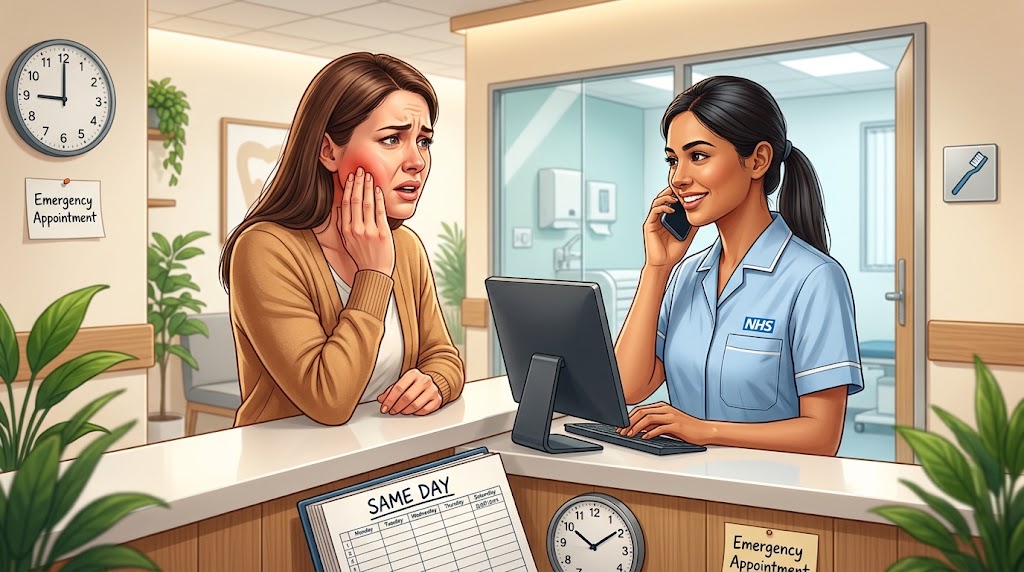
A sudden toothache, knocked-out tooth, broken filling, dental abscess or facial swelling can become extremely painful and worrying, especially when you cannot get a normal dental appointment quickly.
If you need urgent dental care in England, you do not necessarily have to wait weeks for a routine NHS dental appointment. Depending on your symptoms, you may be able to access urgent or emergency NHS dental treatment through your dentist, NHS 111, or an NHS urgent dental service.
The NHS advises people with urgent dental problems to contact their dentist or NHS 111. Depending on the symptoms, you may be offered urgent treatment within 24 hours or within 7 days. Certain emergencies, such as a knocked-out adult tooth, require much faster attention.
This guide explains how to get a same-day NHS dentist appointment, which dental problems qualify as emergencies, what NHS 111 can do, what treatment may cost in 2026, and when you should go directly to A&E or call 999.
Important: This article focuses primarily on NHS dental services in England. NHS dental arrangements and charges differ in Scotland, Wales and Northern Ireland.
Quick Answer: How Do I Get a Same-Day NHS Dentist?
If you have a dental emergency in England:
- Contact your regular dentist first and explain that you need urgent or emergency dental treatment.
- If the practice is closed, check its recorded telephone message for out-of-hours instructions.
- If you do not have a dentist or cannot get an emergency appointment, call NHS 111 or use NHS 111 online.
- NHS 111 can assess your symptoms and help direct you to appropriate urgent dental care.
- If you have severe facial or mouth swelling affecting breathing, swallowing or speaking, uncontrolled bleeding, or a serious facial injury, call 999 or go to A&E instead of waiting for a routine dental appointment.
You can also use the official NHS Find a Dentist service to search for practices offering NHS urgent or specialist dental care in your area.
What Counts as a Dental Emergency?
Not every toothache requires a same-day appointment. However, some symptoms indicate that you need urgent dental assessment.
According to NHS guidance, you should seek urgent or emergency dental advice if you have problems such as:
- Severe tooth or mouth pain
- Toothache that affects sleep or normal daily activities
- Pain that is not adequately controlled with ordinary painkillers
- A knocked-out adult tooth
- A significant dental injury
- A broken or loose filling
- A broken crown, bridge, veneer or denture
- Bleeding after a tooth extraction
- Severe pain following a recent tooth removal
- Increasing swelling or a lump in the mouth
- A persistent or worsening red or white patch in the mouth
- A mouth ulcer lasting two weeks or more
- Signs of a dental infection or abscess
The NHS states that urgent dental care may be arranged within 24 hours or 7 days depending on the severity and type of symptoms. A knocked-out adult tooth is treated as an emergency requiring attention within about an hour or as soon as possible.
Emergency vs Urgent Dental Problems
It helps to understand the difference.
Emergency dental problems
An emergency may involve a potentially serious injury, uncontrolled bleeding, a knocked-out permanent tooth or a rapidly spreading infection.
NHS England’s clinical guidance identifies conditions such as spreading oro-facial swelling that may threaten the airway, severe systemic illness caused by a dental condition, uncontrolled intra-oral bleeding and avulsed permanent teeth as emergency situations requiring rapid clinical triage.
Urgent dental problems
Urgent problems are serious enough to require prompt dental attention but are not necessarily life-threatening.
Examples can include:
- Severe dental pain
- Continuing or spreading dental infection
- Dental swelling without airway compromise
- Fractured or significantly damaged teeth
- Problems affecting your ability to eat or use your mouth normally
These problems may be managed through urgent NHS dental services, depending on your local arrangements and clinical assessment.
How to Get a Same-Day NHS Dentist Appointment
1. Call Your Regular Dentist
If you already have an NHS dentist, this should usually be your first step.
Tell the reception team clearly that you have an urgent dental problem and describe your symptoms.
For example, explain if you have:
- Severe toothache
- Facial swelling
- A dental abscess
- Uncontrolled bleeding
- A knocked-out tooth
- A broken tooth causing significant pain
- Severe pain following an extraction
Do not simply ask for a “check-up”. Explain that you need urgent dental care.
Some practices provide emergency appointments for their existing patients, while others may direct patients to another urgent service.
If the practice is closed, listen to its telephone answering message because it may provide instructions for obtaining out-of-hours dental care.
2. Contact NHS 111 for Emergency Dental Care
If you do not have a dentist, cannot get an emergency appointment, or need help outside normal opening hours, NHS 111 is one of the main routes to urgent dental care in England.
You can:
- Call 111
- Use NHS 111 online
NHS 111 can help with dental problems and may direct you to an emergency or urgent dental service where one is available.
When you contact NHS 111, be ready to explain:
- Where the pain is
- How severe it is
- How long you have had it
- Whether your face or gums are swollen
- Whether you have a fever
- Whether you can eat and drink
- Whether you have difficulty opening your mouth
- Whether you have difficulty swallowing or breathing
- Whether a tooth has been knocked out or severely damaged
- Whether you have recently had dental treatment
The information you provide helps determine how urgently you need to be assessed.
3. Use the NHS Find a Dentist Service
If you are looking for an NHS dentist, the official NHS service allows you to search for dental practices by town, city or postcode in England.
The service can show dentists that may be accepting new patients or offering urgent or specialist dental care.
Tip: Availability can change quickly. A practice appearing in an NHS search does not necessarily mean it has a same-day appointment available, so contact the practice and specifically ask about urgent NHS dental treatment.
Can You Get an NHS Dentist the Same Day?
Yes, same-day or very rapid NHS dental treatment can be available for genuine urgent dental problems, but it is not guaranteed for every type of toothache.
The NHS uses clinical assessment and triage to determine how quickly a patient needs care.
Depending on your symptoms, urgent treatment may be arranged within:
- Around 1 hour or as soon as possible for certain dental emergencies such as a knocked-out permanent tooth
- Within 24 hours for some urgent conditions
- Within 7 days for other urgent or non-emergency dental problems
The exact pathway depends on the clinical situation and local service availability.
This means that “same-day NHS dentist” does not mean every patient with toothache will automatically receive an appointment on the same day.
What Dental Problems Can Qualify for Urgent NHS Treatment?
Severe Toothache
Severe tooth pain can be caused by several problems, including:
- Tooth decay
- Dental infection
- A cracked tooth
- Damaged dental work
- Inflammation of the tooth pulp
- Gum disease
- Trauma
The NHS recommends seeing a dentist if toothache lasts more than two days or does not improve with painkillers. Toothache accompanied by swelling, fever, pain when biting or a bad taste in the mouth can indicate a problem requiring dental assessment.
For more information about NHS dental treatment costs, see our guide:
NHS Dental Charges 2026: Full Price Guide for England
Dental Abscess: When Is It an Emergency?
A dental abscess is a collection of pus caused by an infection in a tooth or gum.
Common symptoms can include:
- Intense toothache
- Gum pain
- Facial or jaw swelling
- Redness
- Bad taste in the mouth
- Difficulty chewing
- Difficulty opening your mouth
- Swollen glands
- Fever
A dental abscess requires urgent dental treatment and does not normally disappear on its own.
If you suspect you have a dental abscess, contact your dentist or NHS 111.
When a Dental Abscess Becomes an Emergency
Call 999 or go to A&E if a dental infection causes severe swelling and you have difficulty:
- Breathing
- Swallowing
- Speaking
You should also seek emergency hospital care if there is significant swelling around the eye, sudden vision problems or severe swelling in the mouth or face.
A GP generally cannot provide definitive dental treatment for an abscess, so you should seek dental care rather than relying on a GP appointment.
What Should You Do If a Tooth Gets Knocked Out?
A knocked-out adult tooth is a dental emergency.
The NHS recommends seeking emergency dental care even if you cannot find the tooth.
The sooner the tooth is assessed, the better the chance of appropriate management.
If you have the tooth:
- Handle it carefully.
- Avoid touching the root.
- Follow professional advice about storing or transporting it.
- Seek emergency dental care immediately.
A dentist may assess the tooth, take an X-ray if necessary and determine whether it can be repositioned and stabilised. Further treatment may be required later.
What If You Have a Broken Tooth?
A broken, cracked or chipped tooth is not always a dental emergency.
However, urgent assessment may be appropriate if:
- The break causes severe pain.
- The tooth has sharp edges causing injury.
- The tooth is loose.
- There is significant bleeding.
- The break exposes sensitive inner tooth tissue.
- You have suffered facial trauma.
- The injury affects your ability to eat or close your mouth.
If the damage is minor and you have no significant pain, your dentist may arrange a routine appointment instead.
What If a Filling, Crown or Bridge Falls Out?
A lost filling, crown, bridge or veneer can be uncomfortable but is not automatically an emergency.
The NHS includes broken or loose fillings, dentures, crowns, bridges and veneers among problems for which urgent dental advice may be appropriate.
While waiting for professional advice:
- Avoid chewing hard foods on the affected side.
- Keep the area clean.
- Avoid very hot or cold foods if they trigger pain.
- Contact your dentist for advice.
Do not attempt permanent repairs yourself.
What Happens at an Emergency NHS Dentist Appointment?
The exact treatment depends on what the dentist finds.
An urgent appointment may involve:
- Clinical assessment
- Examination of your teeth and gums
- X-rays where clinically necessary
- Pain or infection management
- Temporary treatment
- Emergency extraction where appropriate
- Emergency partial root canal treatment
- Drainage of a dental abscess
- Management of a knocked-out or injured tooth
- Repair or refixing of certain dental restorations
NHS guidance lists examination, X-rays, temporary fillings, emergency partial root canal treatment, management of knocked-out teeth, refixing crowns or bridges, extraction of up to two teeth and treatment of dental infections among examples of urgent NHS dental treatment.
The purpose of an emergency appointment is often to deal with the immediate problem and stabilise your dental health. You may still need additional treatment afterwards.
How Much Does an Emergency NHS Dentist Cost in 2026?
For NHS dental patients in England, urgent or unscheduled dental care is charged at the applicable NHS rate.
From 1 April 2026, the NHS dental charges in England are:
| NHS dental charge | Cost from 1 April 2026 |
|---|---|
| Band 1 | £27.90 |
| Band 2 | £76.60 |
| Band 3 | £332.10 |
| Unscheduled urgent care | £27.90 |
NHSBSA confirms that from 1 April 2026 the charge for unscheduled care is £27.90.
The NHS explains that urgent treatment can include assessment, clinically necessary X-rays, temporary fillings, emergency partial root canal treatment, treatment following dental injury, certain extractions, infection management and drainage of a dental abscess.
However, the cost of an emergency appointment does not necessarily mean that all future dental treatment will be covered by that initial charge.
You may need additional treatment after the urgent appointment, and the applicable charge can depend on what treatment is required.
For a complete explanation, read:
NHS Dental Charges 2026: Full Price Guide for England
Is Emergency NHS Dental Treatment Free?
Not necessarily.
Most adults in England have to pay NHS dental charges unless they qualify for an exemption or help with costs.
Some people may qualify for free NHS dental treatment or financial support, depending on their circumstances.
Before treatment begins, the dental professional should explain the relevant NHS treatment and costs.
If you are unsure whether you qualify for free treatment, ask the dental practice before treatment where possible.
Can I Go to A&E for Severe Toothache?
A&E is not normally the right place for ordinary toothache because hospital emergency departments generally cannot provide routine dental treatment.
However, dental problems can become medical emergencies.
You should call 999 or go to A&E if you have:
- Severe swelling affecting breathing
- Difficulty swallowing
- Difficulty speaking because of swelling
- Major facial or jaw injury
- Heavy bleeding from the mouth that will not stop
- Severe swelling around the eye with vision problems
- A serious head or facial injury associated with loss of consciousness, vomiting or double vision
The NHS specifically advises emergency hospital treatment for severe dental or facial problems affecting breathing, swallowing or other potentially serious functions.
If you are unsure whether your symptoms require emergency medical care, NHS 111 can help assess what you should do.
What Can You Do for Toothache While Waiting for a Dentist?
If you are waiting for an appointment, there are some measures that may help manage discomfort temporarily.
The NHS advises that adults can use appropriate painkillers such as paracetamol or ibuprofen, provided they are suitable for the individual and used according to the instructions. A pharmacist can also advise on pain relief.
Other measures include:
- Eating softer foods
- Avoiding chewing with the painful tooth
- Avoiding very hot, cold or sugary foods if they trigger pain
- Keeping your mouth clean with gentle brushing
- Using a soft toothbrush
- Rinsing with salt water where appropriate
These measures do not treat the underlying cause of dental pain.
If the pain persists, worsens or is associated with swelling or infection, professional dental assessment is important.
Can a GP Treat a Dental Emergency?
Usually, no.
A GP can help with certain general medical issues, but a dental problem normally requires assessment and treatment by a dentist.
For example, the NHS advises that people with a dental abscess should seek urgent dental care rather than going to a GP for definitive dental treatment.
If you have an urgent dental problem, contact:
- Your dentist
- An NHS urgent dental service
- NHS 111
If the dental problem has become a serious medical emergency involving breathing, swallowing or significant facial swelling, seek emergency hospital care.
Same-Day NHS Dentist vs Private Emergency Dentist
If you cannot obtain an NHS appointment quickly, you may consider a private emergency dentist.
The main differences can include:
| NHS urgent dental care | Private emergency dentist |
|---|---|
| NHS charges apply where treatment is provided under NHS arrangements | Private fees apply |
| Access depends on local availability and clinical need | Appointment availability varies by practice |
| Treatment is based on NHS eligibility and clinical need | Treatment and pricing are determined privately |
| NHS 111 can help direct patients to urgent care | You can contact private practices directly |
| Additional NHS treatment may be needed after emergency care | Further treatment may involve additional private fees |
If you are considering private treatment because you cannot find an NHS appointment, ask the practice about the full cost before agreeing to treatment.
For a broader comparison of dental treatment costs, you can also read:
Private vs NHS Dental Implants: Cost Comparison in the UK
How to Find an NHS Dentist in 2026
Finding an NHS dentist can sometimes be difficult because availability varies between practices and locations.
If you need a dentist but your situation is not an immediate emergency, you can search for NHS dental practices using the official NHS dentist finder.
You can also read our detailed guide:
How to Find an NHS Dentist in 2026
If you cannot find a practice accepting NHS patients, NHS guidance says you can contact your local Integrated Care Board (ICB), which manages local NHS services and may be able to provide information about local dental appointments.
What If You Cannot Find an NHS Dentist?
If you search for an NHS dentist and cannot find an available appointment, do not assume that you have no options.
Depending on your symptoms, you can:
For urgent symptoms
Contact NHS 111.
They can advise you about dental problems and help identify appropriate urgent care.
For routine dental care
Use the NHS Find a Dentist service and contact practices directly.
If no local NHS practice is available
Your local ICB may be able to provide information about local dental services.
For a serious medical emergency
Call 999 or attend A&E.
How Long Will an Emergency NHS Dentist Appointment Take?
There is no single guaranteed waiting time for every patient.
NHS urgent dental care is based on clinical triage.
Depending on the severity of the problem, you may be offered treatment:
- Within around an hour or as soon as possible for certain emergencies
- Within 24 hours for some urgent problems
- Within 7 days for other urgent or non-urgent unscheduled dental needs
NHS England’s current clinical guidance describes urgent unscheduled dental care as care generally provided within 24 hours or as soon as practicably possible, while some cases can fall within a longer urgent pathway.
Therefore, if you search online for a “same-day NHS dentist”, remember that clinical urgency and local availability determine the actual appointment pathway.
What Should You Take to an Emergency Dental Appointment?
If possible, take:
- Your NHS number if you know it
- A list of medicines you take
- Details of allergies
- Information about existing medical conditions
- Details of recent dental treatment
- Any relevant dental appliances
- Your dental records if you have access to them
If you have knocked out a tooth and have been advised to bring it with you, follow professional guidance on how to handle and transport it.
What Happens After Emergency Dental Treatment?
Emergency treatment often solves the immediate problem but may not be the final treatment.
For example, you might receive temporary treatment for:
- Severe toothache
- Infection
- A damaged tooth
- A broken filling
- An abscess
- A dental injury
You may subsequently need:
- A permanent filling
- Root canal treatment
- Tooth extraction
- Crown treatment
- Periodontal treatment
- Further restorative dental work
If you have ongoing gum problems, you may also want to read our guide to Gum Disease Treatment: NHS vs Private Cost.
If you are considering implants after losing a tooth, see:
How Much Do Dental Implants Cost in the UK in 2026?
Frequently Asked Questions About Same-Day NHS Dental Treatment
Can I get a same-day NHS dentist appointment?
You may be able to get same-day or rapid urgent dental care if your symptoms require it. Contact your dentist first, or NHS 111 if you do not have a dentist or cannot obtain an urgent appointment. The exact timing depends on your symptoms and local availability.
What number do I call for an emergency NHS dentist?
In England, call NHS 111 for advice about urgent dental problems if you cannot obtain an emergency appointment from your dentist. NHS 111 can help direct you to appropriate dental care.
Is NHS 111 available for dental emergencies?
Yes. NHS 111 provides advice for dental problems and can help identify emergency dental services where appropriate.
How much is an emergency NHS dentist in 2026?
From 1 April 2026, the NHS charge for unscheduled urgent dental care in England is £27.90, although eligibility and the treatment provided determine what you actually pay.
Is a dental abscess an emergency?
A dental abscess needs urgent dental treatment because it is an infection and does not normally go away by itself. If swelling causes difficulty breathing, swallowing or speaking, seek emergency medical care.
Can I go to A&E for toothache?
Ordinary toothache should generally be treated by a dentist rather than A&E. Go to A&E or call 999 if you have a serious facial injury, uncontrolled bleeding or severe swelling that affects breathing, swallowing or other vital functions.
What should I do if my tooth is knocked out?
A knocked-out permanent tooth requires emergency dental attention. Contact a dentist or NHS 111 immediately and seek care as quickly as possible.
Can a GP treat a dental abscess?
A GP generally cannot provide definitive dental treatment for an abscess. Contact a dentist or NHS 111 for urgent dental care.
Does NHS dental treatment cover emergency treatment?
NHS dental services include emergency appointments and treatment for dental problems and injuries when clinically necessary. Charges depend on the treatment and your eligibility for free NHS care.
Can I get emergency dental treatment if I do not have an NHS dentist?
Yes, you can contact NHS 111 if you do not have a dentist or cannot obtain an emergency appointment. You can also use the NHS Find a Dentist service to search for available dental services.
Same-Day NHS Dentist: What to Do Right Now
If you are experiencing a dental emergency right now, the most practical steps are:
Severe toothache:
Contact your dentist and explain that you need urgent treatment. If you cannot get an appointment, contact NHS 111.
Dental abscess or swelling:
Seek urgent dental care. If you have difficulty breathing, swallowing or speaking, call 999 or go to A&E.
Knocked-out adult tooth:
Seek emergency dental care immediately.
Broken tooth:
Contact a dentist, particularly if there is severe pain, bleeding, significant damage or facial injury.
Lost filling, crown or bridge:
Contact your dentist for advice and an urgent appointment if you have significant pain or other concerning symptoms.
Uncontrolled mouth bleeding:
Seek emergency medical care, particularly if the bleeding will not stop.
Final Takeaway
Getting a same-day NHS dentist appointment in England depends primarily on the urgency of your symptoms and the availability of local NHS dental services.
For most urgent dental problems, your first steps should be to contact your dentist or NHS 111. NHS guidance indicates that patients may receive urgent care within 24 hours or 7 days depending on their clinical needs, while certain emergencies require much faster treatment.
If you have a dental abscess, severe toothache, significant swelling, a knocked-out tooth or a serious dental injury, do not simply wait for the problem to disappear.
And if you have severe facial or mouth swelling that affects breathing, swallowing or speaking, uncontrolled bleeding, or a serious facial injury, call 999 or go to A&E.
For ongoing dental care and costs, explore our related guides: