
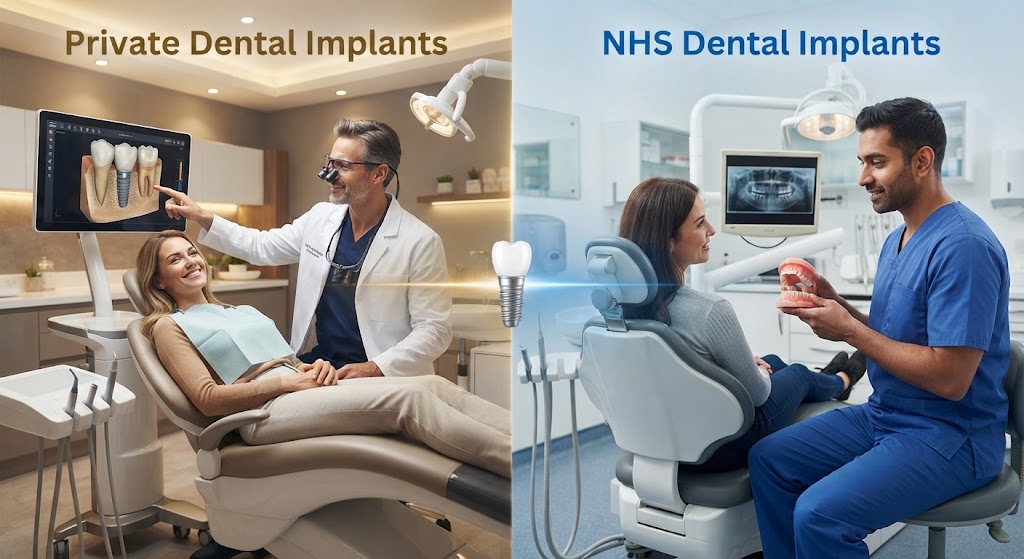
If you have one or more missing teeth, you may be considering dental implants as a long-term replacement. But one of the biggest questions is whether you can get dental implants on the NHS or whether you will need to pay privately.
In the UK, dental implants are usually available privately and are relatively expensive. NHS dental implants are possible in limited circumstances, but they are not routinely available simply because a person prefers implants to dentures or a bridge. NHS guidance states that implants are sometimes provided when there is a specific clinical reason, such as following mouth cancer treatment or an accident.
For most people considering implants, the practical decision is therefore not simply about the price of an NHS Band 3 dental treatment. It involves comparing private implant costs, NHS eligibility, treatment suitability, alternatives, timescales and long-term maintenance.
This guide explains the difference between private vs NHS dental implants in the UK, including what dental implants cost, who may qualify for NHS treatment, what private treatment usually includes and what questions to ask before committing to treatment.
Quick answer: Dental implants are usually provided privately in the UK and can cost several thousand pounds depending on the number of implants, the restoration required and whether additional procedures are needed. NHS implants are uncommon and generally limited to specific clinical circumstances.
Private vs NHS Dental Implants: Quick Comparison
| Factor | NHS dental implants | Private dental implants |
|---|---|---|
| Availability | Limited | Widely available from private implant providers |
| Eligibility | Specific clinical circumstances | Based on suitability and ability to pay |
| Typical purpose | Certain complex clinical needs | Replacement of missing teeth for eligible patients |
| Cost | May be NHS-funded in qualifying circumstances | Patient pays the private fee |
| Choice of implant system | Determined by NHS service/provider | Usually more choice |
| Cosmetic options | Limited by NHS clinical requirements | Wider range of cosmetic options |
| Waiting time | May involve referral and specialist pathways | Varies by private clinic |
| Implant consultation | Depends on NHS service | Usually included or separately charged |
| Bone grafting | Depends on clinical need and pathway | Usually charged separately |
| Implant crown/bridge | Depends on NHS treatment plan | Usually included in a quoted treatment plan or charged separately |
| Maintenance | Depends on provider/pathway | Usually privately funded |
The exact arrangements depend on the patient’s clinical circumstances and the dental service providing treatment.
What Are Dental Implants?
A dental implant is a replacement tooth root, usually made from titanium, which is placed into the jawbone.
Once the implant has integrated with the bone, it can support:
- A single dental crown
- An implant-supported bridge
- An implant-retained denture
- More extensive tooth-replacement solutions
NHS guidance describes implants as a fixed alternative to removable dentures.
A typical implant treatment involves several stages:
- Initial consultation
- Dental examination
- Assessment of the gums and remaining teeth
- X-rays and potentially 3D imaging
- Treatment planning
- Implant placement
- Healing and integration
- Attachment of the restoration
- Follow-up and maintenance
Not everyone is automatically suitable for implants. Your dentist or implant clinician will assess your oral health, bone availability, gum condition and overall suitability.
For example, Cambridge University Hospitals notes that implant patients generally need good oral hygiene and stable dental health, without active tooth decay or infection.
How Much Do Private Dental Implants Cost in the UK?
There is no single nationwide private dental implant price.
The total cost depends on factors including:
- Number of implants
- Type of implant
- Crown or bridge required
- Bone grafting
- Sinus lifting
- Diagnostic scans
- Complexity of the case
- Location of the dental practice
- Experience and qualifications of the clinician
- Laboratory costs
- Sedation requirements
- Follow-up treatment
A private clinic may advertise a price for the implant itself, but this does not necessarily represent the total cost of replacing a tooth.
A private implant quotation may include:
- Consultation
- Implant planning
- X-rays
- 3D CBCT scan
- Implant fixture
- Abutment
- Temporary restoration
- Permanent crown
- Implant placement
- Follow-up appointments
However, some practices charge separately for certain components.
Always ask for a written, itemised treatment plan before agreeing to treatment.
How Much Does One Dental Implant Cost?
The cost of replacing one missing tooth privately can vary considerably.
A single-tooth implant normally consists of three main components:
1. Implant
The implant is the component inserted into the jawbone.
2. Abutment
The abutment connects the implant to the visible replacement tooth.
3. Crown
The crown is the artificial tooth that sits above the gum.
Some clinics advertise a price covering all three components, while others quote separately.
Therefore, when comparing dental implant prices, do not compare an implant fixture-only price with an all-inclusive implant-and-crown package.
This can make two apparently similar quotations look very different.
How Much Do Multiple Dental Implants Cost?
Replacing several missing teeth usually costs more than replacing a single tooth, but the total does not necessarily increase in a simple one-implant-per-tooth calculation.
For example, an implant-supported bridge may replace multiple missing teeth using fewer implants than the number of teeth being replaced.
Similarly, full-arch treatments can use strategically positioned implants to support a complete fixed restoration.
Your clinician will determine the appropriate approach based on:
- Number of missing teeth
- Jawbone condition
- Bite
- Gum health
- Remaining teeth
- Bone volume
- Aesthetic requirements
- Functional requirements
If you are considering implants because several teeth are missing, compare the proposed treatment with dentures and bridges as well as different implant-supported solutions.
Can You Get Dental Implants on the NHS?
Yes, but NHS dental implants are uncommon and are only available in specific circumstances.
The NHS states that dental implants are usually only available privately. However, they can sometimes be available through the NHS for patients who cannot wear dentures for certain reasons, including circumstances such as mouth cancer or an accident.
This is an important distinction.
Simply wanting a fixed replacement instead of removable dentures does not automatically make you eligible for NHS-funded implants.
NHS England guidance also identifies implants as an example of complex elective reconstructive treatment that is not routinely available as NHS-funded care and is subject to relevant NHS acceptance criteria and specialist guidance.
Who Might Qualify for NHS Dental Implants?
NHS implant treatment may be considered when there is a significant clinical need and other conventional options are unsuitable or inappropriate.
Potential circumstances can include:
- Reconstruction following mouth cancer treatment
- Certain serious facial or dental injuries
- Situations where conventional dentures cannot be worn for specific clinical reasons
- Complex specialist dental conditions
- Certain congenital or acquired abnormalities
However, eligibility is determined clinically.
Having a missing tooth by itself does not automatically qualify someone for an NHS implant.
Your dentist may need to refer you to a specialist dental service or hospital dental team for assessment.
NHS Dental Implants vs NHS Dentures
One reason NHS implants are limited is that there are other established ways of replacing missing teeth.
NHS dentures
Dentures are removable replacements for missing teeth.
They can replace:
- One or more teeth
- Several teeth
- All teeth
NHS guidance explains that dentures are commonly used to replace missing teeth and are generally made from materials such as acrylic or metal.
Dental implants
Implants are fixed into the jaw and can support a crown, bridge or denture.
They can provide a more fixed solution but require surgery and adequate conditions for successful implant placement.
Dental bridges
A bridge can replace missing teeth by using neighbouring teeth or other support structures.
The best option depends on your individual dental condition rather than simply the price.
Are NHS Dental Implants Free?
If implant treatment is accepted and provided as NHS treatment under the appropriate specialist pathway, you may not have to pay the private-market price for the implant.
However, you should not assume that every implant-related procedure is automatically NHS-funded.
Your dental team should explain:
- Whether you qualify
- Whether the treatment is NHS-funded
- What treatment is included
- Whether any patient charge applies
- Whether additional treatment will be private
- What alternatives are available
For standard NHS dentistry in England, charges are normally divided into three bands. From 1 April 2026, these are £27.90, £76.60 and £332.10. However, you should not assume that NHS implant treatment simply falls under the standard Band 3 price. Specialist implant pathways and clinical circumstances can be different.
For more information, see our guide to NHS dental charges in England in 2026.
Why Are Dental Implants Usually Private?
Dental implants are more complex than conventional fillings, extractions or dentures.
They can require:
- Specialist planning
- Surgical implant placement
- Advanced imaging
- Laboratory-made restorations
- Multiple appointments
- Healing periods
- Long-term maintenance
The NHS focuses on providing clinically necessary treatment to maintain oral health.
NHS guidance states that treatments which are not clinically necessary or are cosmetic are generally not provided as NHS treatment.
Dental implants are therefore not routinely offered simply because someone prefers an implant to a denture or bridge.
Private Dental Implants: What Does the Price Include?
Before choosing a private implant provider, ask exactly what is included.
A quotation might include:
Consultation
The dentist assesses your teeth, gums, bite and overall suitability.
Diagnostic imaging
You may need conventional dental X-rays or a 3D CBCT scan.
Treatment planning
The clinician determines the number and position of implants and the type of restoration required.
Implant surgery
The implant is placed into the jawbone.
Healing period
The implant normally needs time to integrate with the surrounding bone before the final restoration is fitted.
Abutment
This connects the implant to the crown, bridge or denture.
Final restoration
This could be:
- Crown
- Bridge
- Implant-supported denture
- Full-arch restoration
Follow-up
Follow-up appointments allow the clinician to assess healing and the condition of the implant and restoration.
Extra Costs That Can Increase Dental Implant Prices
The advertised implant price may not include every procedure you need.
Bone Grafting
If there is insufficient bone to support an implant, bone augmentation may be recommended.
This can increase the overall cost.
Sinus Lift
Some upper-jaw implant cases require a sinus lift where bone height is insufficient in the relevant area.
Tooth Extraction
If a damaged tooth needs to be removed before implant treatment, extraction may be an additional cost.
Temporary Teeth
Some patients require temporary replacement teeth while the implant site heals.
Sedation
If you require sedation because of dental anxiety or the complexity of treatment, this may involve an additional fee.
Advanced Scans
A 3D CBCT scan may be recommended to assess the bone and anatomical structures before surgery.
When comparing clinics, ask for the total expected cost, not simply the advertised starting price.
Private vs NHS Dental Implants: Which Is More Expensive?
For most patients, private implant treatment involves paying substantially more directly because the NHS does not routinely provide dental implants.
However, comparing an NHS Band 3 dental charge with a private implant quotation can be misleading.
NHS Band 3 is not the standard price for private dental implants.
From April 2026, NHS Band 3 is £332.10 for eligible Band 3 NHS treatment in England, including crowns, dentures and bridges within the relevant NHS treatment course.
A private implant treatment plan can cost considerably more because it involves implant surgery, specialist planning, components and laboratory-made restorations.
Private Dental Implants vs Dentures: Cost and Practical Differences
For many patients, the real comparison is not NHS implants vs private implants.
It is:
Private implants vs dentures vs bridges.
| Feature | Dental implants | Dentures | Dental bridge |
|---|---|---|---|
| Removable | No | Yes | No |
| Surgery required | Usually | No | Usually no |
| Can replace one tooth | Yes | Yes | Yes |
| Can replace several teeth | Yes | Yes | Yes |
| Can replace all teeth | Yes | Yes | In selected cases |
| Jawbone involvement | Yes | No implant surgery | No implant surgery |
| Initial cost | Usually higher | Usually lower | Varies |
| Maintenance | Required | Required | Required |
| Treatment time | Usually longer | Often shorter | Often shorter |
| NHS availability | Limited | More commonly available | More commonly available |
There is no universally suitable option.
A dentist should assess your individual situation before recommending treatment.
Are Dental Implants Better Than Dentures?
Dental implants and dentures work differently, so it is more useful to ask which option is appropriate for your circumstances.
Implants can provide a fixed solution and can support crowns, bridges or dentures. NHS guidance describes them as a fixed alternative to removable dentures.
Dentures, meanwhile, are removable and can replace multiple or all missing teeth.
Your decision may depend on:
- Number of missing teeth
- Bone availability
- Gum health
- Budget
- General health
- Oral hygiene
- Desired appearance
- Ability to tolerate surgery
- Long-term maintenance
Do not choose an implant solely because it is advertised as a more advanced option.
Are Dental Implants Suitable for Everyone?
No.
Your dentist or implant clinician needs to assess whether you are suitable.
Factors that may affect treatment include:
- Active gum disease
- Tooth decay
- Poor oral hygiene
- Insufficient bone
- Smoking
- Certain medical conditions
- Previous radiation treatment
- Certain medications
- Poorly controlled health conditions
- Inadequate space or bite conditions
Cambridge University Hospitals notes that good oral hygiene, stable dental health and the absence of active infection or tooth decay are important considerations when assessing implant suitability.
If you have gum disease, it is particularly important to treat and stabilise it before implant treatment.
You can read our detailed guide on gum disease treatment: NHS vs private cost.
Can You Get an Implant If You Have Gum Disease?
Possibly, but active gum disease usually needs to be managed first.
Periodontal disease can affect the tissues supporting teeth and may also affect the long-term health of dental implants.
Your dentist may recommend:
- Treating active gum disease
- Improving oral hygiene
- Stabilising your dental health
- Reviewing smoking and other risk factors
- Reassessing implant suitability
Do not assume that an implant can simply be placed immediately after a tooth is lost.
How Long Does Dental Implant Treatment Take?
Dental implant treatment can take several months from initial assessment to completion.
The exact timeline depends on:
- Whether a tooth needs to be extracted
- Bone quality
- Whether bone grafting is required
- Implant integration
- Type of restoration
- Healing
- Number of implants
- Complexity of the case
Some patients may require additional healing time before the final restoration can be fitted.
The dentist should provide an estimated treatment timeline during your consultation.
Does Dental Implant Treatment Hurt?
Implant placement is normally carried out using local anaesthetic, so you should not feel the procedure itself in the same way as an untreated dental procedure.
After surgery, you may experience:
- Soreness
- Swelling
- Bruising
- Mild discomfort
Your dental team should provide aftercare instructions and explain what symptoms are expected.
If you experience severe pain, significant swelling, uncontrolled bleeding or other concerning symptoms following treatment, contact your dental provider or seek appropriate urgent medical advice.
For urgent dental problems, see our guide to emergency dental care in the UK.
What Happens During a Dental Implant Consultation?
A good implant consultation should involve more than simply being told a price.
Your clinician may assess:
Your missing tooth or teeth
The dentist examines the area and considers the best replacement options.
Your remaining teeth
The health of your existing teeth can affect the treatment plan.
Your gums
Active periodontal disease may need to be treated before implant treatment.
Your jawbone
The dentist may use imaging to assess whether there is sufficient bone.
Your bite
The way your teeth meet can affect the implant restoration.
Your expectations
The dentist should discuss your functional and cosmetic goals.
Alternative treatments
You should understand whether a denture or bridge could be suitable.
Questions to Ask Before Paying for Dental Implants
Before agreeing to private treatment, ask:
- What is the total cost?
- Does the quotation include the crown?
- Is the abutment included?
- Are scans included?
- Will I need a bone graft?
- Are temporary teeth included?
- What happens if the implant fails?
- How long is the treatment expected to take?
- Who will place the implant?
- Who will provide the crown?
- What aftercare is included?
- Are maintenance appointments included?
- What happens if I develop an infection?
- Are there finance options?
- Is there a suitable NHS alternative?
Getting clear answers can make it much easier to compare different treatment plans.
How to Compare Dental Implant Quotes
Do not choose a clinic based solely on the lowest advertised price.
Instead, compare the complete treatment package.
Compare these items:
- Consultation
- X-rays
- CBCT scan
- Implant
- Implant placement
- Abutment
- Crown
- Temporary restoration
- Bone grafting
- Extraction
- Sedation
- Follow-up appointments
- Maintenance
- Implant failure policy
For example, a clinic advertising a low implant price may charge separately for the crown and abutment.
Another clinic may advertise a higher price but include the entire treatment.
The total treatment cost is more useful than the headline implant price.
Can You Get Dental Implants on Finance?
Some private dental practices offer finance arrangements for implant treatment.
The availability and terms vary between providers.
If you are considering finance, check:
- Total amount repayable
- Interest or other charges
- Deposit requirements
- Monthly payments
- Contract length
- Eligibility criteria
- What happens if treatment changes
Do not choose a treatment plan simply because the monthly payment appears affordable.
Consider the total cost of treatment and whether the treatment itself is clinically appropriate.
NHS Dental Implants in England: What You Need to Know in 2026
NHS dentistry in England is changing during 2026, including reforms involving urgent care, preventative dentistry and complex care pathways.
However, these reforms do not mean that dental implants have become routinely available on the NHS.
NHS guidance continues to state that implants are usually available privately and only sometimes available through the NHS in specific circumstances.
This distinction is important for anyone searching online for “NHS dental implants 2026”.
If you are considering implants, ask your dentist whether your circumstances meet the relevant NHS clinical criteria.
What If You Cannot Afford Private Dental Implants?
If private implants are outside your budget, you still have options to discuss with a dentist.
These may include:
- NHS dentures
- Private dentures
- Dental bridges
- Implant-supported dentures
- Delaying elective treatment while maintaining oral health
- Seeking assessment through an appropriate NHS specialist service if you may meet clinical criteria
The most appropriate option depends on your oral health and circumstances.
You can also read our guide on how to find an NHS dentist in 2026.
Dental Implants vs Bridges
A dental bridge can replace one or more missing teeth without placing an implant into the jaw.
A traditional bridge may use neighbouring teeth for support.
Potential advantages include:
- No implant surgery
- Usually faster treatment
- Can provide a fixed replacement
- May cost less than an implant in some cases
However, bridge treatment may involve preparing neighbouring teeth.
Your dentist can explain whether a bridge is appropriate for you.
Dental Implants vs Dentures
Dentures are removable, while implants are fixed into the jaw and can support a fixed restoration.
Dentures may be suitable when:
- Several teeth are missing
- All teeth are missing
- You want a non-surgical option
- Implant surgery is unsuitable
- Budget is an important consideration
Implants may be considered when:
- A fixed replacement is desired
- You have adequate conditions for implant placement
- Your oral health is stable
- You understand the surgical and financial commitment
The right choice should be based on a professional dental assessment.
Are Dental Implants Worth the Cost?
There is no single answer that applies to everyone.
Dental implants can offer a fixed method of replacing missing teeth, but they involve surgery, treatment time, maintenance and a substantial private cost for most patients.
Before deciding, consider:
- Your dental health
- Your budget
- Your expectations
- Alternative treatments
- Long-term maintenance
- The experience and qualifications of the treatment provider
- The complete cost rather than the advertised starting price
A consultation with an appropriately qualified dental professional is the best way to determine whether implants are suitable.
Private vs NHS Dental Implants: Key Takeaways
The main differences can be summarised as follows:
Dental implants are usually private in the UK. NHS guidance says implants are normally available privately and are only sometimes available through the NHS in specific circumstances.
NHS implants are not routinely available simply because you prefer implants. Eligibility depends on clinical need and the relevant NHS service criteria.
Private implant prices vary considerably. Always compare the complete treatment cost, including the implant, abutment, crown, scans and any additional procedures.
NHS Band 3 is not the standard private implant price. The 2026 Band 3 NHS charge in England is £332.10 for applicable NHS treatment, but this should not be interpreted as the standard price for private implant treatment.
Alternatives include dentures and bridges. The appropriate treatment depends on your oral health, clinical needs, budget and preferences.
Good oral health matters before implant treatment. Active gum disease, infection and poor oral hygiene may need to be addressed before an implant can be considered.
Frequently Asked Questions
How much do dental implants cost in the UK?
Private dental implant prices vary significantly depending on the number of implants, type of restoration, location, clinician and additional procedures. There is no single UK-wide private price.
Are dental implants available on the NHS?
Yes, but only in limited circumstances. NHS guidance states that implants are usually available privately and may sometimes be available through the NHS for specific clinical reasons, such as certain cases involving mouth cancer or serious injury.
Is an NHS dental implant free?
If you qualify for NHS-funded specialist implant treatment, you may not have to pay the equivalent private implant price. However, eligibility and charging arrangements depend on the specific NHS service and your clinical circumstances.
Can I get an NHS implant instead of dentures?
Not simply because you prefer an implant. NHS implants are limited to specific clinical circumstances, and your dentist or specialist service will determine whether you meet the relevant criteria.
Are NHS dental implants cheaper than private implants?
NHS-funded implant treatment can avoid the full private cost, but access is limited and eligibility is clinically determined. Private implants are more widely available but require the patient to pay the provider’s fees.
How much is an NHS dental implant in 2026?
There is no standard NHS “implant price” that applies to every patient. The standard NHS dental charges in England from 1 April 2026 are £27.90, £76.60 and £332.10 for Bands 1, 2 and 3 respectively, but specialist implant treatment should not automatically be assumed to fall under Band 3.
What is cheaper: dentures or dental implants?
Dentures are generally less expensive initially than private implant treatment. However, the most appropriate option depends on your clinical needs, desired outcome and long-term maintenance requirements.
Can you have dental implants with gum disease?
Active gum disease may need to be treated and stabilised before implant treatment. Your dentist will assess the health of your gums and remaining teeth before recommending an implant.
How long do dental implants take?
Treatment can take several months because the implant may need time to integrate with the jawbone before the final restoration is fitted. The timeline varies according to the patient’s condition and treatment plan.
What should I ask a dentist before getting an implant?
Ask for a complete written treatment plan showing the cost of the implant, abutment, crown, scans, surgery, temporary restoration, possible bone grafting, follow-up care and what happens if the implant fails.
Related HealthCresto Guides
If you are researching dental treatment costs and options in the UK, these related HealthCresto guides may also help:
- How Much Do Dental Implants Cost in the UK in 2026?
- NHS Dental Charges 2026: Full Price Guide for England
- Gum Disease Treatment: NHS vs Private Cost
- How to Find an NHS Dentist in 2026
- Emergency Dentist UK: What to Do When You Need Urgent Dental Care
- Is Teeth Whitening Safe?
- Reliable Private Dentist in Croydon
Final Thoughts
For most people in the UK, private dental implants are the main route to implant treatment because NHS implants are reserved for limited clinical circumstances.
The biggest mistake when comparing prices is looking only at the headline cost of an implant. A proper comparison should include the consultation, scans, implant placement, abutment, crown, possible bone grafting, temporary teeth and aftercare.
If you are considering an implant, ask your dentist for a fully itemised treatment plan and compare it with suitable alternatives such as dentures or bridges.
Your dentist can also tell you whether there is any realistic NHS route based on your individual clinical circumstances.
Before committing to treatment, ask for the complete price, understand what is included, check the available alternatives and make sure you understand the expected treatment timeline and aftercare.