
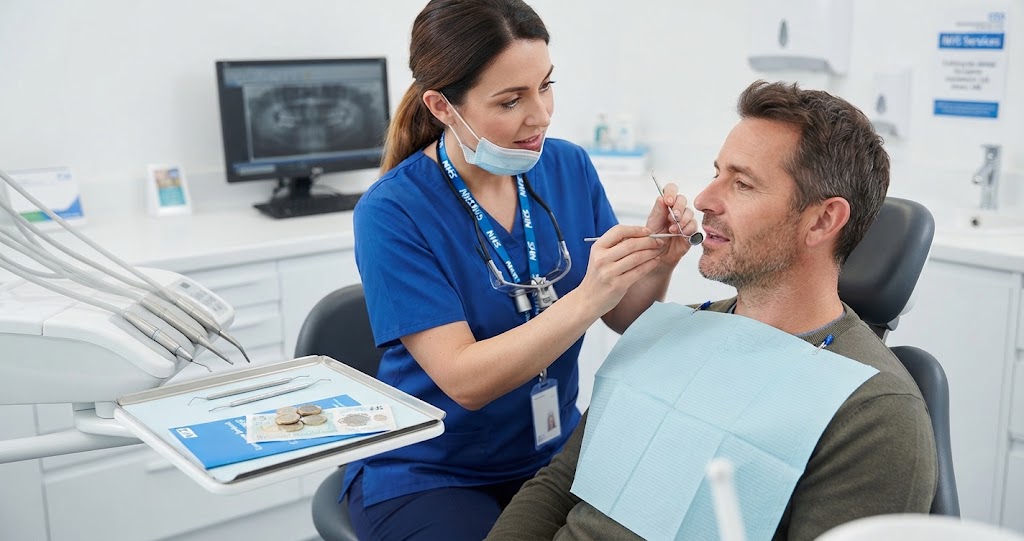
If you need an NHS dentist in England, one of the first questions you may have is: how much does NHS dental treatment cost in 2026?
From 1 April 2026, NHS dental charges in England increased to £27.90 for Band 1, £76.60 for Band 2 and £332.10 for Band 3. Urgent or unscheduled NHS dental care is charged at the Band 1 rate of £27.90 for patients who normally pay dental charges.
The amount you pay depends on the treatment your dentist says you clinically need. You normally pay one NHS charge for the complete course of treatment, rather than paying separately for every appointment or individual procedure within that course.
This guide explains the NHS dental charges for 2026 in England, what each band covers, who can receive free NHS dental treatment, how urgent dental care is charged, and what to do if you cannot afford the full cost.
Quick answer: NHS dental charges in England from 1 April 2026 are £27.90 for Band 1, £76.60 for Band 2 and £332.10 for Band 3.
NHS Dental Charges 2026 at a Glance
| NHS dental treatment band | 2026 charge in England | What it can include |
|---|---|---|
| Band 1 | £27.90 | Examination, diagnosis, X-rays where clinically necessary, prevention and certain gum treatments |
| Band 2 | £76.60 | Everything in Band 1 plus fillings, root canal treatment, extractions and certain other treatments |
| Band 3 | £332.10 | Everything in Bands 1 and 2 plus crowns, dentures, bridges and certain laboratory-made appliances |
| Urgent/unscheduled care | £27.90 | Urgent NHS dental treatment for patients who normally pay charges |
These are the NHS dental patient charges applicable in England from 1 April 2026.
What Are NHS Dental Charges in England in 2026?
NHS dental treatment is divided into three main charging bands.
The band is determined by the treatment you need, rather than simply by how long your appointment lasts.
If you need several treatments during the same course of NHS dental treatment, you generally pay the charge for the highest applicable band. You do not normally pay separate Band 1, Band 2 and Band 3 charges for the same course of treatment.
Band 1 NHS Dental Charge: £27.90
Band 1 costs £27.90 from 1 April 2026.
It can include:
- A dental examination
- Assessment and diagnosis
- Dental X-rays where clinically necessary
- Preventive advice
- Fluoride application where clinically appropriate
- Simple gum disease treatment, including scaling where clinically necessary
- Certain impressions or moulds of your teeth
- Minor adjustments to dentures or orthodontic appliances
If you need clinically necessary scaling as part of your NHS dental treatment, it can be included within the appropriate NHS band.
Band 2 NHS Dental Charge: £76.60
Band 2 costs £76.60 from 1 April 2026.
Band 2 includes the treatments covered by Band 1, plus additional treatment such as:
- Fillings
- Root canal treatment
- Tooth extraction
- Certain oral surgery procedures
- Other clinically necessary Band 2 treatments
For example, if your dentist diagnoses a tooth that requires a filling, your treatment may fall under Band 2 rather than Band 1.
The important point is that the £76.60 charge applies to the course of NHS treatment, rather than being a separate fee for every filling or procedure within that course.
Band 3 NHS Dental Charge: £332.10
Band 3 costs £332.10 from 1 April 2026.
Band 3 includes Band 1 and Band 2 treatment, plus certain more complex treatments such as:
- Crowns
- Bridges
- Dentures
- Certain inlays and onlays
- Some custom-made dental appliances
For example, if you require a clinically necessary crown as part of your NHS course of treatment, the treatment can fall into Band 3.
How Much Does an NHS Dentist Cost in 2026?
For most patients who are not exempt from NHS dental charges:
- Routine examination and Band 1 treatment: £27.90
- Fillings or root canal treatment: £76.60 when classified as Band 2
- Crowns, bridges or dentures: £332.10 when classified as Band 3
- Urgent NHS dental treatment: £27.90
However, the exact band depends on the treatment that your dentist determines you clinically need.
A dentist should explain the proposed treatment and the NHS charge before treatment begins.
Do You Pay for Every NHS Dental Appointment?
No. You generally pay one NHS charge for a complete course of treatment.
This is an important difference between NHS dental charges and the way some private dental services are priced.
For example, if your dentist determines that you need a Band 2 course of treatment and you have several appointments to complete it, you would normally pay the Band 2 charge of £76.60, rather than £76.60 for every appointment.
Similarly, if several treatments are required within the same course and the highest treatment falls into Band 3, the applicable charge is normally the Band 3 charge.
Are NHS Dental X-Rays Included in the Price?
Usually, yes, when an X-ray is clinically necessary as part of your NHS dental treatment.
You do not normally pay a separate NHS patient charge for each clinically necessary X-ray. X-rays form part of the relevant NHS treatment band.
Your dentist decides whether an X-ray is clinically necessary based on your dental assessment.
Are NHS Fillings Free?
For patients who normally pay NHS dental charges, fillings are not free.
A filling is generally included within a Band 2 course of NHS dental treatment, which costs £76.60 in England from 1 April 2026.
However, some people qualify for free NHS dental treatment or help with the cost. This includes certain children, pregnant women, recent mothers and people receiving qualifying benefits or holding relevant certificates.
How Much Does NHS Root Canal Treatment Cost in 2026?
Root canal treatment is generally included within Band 2 NHS dental treatment when it is clinically necessary.
The NHS dental charge for Band 2 is £76.60 in England from 1 April 2026.
A root canal may require more than one appointment, but you normally pay the applicable NHS charge for the course of treatment rather than paying the Band 2 charge at every visit.
How Much Does an NHS Tooth Extraction Cost?
A clinically necessary tooth extraction is generally covered under Band 2 NHS dental treatment.
The Band 2 patient charge in England is £76.60 from 1 April 2026.
Wisdom teeth can also be removed through NHS dental services when removal is clinically necessary. Your dentist may carry out the treatment or refer you to an appropriate specialist service.
If you are experiencing severe dental pain, swelling or another urgent problem, read our guide to emergency dental care in the UK.
How Much Do NHS Crowns Cost in 2026?
A crown provided as clinically necessary NHS treatment falls under Band 3.
The Band 3 NHS dental charge in England from 1 April 2026 is £332.10.
NHS dentistry may use specific clinically appropriate materials and treatment options. If you are considering cosmetic or alternative private options, your dentist can explain what is available and the associated costs.
How Much Do NHS Dentures Cost in 2026?
Dentures provided as NHS treatment are generally covered under Band 3.
The NHS dental charge for Band 3 in England is £332.10 from 1 April 2026.
The exact type of denture and treatment required depends on your clinical circumstances.
It is important to distinguish between NHS treatment and private dental treatment. If you choose a private denture or other private treatment, the NHS dental charge bands do not apply to the private fee.
How Much Does an NHS Bridge Cost?
A clinically necessary bridge can fall under Band 3 NHS dental treatment.
The applicable NHS patient charge is £332.10 from 1 April 2026.
A dentist should explain whether the proposed treatment can be provided under the NHS and what alternatives may be available.
If you are considering dental implants instead, our guide explains how much dental implants cost in the UK in 2026.
Is NHS Teeth Whitening Free?
No. Teeth whitening is generally considered a cosmetic treatment and is not normally available as NHS dental treatment.
If you want teeth whitening for cosmetic reasons, you will generally need to pay privately.
Before paying for whitening, it is important to understand the safety considerations. You can read our guide on whether teeth whitening is safe.
Is NHS Dental Treatment Free for Children?
Yes, eligible children can receive free NHS dental treatment.
In England, NHS dental treatment is free for:
- Children under 18
- People under 19 in full-time education
Other exemptions can also apply depending on age, pregnancy, benefits and circumstances.
Parents and carers should still check eligibility and make sure the dentist has the information needed to record the exemption correctly.
Is NHS Dental Treatment Free During Pregnancy?
Yes, NHS dental treatment can be free during pregnancy and for 12 months after the baby is born, provided the relevant eligibility requirements are met.
NHS guidance states that pregnant women and people who have had a baby in the previous 12 months can qualify for free NHS dental treatment.
You may need to provide appropriate evidence, such as a valid maternity exemption certificate or other accepted proof.
Who Gets Free NHS Dental Treatment in England?
You may qualify for free NHS dental treatment if you:
- Are under 18
- Are under 19 and in full-time education
- Are pregnant
- Have had a baby within the previous 12 months
- Receive certain qualifying benefits
- Receive qualifying Pension Credit
- Qualify under specific Armed Forces or War Pension arrangements
- Have treatment as an NHS hospital dental patient in qualifying circumstances
- Hold a valid HC2 certificate under the NHS Low Income Scheme
The exact rules depend on your circumstances, and receiving a benefit does not automatically mean every person in every situation is exempt.
What Is an HC2 Certificate?
An HC2 certificate can provide full help with certain NHS healthcare costs, including NHS dental treatment, for people who qualify under the NHS Low Income Scheme.
An HC3 certificate can provide partial help towards NHS dental costs.
The amount of help depends on the individual’s circumstances and the certificate issued.
If you have a low income but do not qualify automatically for free NHS dental treatment, it may be worth checking whether you can receive help through the NHS Low Income Scheme.
What Happens If You Cannot Afford NHS Dental Charges?
If you are struggling to pay for dental treatment, do not assume that you must simply go without treatment.
You may be able to receive:
- Free NHS dental treatment through an exemption
- Partial help through the NHS Low Income Scheme
- An HC2 certificate
- An HC3 certificate
- Treatment through another eligible exemption category
The NHS recommends checking your eligibility before claiming an exemption.
You should not claim an exemption unless you are actually entitled to it. NHS guidance states that incorrect exemption claims can result in the charge being recovered and may lead to a penalty.
NHS Urgent Dental Treatment Cost in 2026
From 1 April 2026, the charge for NHS urgent or unscheduled dental care for patients who normally pay dental charges is £27.90.
Urgent dental care is intended for dental problems requiring prompt clinical attention.
Examples may include:
- Severe dental pain
- Dental swelling
- Certain dental infections
- A broken tooth causing significant problems
- Other urgent dental conditions
The appropriate service depends on the nature and severity of the problem.
If you need urgent help, our guide explains how emergency dental care works in the UK.
When Should You Seek Emergency Help?
Some symptoms require urgent medical attention rather than simply waiting for a routine dental appointment.
Seek urgent medical help if dental swelling is affecting your ability to:
- Breathe
- Swallow
- Speak
A rapidly spreading facial or neck swelling can potentially become serious.
For severe or rapidly worsening symptoms, seek appropriate urgent medical care rather than relying solely on an online dental guide.
What Are the NHS Dental Charges for Gum Disease?
The cost depends on the treatment required.
Simple gum disease treatment, including clinically necessary scaling, can be included in Band 1. More extensive or complex gum treatment may fall into a higher band depending on the treatment provided.
For a broader explanation, read our guide to gum disease treatment: NHS vs private costs.
Maintaining good oral hygiene can also help reduce the risk of gum disease progressing.
Do NHS Dental Charges Cover Cosmetic Dentistry?
Generally, no.
NHS dentistry is intended to provide clinically necessary dental treatment rather than treatment performed solely to improve appearance.
Examples of treatments that may usually require private payment include cosmetic:
- Teeth whitening
- Certain types of veneers
- Cosmetic reshaping
- Aesthetic orthodontic options
- Other treatments provided primarily for appearance
The distinction is important because a dental practice may offer both NHS and private treatment.
If a treatment is not clinically necessary under NHS rules, your dentist should explain the private option and associated costs where appropriate.
NHS Braces and Orthodontic Treatment
Orthodontic treatment through the NHS is subject to eligibility criteria.
Not every adult or child who wants braces for cosmetic reasons will qualify for NHS-funded orthodontic treatment.
Where orthodontic treatment is clinically eligible, NHS rules and charging arrangements can differ depending on the patient’s age and circumstances.
Patients who choose private orthodontic treatment will generally pay the private provider’s fees.
For cosmetic teeth straightening, you can also read our existing guide about Invisalign teeth straightening in Hanwell.
NHS vs Private Dentist: What Is the Difference?
One of the biggest differences is the way treatment is funded and priced.
NHS dentistry
NHS dental charges are nationally set in England.
For paying patients in 2026:
- Band 1: £27.90
- Band 2: £76.60
- Band 3: £332.10
These charges apply to eligible NHS treatment.
Private dentistry
Private dental fees are set by the dental practice.
Private treatment can therefore vary significantly depending on:
- Location
- Dentist
- Materials
- Laboratory costs
- Treatment complexity
- Technology used
- Type of restoration
- Whether treatment is cosmetic or clinically necessary
If you are comparing private and NHS options, ask the dentist for a clear treatment plan and written price information before agreeing to treatment.
Can You Mix NHS and Private Dental Treatment?
In some situations, a dental practice may provide both NHS and private treatment.
However, NHS and private treatment are separate arrangements. You should understand:
- Which parts of your treatment are being provided under the NHS
- Which parts are private
- What you will pay privately
- Whether the proposed treatment is clinically necessary
- Whether an NHS alternative is available
Do not assume that every treatment offered by an NHS dental practice is automatically covered by NHS funding.
Can an NHS Dentist Charge More Than £332.10?
For a standard NHS course of treatment in England, the three main patient charges are £27.90, £76.60 and £332.10 from 1 April 2026.
However, there are specific circumstances involving certain NHS dental appliances and replacement arrangements that have separate charges.
For example, NHSBSA lists Regulation 11 replacement NHS dental appliances at £99.60 for one appliance or £199.20 for two from 1 April 2026.
This is different from a standard Band 1, Band 2 or Band 3 course of treatment.
What Are the NHS Dental Charges for 2026 Compared With 2025?
The NHS dental charges increased from 1 April 2026.
| Treatment band | Before 1 April 2026 | From 1 April 2026 |
|---|---|---|
| Band 1 | £27.40 | £27.90 |
| Band 2 | £75.30 | £76.60 |
| Band 3 | £326.70 | £332.10 |
| Urgent dental treatment | £27.40 | £27.90 |
These figures are published by NHSBSA.
How Much Can NHS Dental Treatment Save You?
The NHS charging system can make clinically necessary treatment considerably less expensive than comparable private treatment, particularly for complex procedures.
For example, a patient who qualifies for NHS Band 3 treatment would pay £332.10, provided the treatment is delivered under NHS arrangements and the patient is liable for the standard charge.
A private dentist may charge a different amount for similar treatment because private fees are not governed by the NHS dental charging bands.
This is one reason it is important to establish whether your proposed treatment is NHS or private before treatment starts.
How to Find an NHS Dentist in England
Finding an NHS dentist can be challenging in some areas.
You can use NHS services to search for dental practices and check availability. You can also contact dental practices directly and ask whether they are accepting NHS patients.
Before booking, ask:
- Are you currently accepting NHS patients?
- Are you accepting new NHS patients?
- Is the appointment NHS or private?
- What NHS treatment charges apply?
- Is there a waiting list?
- Do you provide urgent NHS appointments?
- Do you treat children under the NHS?
- Do you offer NHS treatment for the type of problem I have?
You can also read our guide on how to find an NHS dentist in 2026.
Why NHS Dental Availability Can Be Different From NHS Dental Charges
The fact that NHS dental charges are nationally set does not mean every dental practice has unlimited NHS appointment availability.
Access depends on local NHS dental services, contracts, capacity and individual practice arrangements.
NHS England introduced changes for 2026/27 designed to increase the provision of urgent care and support preventative and more complex care pathways.
This means the price of NHS dental treatment and the availability of an NHS dentist are two separate issues.
A treatment may have a nationally defined NHS charge, while finding a practice currently accepting NHS patients may still require additional searching.
NHS Dental Care Reforms in 2026
NHS dentistry is undergoing changes during 2026.
NHS England’s 2026 dental contract reforms include a stronger focus on urgent care, prevention and oral health stabilisation. The reforms also introduce changes to how certain complex care and denture-related treatments are handled.
For patients, the practical takeaway is that the NHS dental system is not completely static. Contractual and care pathway arrangements can change during the 2026/27 financial year.
However, the standard NHS patient charges from 1 April 2026 remain:
- Band 1: £27.90
- Band 2: £76.60
- Band 3: £332.10
How to Reduce Your Dental Costs
There are several legitimate ways to manage dental costs.
1. Check whether you qualify for free NHS treatment
Before paying, check whether you qualify for an exemption.
Pregnancy, age, qualifying benefits and certain certificates can affect eligibility.
2. Check the NHS Low Income Scheme
If you are on a low income but do not automatically qualify for free treatment, investigate whether you can receive partial or full help through the NHS Low Income Scheme.
3. Ask whether treatment is NHS or private
If your dentist discusses several options, ask which option is available through the NHS and which would be private.
4. Ask about the treatment band
Before starting treatment, make sure you understand which NHS band applies.
5. Treat problems early
A small dental problem can become more complicated if left untreated.
Regular dental care and good oral hygiene may help prevent problems from becoming more serious and potentially requiring more complex treatment.
Common Questions About NHS Dental Charges 2026
How much is an NHS dentist in England in 2026?
From 1 April 2026, NHS dental charges in England are £27.90 for Band 1, £76.60 for Band 2 and £332.10 for Band 3.
What is the cheapest NHS dental treatment in 2026?
The lowest standard NHS dental charge for a paying patient is £27.90 for Band 1 treatment.
How much is Band 1 NHS dental treatment?
Band 1 costs £27.90 in England from 1 April 2026.
How much is Band 2 NHS dental treatment?
Band 2 costs £76.60 in England from 1 April 2026.
How much is Band 3 NHS dental treatment?
Band 3 costs £332.10 in England from 1 April 2026.
Is an NHS dental check-up free?
Not necessarily. Most adults who are not exempt from charges have to pay the applicable NHS dental charge. A routine examination can fall under Band 1, which costs £27.90 in 2026.
Are NHS fillings free?
Not for most paying adults. A clinically necessary filling is generally covered under Band 2, which costs £76.60 in England from 1 April 2026.
Are NHS root canals free?
Not usually for paying adults. Clinically necessary root canal treatment is generally included in Band 2, costing £76.60 in 2026.
Are NHS crowns free?
Not usually for paying adults. A clinically necessary crown falls under Band 3, which costs £332.10 in England from 1 April 2026.
Who gets free NHS dental treatment?
Eligible groups include children, certain students under 19, pregnant women, people who have recently had a baby and people who meet specific benefit or NHS Low Income Scheme criteria.
Is NHS dental treatment free if you are pregnant?
Yes, eligible pregnant women can receive free NHS dental treatment, and the exemption can continue for 12 months after the baby is born.
Can I get help with NHS dental costs if I have a low income?
Yes. Depending on your circumstances, the NHS Low Income Scheme may provide full or partial help. An HC2 certificate can provide full help, while an HC3 certificate can provide partial help.
How much does emergency NHS dental treatment cost in 2026?
The NHSBSA lists unscheduled care at £27.90 from 1 April 2026 for patients who normally pay NHS dental charges.
Related Dental Health Guides
For more information about dental treatment and costs in the UK, explore these HealthCresto guides:
- How to Find an NHS Dentist in 2026
- Emergency Dentist UK: What to Do When You Need Urgent Dental Care
- Gum Disease Treatment: NHS vs Private Cost
- How Much Do Dental Implants Cost in the UK in 2026?
- Is Teeth Whitening Safe?
- Invisalign Teeth Straightening in Hanwell
- Reliable Private Dentist in Croydon
Key Takeaways: NHS Dental Charges 2026
The NHS dental charges in England from 1 April 2026 are:
Band 1: £27.90
Covers examinations, diagnosis, clinically necessary X-rays, preventive care and certain simple treatments.
Band 2: £76.60
Includes Band 1 treatment plus fillings, root canal treatment, extractions and other applicable treatments.
Band 3: £332.10
Includes Bands 1 and 2 plus certain crowns, dentures, bridges and other laboratory-made dental appliances.
Urgent/unscheduled NHS dental care: £27.90
This applies to patients who normally pay NHS dental charges.
Some people can receive NHS dental treatment free of charge, while others may qualify for partial help with costs.
Because NHS dental rules, contracts and eligibility arrangements can change, always check the latest NHS or NHSBSA information before relying on a specific exemption or charge.
Official NHS Sources
- NHS: How much NHS dental treatment costs
- NHS: Who can get free NHS dental treatment or help with dental costs
- NHS Business Services Authority: Current NHS dental charges
- NHS England: NHS dentistry quality and payment reforms
Last reviewed: September 2026
Applies to: England
Topic: NHS dental charges and patient costs