
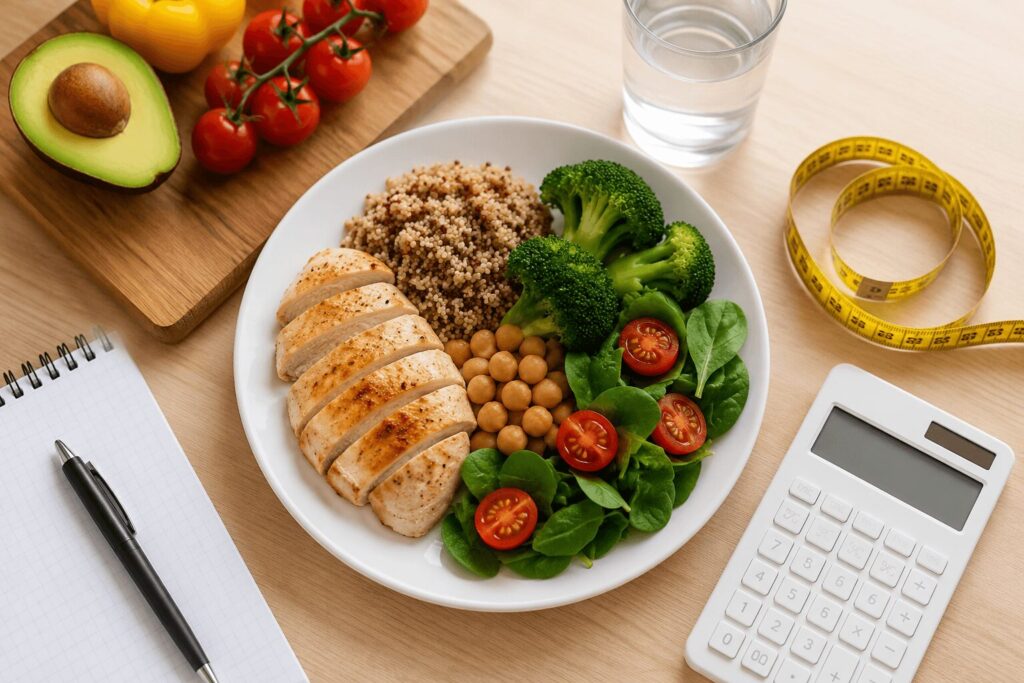
There’s no single calorie number that applies to everyone — it depends on your size, sex, age, activity level, and how much weight you’re carrying. But the underlying method for working out your own number is the same for everyone, and it takes about five minutes to calculate.
The Basic Principle: Calorie Deficit
Weight loss happens when you consistently eat fewer calories than your body uses. Your body’s total daily energy use is made up of your basal metabolic rate (the energy your body burns at rest just keeping you alive) plus the energy used through daily movement, exercise, and digestion. Eating below that total, consistently, produces a deficit, and the body draws on stored fat to make up the difference.
Step 1: Estimate Your Maintenance Calories
Your maintenance number — the calories that keep your weight stable — is commonly estimated using your basal metabolic rate (BMR) multiplied by an activity factor to get your total daily energy expenditure (TDEE). Several validated formulas exist (Mifflin-St Jeor is the most widely used and accurate for most adults), and most online TDEE calculators use one of these behind the scenes. As a rough guide, many adult women maintain weight somewhere around 1,800–2,200 calories a day and many adult men around 2,200–2,800, though individual variation is large enough that a personal calculation is far more useful than an average.
Step 2: Choose a Sensible Deficit
A deficit of roughly 500 calories a day is a common, well-tolerated starting point, producing an average loss of around 0.5kg (about 1lb) a week, since one kilogram of body fat represents roughly 7,700 calories. Larger deficits produce faster short-term loss but are harder to sustain and carry a higher risk of muscle loss, nutrient shortfalls, and rebound weight regain. As a general safety floor, adult women are usually advised not to go below around 1,200 calories a day, and adult men not below around 1,500, without medical supervision.
Factors That Change Your Calorie Needs
- Age — metabolic rate tends to decline gradually with age, partly due to reduced muscle mass
- Sex — men typically have more muscle mass and a higher BMR than women at the same body weight
- Activity level — a desk job with no exercise and an active manual job can differ by several hundred calories a day
- Muscle mass — muscle burns more energy at rest than fat, so two people at the same weight can have different needs
- Sleep and stress — poor sleep and chronic stress are linked to increased appetite and altered hunger hormones, which can undermine an otherwise sound calorie plan
Sample Calorie Targets by Scenario
- Sedentary adult woman, moderate weight-loss goal: roughly 1,500–1,700 calories/day
- Moderately active adult woman: roughly 1,700–1,900 calories/day
- Sedentary adult man, moderate weight-loss goal: roughly 1,900–2,100 calories/day
- Moderately active adult man: roughly 2,100–2,400 calories/day
These are starting estimates, not prescriptions — actual results should guide adjustments. If weight isn’t moving after two to three consistent weeks at a given calorie level, that’s a signal to reassess the number, not to drop it drastically.
Calorie Needs While Using a Weight-Loss Injection
GLP-1 medications such as Wegovy and Mounjaro reduce appetite substantially, which naturally lowers intake for many people without requiring the same conscious tracking effort. That said, the same safety floors still apply, and getting enough protein becomes especially important on these medications to protect muscle mass while appetite is suppressed.
For how eligibility and medical supervision work for these medications, see our guides on Ozempic UK: how it works, cost, and NHS eligibility and how to get weight loss injections on the NHS.
Why Under-Eating Backfires
Very low calorie intake can slow metabolic rate over time, disrupt sleep and mood, and increase the likelihood of bingeing or abandoning the plan altogether. This matters particularly if you’re also dealing with high stress or burnout, since both already disrupt appetite regulation on their own.
If low energy and appetite changes are linked more to work stress than deliberate dieting, our guide on how to recover from burnout while still working covers how to rebuild those basics safely before layering a calorie plan on top.
Building a Sustainable Routine
- Track intake loosely for one to two weeks to understand your actual current habits before changing anything
- Prioritise protein and fibre to manage hunger within your target calories
- Expect weight to fluctuate day to day — judge progress over weekly averages, not single readings
- Reassess your calorie target every 5–10% of body weight lost, since maintenance calories drop as body weight drops
For an official, plain-English explanation of calories and healthy weight loss, see the NHS’s guide to understanding calories.
Frequently Asked Questions
How many calories a day do I need to lose 1lb a week?
Roughly a 500-calorie daily deficit below your maintenance level produces about 0.5kg (1lb) of loss per week, since a kilogram of fat represents approximately 7,700 calories.
Is 1,200 calories a day safe for weight loss?
1,200 calories is generally considered a lower safety floor for adult women and is too low for most adult men. Going below these general floors without medical supervision increases the risk of nutrient shortfalls and should be discussed with a GP or dietitian first.
Why am I not losing weight even though I’m in a calorie deficit?
Common reasons include underestimating portion sizes, not accounting for drinks and condiments, water retention masking fat loss, or a maintenance calorie level that’s actually lower than assumed as body weight decreases. Reassessing intake honestly for a week is usually more useful than cutting calories further.
Do weight-loss injections change how many calories I should eat?
The same general calorie principles apply, but appetite suppression from GLP-1 medications means many people naturally eat less without tracking. Prioritising protein intake becomes particularly important on these medications to help preserve muscle mass.