
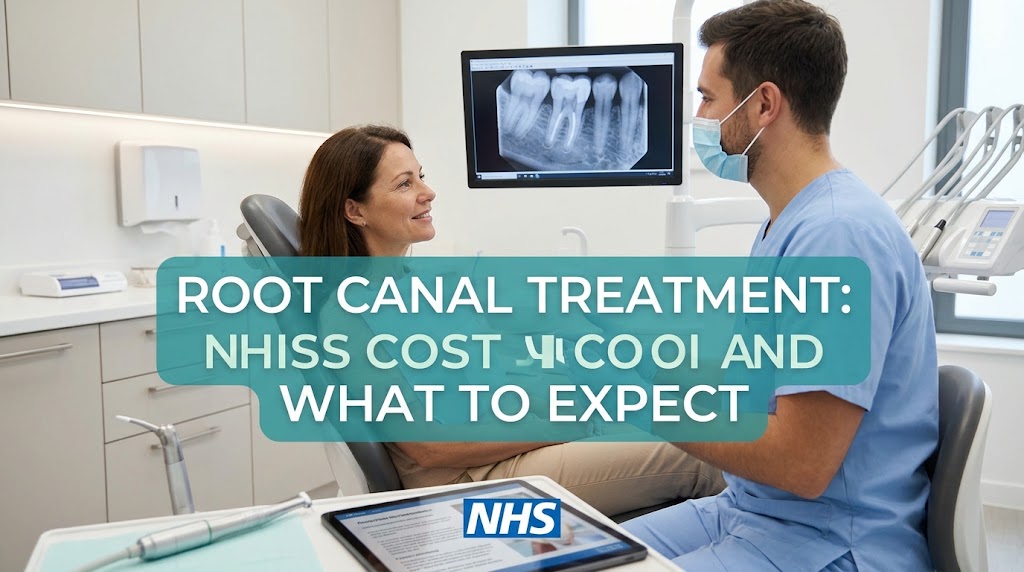
Root canal treatment NHS cost UK is a common concern for people experiencing toothache, sensitivity or a dental infection. In England, root canal treatment is generally covered by NHS Band 2, which costs £76.60 per course of treatment from 1 April 2026 for patients who pay standard NHS dental charges. If a crown is also required as part of the same course of treatment, the Band 3 charge is generally £332.10. Your dentist will explain the treatment plan and applicable charges before starting.

NHS+1
Root canal treatment can help save a natural tooth that might otherwise need to be removed. Although the procedure may sound intimidating, local anaesthetic is normally used to prevent pain during treatment.
This guide explains NHS root canal costs, what happens during the procedure, how long recovery takes, and how to find suitable dental care in the UK.
How much does root canal treatment NHS cost UK in 2026?
The cost of NHS root canal treatment depends on where you live in the UK, whether you qualify for free dental care, and whether your treatment includes additional procedures.
In England, NHS dental charges are organised into treatment bands. Root canal treatment falls under Band 2, while crowns and certain other complex restorations fall under Band 3.
NHS
NHS dental charges in England
| NHS treatment band | Cost from 1 April 2026 | What it covers |
|---|---|---|
| Band 1 | £27.90 | Examination, diagnosis, necessary X-rays and preventive care |
| Band 2 | £76.60 | Band 1 care plus root canal treatment, fillings and extractions |
| Band 3 | £332.10 | Band 1 and 2 care plus eligible crowns, dentures and bridges |
Source: NHS and NHS Business Services Authority dental charges for England, effective 1 April 2026.
NHS+1
Important: You generally pay one charge for a complete course of NHS treatment, even if you need several appointments. If a crown is clinically necessary and included in the same course of treatment, the applicable charge may be Band 3 rather than an additional Band 2 fee plus Band 3. Ask your dentist to confirm the precise treatment plan and charge.
For a detailed breakdown, read Healthcresto’s NHS dental charges 2026: full price guide for England.
Does root canal treatment cost the same across the UK?
No. NHS dental charging arrangements differ between England, Scotland, Wales and Northern Ireland.
- England: Root canal treatment is normally included in Band 2, currently £76.60 for paying patients.
- Scotland: NHS dental examinations are free, but treatment may incur charges. Paying patients generally contribute 80% of the treatment cost, up to £384 per course of treatment, subject to exemptions.
- Wales: Charges are based on the applicable treatment category. From April 2026, the published charge is £91.18 for anterior root canal treatment and £182.72 for posterior root canal treatment.
- Northern Ireland: NHS dental charges follow a separate system, so check the current rules and costs with your local dental service.
These figures apply to different charging systems and should not be compared as though they represent identical treatment packages. Check the applicable rules before booking.
NHSBSA FAQ+2
Who is eligible for free NHS root canal treatment?
You may qualify for free NHS dental treatment in England if you meet certain eligibility criteria. These can include:
- Being under 18, or under 19 and in qualifying full-time education.
- Being pregnant or having had a baby in the previous 12 months.
- Receiving certain qualifying benefits, subject to the applicable conditions.
- Holding a valid NHS Low Income Scheme HC2 certificate.
Eligibility rules and qualifying conditions apply, and not every person receiving a benefit automatically qualifies. Check the official NHS guidance on dental treatment costs and exemptions before claiming an exemption.
NHSBSA FAQ+1
What is root canal treatment?
Root canal treatment is a dental procedure used to remove infected or inflamed tissue from inside a tooth. The dentist cleans and disinfects the internal canals, then fills and seals them to help prevent reinfection.
The soft tissue inside the tooth, known as the pulp, contains nerves and blood vessels. Deep tooth decay, cracks, dental injuries or other damage can allow bacteria to reach this tissue, causing inflammation or infection.
Without appropriate treatment, the infection may progress and lead to an abscess or the need for tooth extraction. Root canal treatment aims to preserve the natural tooth when it is suitable for restoration.
NHS
What are the signs you might need a root canal?
Not every toothache requires root canal treatment. However, certain symptoms may indicate that the pulp inside a tooth is inflamed or infected.
Common warning signs include:
- Persistent or severe toothache.
- Pain when biting or chewing.
- Prolonged sensitivity to hot or cold foods and drinks.
- Swelling or tenderness around the affected tooth.
- A darkening or discolouration of the tooth.
- A small gum swelling or a recurring spot that releases pus.
- An unpleasant taste associated with a dental infection.
Some infected teeth cause little or no pain, so the absence of symptoms does not always rule out a problem.
A dentist may examine your teeth, take X-rays and assess the condition of the pulp before recommending treatment. If you have swelling, persistent pain or suspected infection, arrange a dental appointment promptly.
If you have severe dental pain or facial swelling and cannot obtain a routine appointment, read our guide to getting same-day NHS emergency dental treatment.
What happens during root canal treatment?
Root canal treatment usually takes two or more appointments, although the exact number depends on the tooth, the severity of the infection and the complexity of the root canals. Some cases can be completed in fewer visits.
NHS

Step 1: Examination and X-rays
Your dentist examines the affected tooth and may take X-rays to assess the roots, surrounding bone and extent of the infection. They explain the treatment options and expected costs.
Step 2: Local anaesthetic
The tooth and surrounding area are numbed. You should not feel sharp pain during the procedure, although pressure or vibration may be noticeable.

Step 3: Removing infected pulp
The dentist creates an opening in the tooth, removes the infected or inflamed pulp and cleans the root canals. An abscess may also need to be drained.

Step 4: Cleaning, filling and sealing
The canals are shaped, cleaned and filled. A temporary filling may be placed if further treatment is required at another appointment.

Step 5: Final restoration
The tooth is permanently restored with a suitable filling or, where clinically necessary, a crown. Your dentist will advise you about protecting the tooth and arranging follow-up care.
The images illustrate typical stages of dental care; the exact procedure and number of appointments will vary.
Is root canal treatment painful?
Root canal treatment should not normally be painful during the procedure because local anaesthetic is used to numb the affected area.
You may experience some pressure, vibration or discomfort. If you feel pain during treatment, tell your dentist so they can assess whether additional anaesthetic or another adjustment is needed.
After treatment, the tooth and surrounding gum may feel tender for several days. Mild soreness should gradually improve, although recovery can take longer in more complicated cases.
NHS
How to manage pain after a root canal
To support recovery:
- Follow your dentist’s aftercare instructions.
- Ask a pharmacist or dentist whether paracetamol or ibuprofen is suitable for you, and follow the recommended dose.
- Avoid chewing hard foods on the treated tooth until your dentist confirms it is safe.
- Brush gently and maintain normal oral hygiene.
- Attend any follow-up appointments.
Seek dental advice if the pain worsens, swelling develops or symptoms do not improve as expected.
Get urgent help if you develop significant facial or neck swelling, or difficulty swallowing or breathing. Difficulty breathing or swallowing requires emergency assessment; call 999 or attend A&E if necessary.
How long does recovery from root canal treatment take?
Many people return to normal daily activities the same day or the following day, depending on their discomfort and the type of treatment performed.
Mild tenderness can persist for several days, and the tissues around the tooth may take up to a couple of weeks to settle. Recovery varies according to the original infection, the tooth involved and whether further restoration is needed.
NHS
You should contact your dentist if you experience:
- Increasing rather than improving pain.
- New or worsening swelling.
- A fever or feeling generally unwell alongside dental symptoms.
- A temporary filling that falls out.
- A bite that feels noticeably uneven after treatment.
Do not assume that severe or worsening symptoms are a normal part of recovery.
Will I need a crown after root canal treatment?
Not everyone needs a dental crown after root canal treatment. The decision depends on the tooth’s remaining structure, its location and the amount of damage caused by decay or infection.
A crown may be recommended if the tooth is badly weakened or needs additional protection against fracture, particularly when a large amount of natural tooth structure has been lost.
A suitable filling may be sufficient in other cases.
In England, a clinically necessary crown included in the same NHS course of treatment may mean that the applicable patient charge is Band 3 (£332.10), rather than Band 2. Confirm with your dentist whether the crown is included in the proposed course of treatment and whether any suggested treatment is NHS or private.
For more information about dental restoration options, explore our guides to dental implant costs in the UK and NHS versus private dental implant costs.
NHS vs private root canal treatment: what is the difference?
Both NHS and private dentists can provide root canal treatment. The right option depends on clinical suitability, availability, the complexity of your case and your budget.
| Factor | NHS treatment | Private treatment |
|---|---|---|
| Cost in England | Usually covered by Band 2, or Band 3 if the course includes eligible crown treatment | Fees set by the dental practice |
| Availability | Depends on local NHS dental capacity | Depends on private appointment availability |
| Treatment options | Clinically necessary NHS care | May offer additional treatment choices |
| Specialist care | Referral may be required for complex cases | You may be able to book directly with a specialist |
| Follow-up | Based on the agreed NHS treatment plan | Based on the private treatment plan |
A private dentist may offer specialist endodontic care or additional appointment options, but this does not automatically mean private treatment will produce a better result.
If you are considering private treatment, ask for a written estimate that separates the root canal procedure, any crown, X-rays and follow-up appointments.
You can also read our guide to finding an NHS dentist in 2026 to understand your options for accessing care.
What happens if you do not get a root canal?
If a dentist recommends root canal treatment for an infected tooth, delaying care can allow the infection to persist or spread.
Possible complications include:
- Continuing or recurring toothache.
- Formation or worsening of a dental abscess.
- Swelling and tenderness around the tooth.
- Damage to surrounding tissues.
- The eventual need for extraction if the tooth cannot be saved.
Antibiotics alone are not usually a substitute for treating the source of a dental infection. Your dentist will determine whether drainage, root canal treatment, extraction or other care is required.
If the tooth cannot be restored successfully, extraction may be the most appropriate option. Read our guide to NHS wisdom tooth removal for information about another type of dental extraction.
How can you find an NHS dentist for root canal treatment?
If you think you need a root canal, follow these steps:
- Contact an NHS dental practice. Explain your symptoms and ask whether it is accepting NHS patients or can provide an urgent appointment.
- Describe your symptoms clearly. Mention persistent pain, swelling, sensitivity, a broken tooth or any discharge.
- Attend the examination. Your dentist may take X-rays and explain whether the tooth can be treated.
- Confirm your costs. Ask which NHS treatment band applies and whether a crown or referral may be necessary.
- Discuss alternatives. If the tooth cannot be saved or the required treatment is unavailable, ask about the next appropriate step.
If you cannot access a routine appointment and have urgent symptoms, contact NHS 111 or use the official NHS urgent dental care guidance. For severe swelling with difficulty breathing or swallowing, seek emergency help.
You can start with Healthcresto’s guide to how to find an NHS dentist in 2026 or read our emergency dentist guide for the UK.
Frequently asked questions about root canal treatment
1. How much does a root canal cost on the NHS in England in 2026?
Root canal treatment is generally covered by NHS Band 2, which costs £76.60 from 1 April 2026. If a clinically necessary crown is included in the same course of treatment, Band 3 may apply at £332.10.
NHS
2. Can I get root canal treatment free on the NHS?
Yes, if you meet the eligibility requirements for free NHS dental treatment. Eligibility may depend on age, pregnancy status, qualifying benefits or an NHS Low Income Scheme certificate. Check the official rules before claiming an exemption.
NHSBSA FAQ
3. How many appointments does a root canal take?
Many root canal treatments require two or more appointments, although some can be completed in one visit. The number depends on the tooth, the infection and the complexity of the root canals.
NHS
4. Does a root canal hurt?
Local anaesthetic is normally used to prevent pain during treatment. Some tenderness or soreness afterwards is common, but symptoms should generally improve over time. Contact your dentist if pain becomes severe or worsens.
5. Do I always need a crown after root canal treatment?
No. A crown is recommended when the tooth needs additional strength or protection. Some teeth can be restored with a filling, depending on how much healthy tooth structure remains.
6. Is root canal treatment better than extraction?
Saving a natural tooth with root canal treatment may be preferable when the tooth can be restored successfully. Extraction may be appropriate if the tooth is too damaged to save. Your dentist can explain the benefits, risks and costs of both options.
7. Can I eat after root canal treatment?
You can usually eat once the numbness has worn off, but avoid chewing hard foods on the treated tooth until your dentist advises that it is safe. Follow any specific instructions about temporary fillings or restorations.
8. What should I do if I have severe toothache and cannot find an NHS dentist?
Contact your dentist for an urgent appointment or use NHS 111 to find appropriate urgent dental care. If you have difficulty breathing or swallowing, seek emergency assistance immediately.
Conclusion
Root canal treatment can save a natural tooth and help resolve an infection when the tooth is suitable for restoration. In England, the standard NHS Band 2 charge is £76.60 in 2026, although a course of treatment that includes a clinically necessary crown may fall under Band 3 at £332.10.
The most important steps are to seek prompt dental advice, understand your treatment options and confirm the applicable costs before treatment begins.