
Free NHS prescriptions in England are available to millions of people, but not everyone automatically qualifies. While some people receive free prescriptions because of their age, pregnancy, medical conditions or qualifying benefits, other patients must pay for each prescribed item.
For 2026/27, the standard NHS prescription charge in England remains £9.90 per item. However, several exemption schemes can help eligible people avoid these costs. Patients who regularly need medicines may also save money through a Prescription Prepayment Certificate (PPC).
Understanding NHS prescription charges 2026 in England is particularly important if you have a long-term health condition, receive Universal Credit, are pregnant, are approaching retirement age or have a low household income.
This guide explains who gets free nhs prescriptions in England, which medical conditions qualify, how exemption certificates work, what Universal Credit recipients need to know and how to reduce prescription costs legally.
Important: This guide covers England. Prescription charges and exemption arrangements differ across the UK.

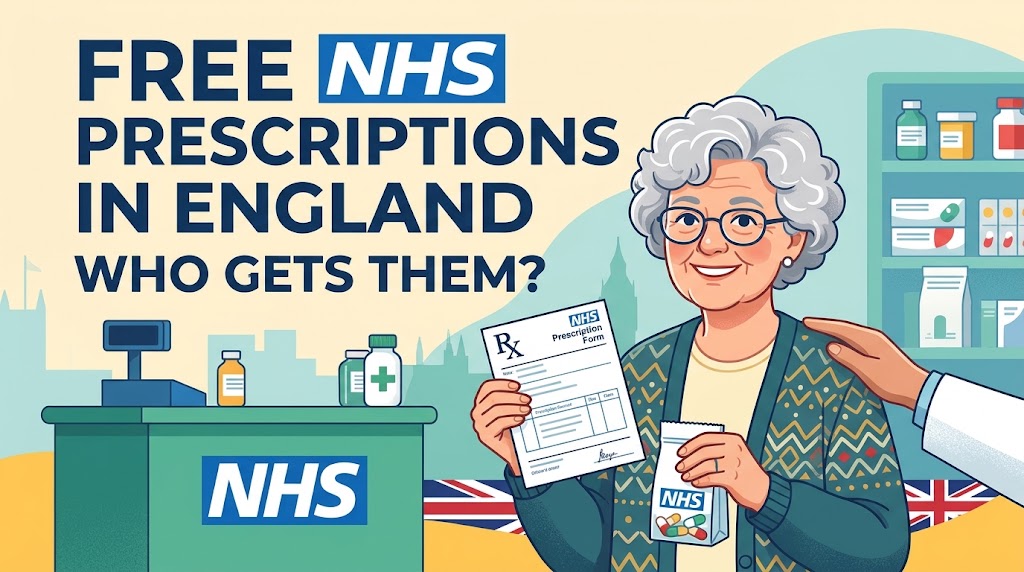
Featured image: A pharmacist helping a patient understand NHS prescriptions and medicine costs.
1. How much do NHS prescriptions cost in England in 2026?
The NHS prescription charge in England is £9.90 for each prescribed item during the 2026/27 financial year.
The charge applies separately to each medicine or medical appliance on a prescription, rather than once for the entire prescription.
For example:
| Number of prescribed items | Total cost |
|---|---|
| 1 item | £9.90 |
| 2 items | £19.80 |
| 3 items | £29.70 |
| 4 items | £39.60 |
| 5 items | £49.50 |
| 10 items | £99.00 |
The charge has been frozen for 2026/27, so patients will continue paying £9.90 per item rather than facing an increase this financial year. Community Pharmacy England+2
However, not everyone needs to pay. People who meet the qualifying criteria can receive free NHS prescriptions in England through age-related exemptions, medical certificates, maternity certificates or qualifying financial support.
Some medicines are also free regardless of a patient’s age or income. These include NHS-prescribed contraceptives and medicines supplied to NHS hospital inpatients. NHSBSA
2. Who gets free NHS prescriptions in England?
Several groups qualify for free prescriptions under NHS rules.
You may be eligible if you fall into one or more of the following categories:
- Children under 16.
- Young people aged 16, 17 or 18 in full-time education.
- Adults aged 60 or over.
- Pregnant women with a valid maternity exemption certificate.
- Women who have given birth within the previous 12 months and have a valid maternity exemption certificate.
- People with certain qualifying medical conditions and a valid medical exemption certificate.
- People receiving qualifying Universal Credit payments who meet the income requirements.
- People receiving Pension Credit Guarantee Credit.
- Individuals with a valid NHS HC2 certificate.
- Eligible war pensioners receiving treatment for an accepted disability.
- NHS hospital inpatients.
These exemptions are assessed according to the rules applicable when the prescription is dispensed. nhsbsa-live.powerappsportals.com+2
Free prescriptions for children under 16
Children under 16 automatically qualify for free NHS prescriptions in England.
Parents and guardians do not need to apply for a separate prescription exemption certificate for children in this age group.
This support helps families access necessary medicines without paying the standard prescription charge.
It is particularly useful for children who regularly require treatment for conditions such as asthma, infections, allergies or other health problems.
For parents, understanding these entitlements can also help when arranging routine healthcare and prescriptions for their children.
Free prescriptions for young people aged 16–18
Young people aged 16, 17 or 18 can receive free NHS prescriptions if they remain in full-time education.
However, turning 19 can change eligibility.
Students aged 19 and over do not automatically qualify for free prescriptions simply because they are studying.
They may still qualify through another exemption, such as a medical exemption, qualifying benefits or the NHS Low Income Scheme.
Free prescriptions for people aged 60 or over
Adults aged 60 and above automatically qualify for free NHS prescriptions in England.
There is no requirement to apply for a medical exemption certificate or demonstrate financial hardship.
Once you reach 60, you can receive free NHS prescriptions regardless of whether you are employed, retired or receiving a pension.
This exemption can be particularly helpful for older adults who regularly take medicines for conditions such as high blood pressure, diabetes, arthritis and heart disease.
For further information about age-related health concerns, read our guide to normal blood pressure readings by age.
Important: The age exemption applies from age 60, not the State Pension age. You do not need to wait until you qualify for your State Pension.
3. Free prescriptions for pregnant women and new mothers
Pregnant women and eligible new mothers can receive free NHS prescriptions through a Maternity Exemption Certificate (MatEx).
This scheme helps reduce healthcare costs during pregnancy and after childbirth.
You may qualify if:
- You are currently pregnant.
- You have given birth within the previous 12 months.
However, being pregnant or having recently given birth does not automatically establish prescription exemption. You need a valid maternity exemption certificate.
How to apply for a maternity exemption certificate
You can apply through your:
- GP.
- Midwife.
- Health visitor.
Your healthcare professional will complete the application once your pregnancy has been confirmed.
Depending on the application process, you may receive a digital certificate by email or a paper certificate through the post.
The certificate:
- Can be backdated by one month before the application is received.
- Normally expires 12 months after your expected delivery date or your baby’s birth.
- Allows you to claim free NHS prescriptions while it remains valid.
If you experience a miscarriage or stillbirth, you can continue using your certificate until its expiry date under the NHS rules. NHSBSA
Do pregnant women get free dental treatment too?
Yes. A valid maternity exemption certificate can also provide access to free NHS dental treatment during pregnancy.
This is an additional benefit that can help women manage healthcare expenses.
For more pregnancy-related information, read HealthCresto’s guides:
- How many weeks pregnant am I?
- Postpartum recovery: The first six weeks
- Endometriosis diagnosis in the UK
4. Medical conditions that qualify for free NHS prescriptions
Some people with long-term medical conditions can receive free prescriptions through a Medical Exemption Certificate (MedEx).
However, having a chronic illness does not automatically mean you qualify.
The NHS maintains a specific list of qualifying medical conditions. Patients must meet the eligibility requirements and hold a valid certificate.
Which medical conditions qualify?
The following conditions can qualify for a medical exemption certificate:
| Medical condition | Eligibility details |
|---|---|
| Diabetes mellitus | Diabetes requiring treatment other than diet alone |
| Epilepsy | Requires continuous anticonvulsive therapy |
| Hypothyroidism (myxoedema) | Requires thyroid hormone replacement |
| Hypoparathyroidism | Qualifying medical diagnosis |
| Myasthenia gravis | Qualifying medical diagnosis |
| Diabetes insipidus | Qualifying medical diagnosis |
| Hypopituitarism | Qualifying medical diagnosis |
| Addison’s disease | Requires essential substitution therapy |
| Permanent fistula | Requires continuous surgical dressing or an appliance |
| Certain physical disabilities | Prevents the person going out without another person’s help |
| Cancer-related treatment | Includes treatment for cancer and its effects |
Cancer-related medical exemptions are available to people undergoing treatment for cancer, the effects of cancer or the effects of cancer treatment.
The certificate is generally valid for five years for cancer-related treatment and ten years for the other qualifying conditions under the current NHSBSA arrangements. NHSBSA
Does diabetes qualify for free NHS prescriptions?
Yes. People diagnosed with diabetes mellitus can qualify for free NHS prescriptions if their treatment involves medication rather than diet alone.
This includes eligible patients who require insulin or other prescribed diabetes medicines.
However, people managing diabetes through diet alone do not qualify for a medical exemption on the basis of diabetes alone.
This distinction is important because not everyone with the same diagnosis will automatically qualify.
You can learn more about managing this condition in our guide to Type 2 diabetes remission in the UK.
Does high blood pressure qualify for free prescriptions?
No. High blood pressure (hypertension) is not independently included on the NHS medical exemption list.
Even if you take daily medication to control your blood pressure, you will generally need to pay for your prescriptions unless you qualify through another exemption.
For example, someone with hypertension may still receive free prescriptions if they are aged 60 or over, qualify through Universal Credit or hold an HC2 certificate.
Read our guide to normal blood pressure readings by age to understand blood pressure ranges and when to seek medical advice.
Does asthma qualify for free NHS prescriptions?
Asthma is not included in the standard medical exemption list.
People who use inhalers regularly may therefore need to pay prescription charges unless another exemption applies.
However, patients with asthma can explore a Prescription Prepayment Certificate to reduce their annual medicine costs.
For more information, see our articles:
Does cancer qualify for free NHS prescriptions?
Yes. Patients undergoing treatment for cancer, the effects of cancer or the effects of cancer treatment can qualify for a medical exemption certificate.
The exemption is designed to help patients manage the financial burden of treatment and related medication.
A valid certificate allows eligible patients to receive free NHS prescriptions, rather than paying £9.90 for each prescribed item.
However, patients must ensure their certificate is valid when collecting their medicines.
5. How to get a Medical Exemption Certificate (MedEx)
If you have a qualifying medical condition, applying for a Medical Exemption Certificate is relatively straightforward.
Follow these steps:
Step 1: Speak to your GP
Contact your GP or treating doctor and explain that you believe your condition qualifies for a medical exemption.
Step 2: Request an application form
Your doctor can provide the appropriate application form if you meet the eligibility requirements.
Step 3: Complete the application
Your healthcare professional will confirm the relevant medical details and complete the required section.
Step 4: Wait for confirmation
The NHS Business Services Authority (NHSBSA) will process your application.
The certificate is normally sent by post within 10 working days of receiving the application.
Step 5: Check your certificate
Make sure your personal details and expiry date are correct.
The certificate is normally backdated by one month before the date the application is received, meaning eligible prescription costs during the covered period may qualify for a refund if the required receipt was obtained. NHSBSA
Useful advice: Do not assume that having a qualifying diagnosis is enough. Make sure your certificate covers the date your prescription is dispensed.
6. Do people on Universal Credit get free NHS prescriptions?
Yes, some people receiving Universal Credit can qualify for free NHS prescriptions in England.
However, receiving Universal Credit does not automatically make someone eligible.
The NHS uses household take-home earnings during the most recent completed Universal Credit assessment period to determine eligibility.
Universal Credit income limits for free prescriptions
For 2026, the qualifying limits are:
| Universal Credit circumstances | Maximum household take-home pay |
|---|---|
| Standard qualifying Universal Credit award | £435 |
| Includes a child element | £935 |
| Includes limited capability for work | £935 |
| Includes limited capability for work and work-related activity | £935 |
These limits apply to the relevant assessment period, not your annual salary or gross income.
If you claim Universal Credit as a couple, the combined take-home earnings of you and your partner are considered.
You must also be receiving a positive Universal Credit payment and meet the applicable conditions. NHS BSA FAQ+2
Example: Can someone earning £400 get free prescriptions?
Imagine someone receives Universal Credit and their total household take-home pay during the last assessment period is £400.
If they meet the other eligibility requirements, they can qualify for free NHS prescriptions because their earnings are below the £435 threshold.
However, if their household take-home pay increases to £500 and they do not receive a qualifying child element or limited capability for work element, they will not qualify through Universal Credit alone.
They could still qualify through another exemption or apply for the NHS Low Income Scheme.
What if my Universal Credit earnings change?
Your eligibility can change from one assessment period to another.
For example, if you work additional hours or receive increased earnings, you may no longer qualify for free prescriptions through Universal Credit.
Similarly, if your earnings decrease, you may become eligible again.
It is therefore important to check your eligibility regularly rather than assuming that a previous exemption still applies.
Do PIP and disability benefits give you free prescriptions?
No. Receiving Personal Independence Payment (PIP), Disability Living Allowance (DLA) or Attendance Allowance alone does not automatically qualify you for free NHS prescriptions.
However, someone receiving these benefits might qualify through another route, including age, a qualifying medical condition or the NHS Low Income Scheme. NHSBSA+1
Important 2026 update: Income Support and income-based Jobseeker’s Allowance are no longer valid standalone exemption categories from 15 April 2026. Do not rely on an old benefits award as proof of current entitlement. Check the latest NHSBSA eligibility guidance. Community Pharmacy England+1
7. Free NHS prescriptions through Pension Credit
People receiving Pension Credit Guarantee Credit can qualify for free NHS prescriptions in England.
Pension Credit is designed to provide financial support to people who have reached State Pension age and have a lower income.
There are two main elements:
- Guarantee Credit: Helps increase weekly income to a minimum level for eligible pensioners.
- Savings Credit: Provides additional support for some people who reached State Pension age before 6 April 2016 and meet the relevant conditions.
The distinction matters because Pension Credit Savings Credit alone does not automatically provide free NHS prescriptions.
If you receive Guarantee Credit, either on its own or alongside Savings Credit, you can qualify for free prescriptions.
Your partner and eligible dependants may also receive help when included in the qualifying award.
If you are unsure which type of Pension Credit you receive, check your award notice before claiming free NHS prescriptions. NHSBSA+1
8. NHS Low Income Scheme: How to get free or reduced-cost prescriptions
The NHS Low Income Scheme (LIS) helps people who have limited income and savings but do not automatically qualify for free prescriptions.
This scheme is particularly useful for:
- People on low wages.
- Part-time workers.
- Students.
- People who are unemployed but do not receive qualifying benefits.
- Retired people who do not qualify through Pension Credit.
- People with limited household income and significant housing costs.
The scheme considers your income, savings, investments, housing costs and personal circumstances.
What is an HC2 certificate?
An HC2 certificate provides full help with eligible NHS health costs.
If you receive a valid HC2 certificate, you can claim free NHS prescriptions.
Your eligible partner and dependent children under 19 named on your claim can also receive the relevant help while the certificate remains valid.
What is an HC3 certificate?
An HC3 certificate provides partial help with NHS health costs.
It means the NHS has assessed your circumstances and determined that you can receive some financial assistance.
However, an HC3 certificate does not provide free NHS prescriptions.
You may still need to pay prescription charges, depending on your certificate’s terms.
NHS Low Income Scheme savings limits
For people living in England, the capital limits are:
| Circumstances | Maximum savings and capital |
|---|---|
| Most applicants | £16,000 |
| People permanently living in a care home | £23,250 |
The home you normally live in is excluded from the capital calculation.
Meeting the savings limit does not automatically guarantee an HC2 certificate. Your income and other circumstances must also be assessed. NHS
How to apply for the NHS Low Income Scheme
You can apply online or by post.
Online application:
- Visit the NHS Business Services Authority website.
- Find the NHS Low Income Scheme section.
- Complete the application with your financial details.
- Provide the requested supporting information.
- Wait for the assessment and decision.
Postal application:
- Obtain an HC1 application form.
- Complete your personal and financial details.
- Include the requested supporting information.
- Send the form to the address provided.
- Wait for the NHSBSA decision.
You can obtain an HC1 form online or through certain Jobcentre Plus offices, NHS hospitals and healthcare professionals.
Depending on your circumstances, an HC2 or HC3 certificate may be issued for between six months and five years. NHS
For more information, visit the official NHS Low Income Scheme guidance.
9. Prescription Prepayment Certificate (PPC): How to save money
If you do not qualify for free prescriptions but regularly need medication, a Prescription Prepayment Certificate (PPC) could help reduce your healthcare expenses.
A PPC allows you to pay a fixed amount for a specific period and receive unlimited eligible NHS prescriptions during that time.
Rather than paying £9.90 every time you collect a medicine, you pay for a certificate covering three or 12 months.
Prescription Prepayment Certificate prices in 2026/27
NHS prescription savings
3-month PPC
£32.05
Unlimited eligible prescriptions for three months
12-month PPC
£114.50
Unlimited eligible prescriptions for 12 months
Prices remain frozen for the 2026/27 financial year.
Official NHSBSA PPC information and applicationNHSBSA+1
When does a PPC save money?
A three-month PPC can save money if you need four or more prescription items within three months.
A 12-month PPC can save money if you need 12 or more items within a year.
For example:
| Prescription requirements | Paying individually | PPC cost |
|---|---|---|
| 4 items in 3 months | £39.60 | £32.05 |
| 6 items in 3 months | £59.40 | £32.05 |
| 12 items in 12 months | £118.80 | £114.50 |
| 24 items in 12 months | £237.60 | £114.50 |
The more medicines you need, the greater your potential savings.
Can I pay monthly for a PPC?
Yes. If you purchase a 12-month PPC, you can choose to pay through Direct Debit.
The monthly instalment option costs £11.45 per month over 10 months.
This makes it easier for people who prefer spreading their prescription expenses rather than paying the entire annual amount upfront. NHS BSA FAQ+1
How to buy a PPC
You can purchase a certificate:
- Online through the NHSBSA website.
- At participating pharmacies.
- By telephone using the NHS PPC order line.
You can also choose an appropriate start date, subject to NHSBSA rules.
Remember: A standard PPC covers eligible NHS prescriptions, including NHS dental prescriptions, but it does not cover every NHS health cost, such as wigs and fabric supports.
10. What is the HRT Prescription Prepayment Certificate?
Women prescribed hormone replacement therapy (HRT) medicines may benefit from a separate certificate called the Hormone Replacement Therapy Prescription Prepayment Certificate (HRT PPC).
This scheme helps reduce the cost of eligible HRT medicines prescribed on the NHS.
The HRT PPC costs £19.80 for 12 months in 2026/27.
It covers an unlimited number of listed eligible HRT medicines during its validity period.
Who should consider an HRT PPC?
It may be useful for women who:
- Receive regular HRT prescriptions.
- Use more than one eligible HRT medicine.
- Pay prescription charges for menopause treatment.
- Need ongoing hormone replacement medication.
The certificate is particularly useful for women experiencing menopause symptoms who need continuing treatment.
For example, a woman who pays for three eligible HRT prescription items within a year would normally spend £29.70 individually.
With an HRT PPC, she would pay £19.80, saving £9.90.
However, the certificate only covers medicines included on the official eligible HRT medicines list.
If you also regularly need non-HRT prescriptions, compare the standard PPC with the HRT PPC before purchasing either certificate. GOV.UK+1
You can read more about menopause-related healthcare in our guides:
Official information: NHS HRT Prescription Prepayment Certificate.
11. Which NHS medicines are always free in England?
Some prescribed items are exempt from NHS prescription charges regardless of a patient’s age, income or medical exemption status.
These include:
- NHS-prescribed contraceptives.
- Medicines supplied to NHS hospital inpatients.
This means you do not need an age-related exemption or a medical exemption certificate to receive these particular items without a prescription charge.
Are contraceptive pills free on the NHS?
Yes. NHS-prescribed contraceptives are free.
This includes eligible contraceptive pills and other NHS contraceptive methods.
Patients can access contraceptive services through appropriate NHS healthcare providers.
For a comparison of available methods, read our guide to contraception options in the UK.
Are hospital prescriptions free?
Medicines supplied to you as an NHS hospital inpatient are free.
However, this does not mean every medicine prescribed following a hospital appointment is automatically free.
For example, if you attend an outpatient appointment and receive a prescription to collect from a community pharmacy, the usual prescription charging and exemption rules may apply.
If you are unsure, ask the hospital pharmacy or your healthcare team.
12. What happens if you wrongly claim free NHS prescriptions?
Claiming free NHS prescriptions when you are not eligible can result in a financial penalty.
The NHS Business Services Authority (NHSBSA) carries out checks to verify prescription exemption claims.
If you incorrectly declare that you qualify, you may be required to pay:
- The original prescription charge.
- An additional penalty charge of up to £100.
- A further increase if the penalty is not paid within the specified period.
The penalty is generally £100 or five times the original charge, whichever is lower, in addition to the original amount. House of Commons Library+1
Common mistakes that lead to prescription penalties
Some of the most common mistakes include:
- Assuming that receiving Universal Credit automatically provides free prescriptions.
- Claiming free prescriptions using an expired medical exemption certificate.
- Assuming that receiving PIP or another disability benefit automatically qualifies you.
- Claiming free prescriptions because you are pregnant without having a valid maternity exemption certificate.
- Continuing to claim free prescriptions after your circumstances change.
- Assuming that an old benefits exemption remains valid under the 2026 rules.
How to avoid an NHS prescription penalty
Before collecting your medicine, check whether your exemption is valid.
You should:
- Check your eligibility using the NHSBSA checker.
- Keep your exemption certificate up to date.
- Check your Universal Credit assessment period and take-home earnings.
- Renew certificates before their expiry dates.
- Ask your pharmacist if you are uncertain.
You can use the official NHSBSA prescription eligibility checker.
13. Can you claim a refund if you have already paid for prescriptions?
Yes. In certain circumstances, you can claim a refund if you paid for NHS prescriptions but were entitled to free prescriptions on the date you collected your medicine.
However, there is an important requirement.
You must obtain an NHS FP57 refund receipt when paying for your prescription. You cannot ask the pharmacy to issue this receipt retrospectively.
How to claim an NHS prescription refund
Follow these steps:
Step 1: Ask the pharmacist for an FP57 refund receipt when paying for your prescription.
Step 2: Keep the receipt safe.
Step 3: Obtain evidence showing that you were entitled to free prescriptions on the date you paid.
Step 4: Follow the refund instructions on your FP57 form.
Step 5: Submit your refund claim within three months of the original payment.
The pharmacy can process eligible refunds when you provide the required receipt and evidence. NHSBSA+2
What if I bought a prescription before receiving my exemption certificate?
You may still qualify for a refund if your exemption certificate covers the date you collected the medicine.
For example, a medical exemption certificate can be backdated by one month before the NHSBSA receives your application.
If the certificate covers the date of your prescription purchase, you may be able to claim a refund.
However, you must have the required FP57 receipt.
14. Are NHS prescriptions free in Scotland, Wales and Northern Ireland?
NHS prescription charging arrangements differ across the UK.
While England charges most working-age adults for NHS prescriptions, the other three UK nations provide free NHS prescriptions.
| UK nation | Standard NHS prescription charge |
|---|---|
| England | £9.90 per item |
| Scotland | Free |
| Wales | Free |
| Northern Ireland | Free |
NHSBSA+1
Why are prescriptions different in England?
Prescription charges in England operate under a different system from the arrangements in Scotland, Wales and Northern Ireland.
In England, the NHS uses prescription charges alongside exemption schemes and financial support arrangements.
These arrangements are intended to help people who are more likely to experience financial difficulties accessing necessary medicines.
For patients who regularly require medication, prescription prepayment certificates can also reduce costs.
What if I move from Scotland or Wales to England?
If you move to England from another UK nation, you should understand that free prescriptions are not automatically available under the same arrangements.
You may need to pay the standard prescription charge unless you qualify through an English exemption.
For example, a person aged 45 who moves from Scotland to England and does not meet an exemption requirement will generally need to pay £9.90 for each prescribed item.
It is worth checking your eligibility before collecting your first prescription.
15. Practical ways to reduce NHS prescription costs
If you do not qualify for free NHS prescriptions in England, there are several ways to manage your medicine expenses.
1. Check whether you qualify for an exemption
Start by checking your age, medical condition, benefit entitlement and household income.
You might qualify for free prescriptions without realising it.
2. Apply for an HC2 certificate
If your income is limited, consider applying for the NHS Low Income Scheme.
An HC2 certificate can provide full help with prescription costs.
3. Compare prescription prepayment certificates
If you regularly need medicines, compare the cost of individual prescriptions with a three-month or 12-month PPC.
4. Consider the HRT PPC
If you regularly pay for eligible HRT medicines, the HRT PPC may be cheaper than purchasing individual prescriptions.
5. Check your exemption certificate expiry date
An expired certificate can mean you unexpectedly become responsible for prescription charges.
Check the validity of your certificate before collecting medicines.
6. Speak to your pharmacist
Pharmacists can help explain prescription charges, exemption declarations and available payment options.
You can also ask your GP about the most appropriate prescription arrangements for your circumstances.
7. Never stop essential medication to save money
If prescription costs are becoming difficult to manage, seek advice from your pharmacist or GP.
Do not stop prescribed medication or change your dosage without appropriate medical advice.
Your healthcare team can help you explore legitimate financial support options.
16. How to check if you qualify for free NHS prescriptions
The NHSBSA provides an online eligibility checker to help people understand whether they qualify for free prescriptions and other NHS health-cost support.
You can use it to explore eligibility based on:
- Your age.
- Your medical exemption.
- Your pregnancy status.
- Your Universal Credit entitlement.
- Your Pension Credit status.
- Your household income.
- Your NHS Low Income Scheme certificate.
Check your eligibility
The official NHS eligibility checker can help establish whether you qualify for free NHS prescriptions.Open NHSBSA eligibility checker Use the official government-backed service before declaring an exemption.
What information should you prepare?
Before using the checker, it may help to have:
- Your date of birth.
- Details of your current benefits.
- Your latest Universal Credit statement, if applicable.
- Your medical exemption certificate, if applicable.
- Your maternity exemption certificate, if applicable.
- Details of your savings and household income, if applying for low-income support.
The checker is a useful starting point, but you should also check that your certificate or exemption is valid when your prescription is dispensed.
17. Frequently asked questions about free NHS prescriptions in England
1. Who is entitled to free NHS prescriptions in England in 2026?
People under 16, young people aged 16–18 in full-time education, adults aged 60 or over, eligible pregnant women and new mothers, people with qualifying medical conditions, qualifying Universal Credit recipients, Pension Credit Guarantee Credit recipients and HC2 certificate holders can receive free NHS prescriptions.
2. Are NHS prescriptions free for everyone over 60?
Yes. Everyone aged 60 or over qualifies for free NHS prescriptions in England, regardless of income or employment status.
3. Do people on Universal Credit automatically get free prescriptions?
No. Universal Credit recipients must meet specific take-home earnings requirements. The limit is £435 per assessment period, or £935 if their award includes a child element or qualifying limited capability for work element.
4. Can I get free prescriptions if I have diabetes?
Yes. People with diabetes mellitus who require treatment other than diet alone can qualify for a medical exemption certificate. A valid certificate is required.
5. Does high blood pressure qualify for free prescriptions?
No. High blood pressure is not included on the standard NHS medical exemption list. However, you may qualify through another exemption, such as age or low income.
6. Are prescriptions free during pregnancy?
Yes, if you have a valid maternity exemption certificate. The certificate also covers eligible prescriptions for up to 12 months after your baby’s birth, subject to its expiry date.
7. Do people receiving PIP get free prescriptions?
Not automatically. Personal Independence Payment alone does not qualify someone for free NHS prescriptions. Other exemptions may apply.
8. What is an HC2 certificate?
An HC2 certificate provides full help with eligible NHS health costs, including free NHS prescriptions. It is available through the NHS Low Income Scheme for people who meet the financial requirements.
9. What is the cost of an NHS prescription in England in 2026?
The standard NHS prescription charge is £9.90 per item for 2026/27.
10. Is a Prescription Prepayment Certificate worth buying?
It can be worthwhile if you regularly need prescribed medicines. A three-month PPC costs £32.05, while a 12-month PPC costs £114.50.
11. Are NHS prescriptions free in Scotland and Wales?
Yes. Standard NHS prescriptions are free in Scotland, Wales and Northern Ireland. England is the only UK nation that charges most working-age adults for NHS prescriptions.
12. Can I get a refund if I paid for a prescription but was exempt?
Yes, if your exemption covered the date you paid and you obtained an FP57 refund receipt at the pharmacy. You generally need to claim within three months.
13. Does receiving Pension Credit mean I qualify for free prescriptions?
You qualify if you receive Pension Credit Guarantee Credit, either alone or alongside Savings Credit. Savings Credit alone does not provide automatic exemption.
14. Are contraceptive prescriptions free in England?
Yes. NHS-prescribed contraceptives are exempt from standard prescription charges, regardless of age or income.
15. What happens if I claim free prescriptions incorrectly?
You may have to pay the original prescription charge and a penalty charge of up to £100. Always check your entitlement before making an exemption declaration.
Conclusion: Understanding your NHS prescription entitlement
Understanding prescription charges in England can help you avoid unnecessary healthcare expenses and access the financial support available through the NHS.
Although the standard prescription charge remains £9.90 per item in 2026/27, many people qualify for free prescriptions through age-related exemptions, maternity certificates, medical exemption certificates, qualifying benefits or the NHS Low Income Scheme.