

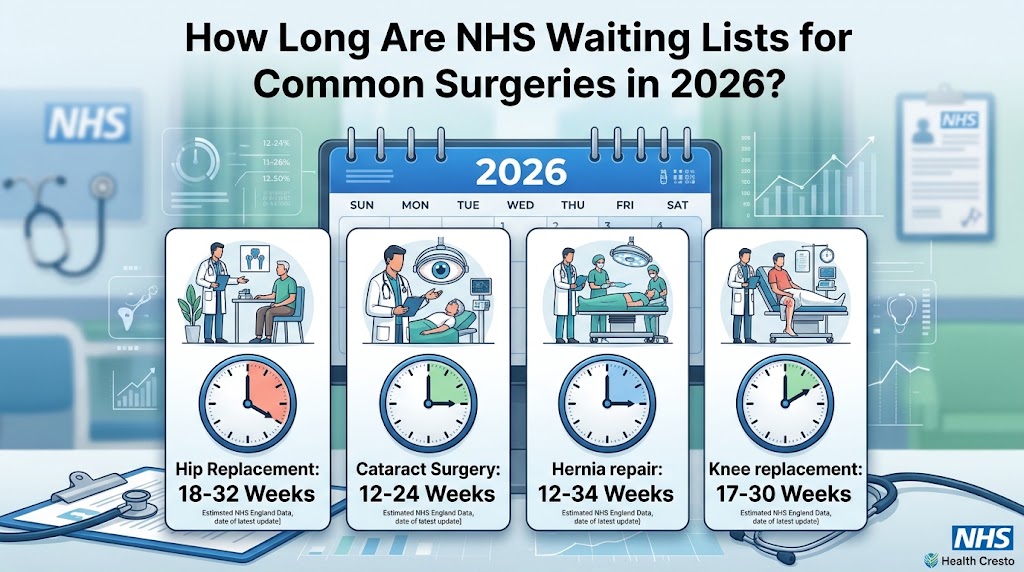
NHS waiting lists for surgery 2026 remain a major concern for patients across the UK in 2026. Whether you need a hip replacement, knee surgery, cataract removal or a hernia repair, the time between your GP referral and receiving treatment can vary considerably depending on your condition, hospital and clinical priority.
In England, the latest available figures for August 2026 show approximately 7.19 million referral-to-treatment pathways on NHS waiting lists. Around 65.2% of patients waiting for consultant-led treatment had been waiting 18 weeks or less, while approximately 112,958 pathways had exceeded 52 weeks. These figures describe treatment pathways, not necessarily unique individuals. NHSQueue+1
So, how long might you have to wait for common NHS surgeries in 2026? And what can you do if your symptoms worsen or your operation is delayed?
This guide explains typical waiting times, your rights as an NHS patient, how to check hospital waiting lists and the options available if you need treatment sooner.
Quick answer: How long are NHS waiting lists for surgery 2026?
NHS surgery waiting times in England vary by specialty. The latest August 2026 data indicates that the median wait among patients still waiting was approximately 10–16 weeks across several major surgical specialties. Individual waits can be substantially shorter or longer. NHSQueue+1
The table below provides a useful starting point.
| Surgery or specialty | Indicative median waiting time in England |
|---|---|
| Cataract surgery (ophthalmology) | 10.4 weeks |
| Hip replacement (trauma and orthopaedics) | 13.9 weeks |
| Knee replacement (trauma and orthopaedics) | 13.9 weeks |
| Hernia repair (general surgery) | 12.8 weeks |
| Gallbladder removal (general surgery) | 12.8 weeks |
| Hysterectomy (gynaecology) | 14.2 weeks |
| Tonsillectomy (ENT) | 15.4 weeks |
| Wisdom teeth removal (oral surgery) | 16.4 weeks |
Source: NHS England specialty waiting-list data for August 2026, presented through NHSQueue. Figures are specialty-level medians for people still waiting, not procedure-specific promises or the total time from first GP appointment to surgery. NHSQueue+1
What does this mean? A median wait of 12.8 weeks does not mean every patient will receive surgery within 12.8 weeks. Some patients will be treated sooner, while others may wait considerably longer.
These figures relate to England. NHS Scotland, Wales and Northern Ireland have different waiting-time reporting systems, policies and targets.
1. What are NHS waiting lists like in 2026?
NHS waiting lists include people who have been referred for consultant-led hospital treatment but have not yet started treatment.
The latest available England figures for August 2026 indicate:
- 7.19 million waiting pathways across consultant-led services.
- 65.2% waiting 18 weeks or less.
- 112,958 pathways exceeding 52 weeks.
- A median waiting time of approximately 12.2 weeks among patients still waiting across all specialties. NHSQueue+1
These figures show that many patients receive treatment within several months, but a substantial number continue to experience longer delays.
The overall waiting-list figure covers a wide range of services, not just surgery. It includes different specialties and stages of the treatment pathway.
Waiting times can be affected by:
- The type and complexity of the operation.
- Whether the condition is urgent or routine.
- The number of patients already waiting at the hospital.
- The availability of surgeons, theatre staff and beds.
- Additional scans, tests or pre-operative assessments.
- Whether your condition requires further monitoring before surgery.
For more information about navigating NHS services, read our guide on how to get a second opinion on the NHS.
2. How long is the NHS waiting list for hip replacement surgery?

Hip replacement surgery is commonly offered to people with severe arthritis or other hip conditions that cause persistent pain, stiffness and difficulty walking.
In England, the latest August 2026 figures show a median waiting time of approximately 13.9 weeks for the trauma and orthopaedics specialty. This is a specialty-wide figure rather than a median calculated exclusively for hip replacements. NHSQueue+1
Your individual waiting time may depend on the severity of your symptoms, the hospital’s capacity and whether your consultant considers surgery clinically urgent.
What can you do while waiting for a hip replacement?
Depending on your circumstances, your healthcare team may recommend:
- Appropriate low-impact physical activity.
- Physiotherapy or exercises tailored to your mobility.
- Suitable pain relief following advice from a healthcare professional.
- Using a walking aid if recommended.
- Reviewing your symptoms with your GP if pain or mobility deteriorates.
Do not assume you must simply tolerate worsening pain until your operation date. Contact your GP or hospital team if your condition changes significantly.
3. How long is the NHS waiting list for knee replacement surgery?

Knee replacement surgery may be recommended when severe arthritis or joint damage causes persistent pain and limits everyday activities.
The latest England-wide trauma and orthopaedics specialty median was approximately 13.9 weeks in August 2026. However, the actual wait for knee replacement surgery can differ from this figure. NHSQueue+1
Your waiting time may depend on the extent of joint damage, the impact on your daily life, your fitness for surgery and local hospital capacity.
How can you manage knee pain while waiting?
Your GP or physiotherapist may recommend suitable exercises, mobility support, weight management where appropriate or pain-relief options based on your medical history.
If excess weight is contributing to joint symptoms, our guide to NHS-approved weight-loss programmes explains some of the support available.
Weight loss is not a requirement for every patient, and you should not delay necessary treatment without discussing the decision with your clinical team.
4. How long is the NHS waiting list for cataract surgery?

Cataract surgery treats clouding of the eye’s natural lens, which can cause blurred vision, glare and difficulty seeing clearly.
In England, the median wait for the ophthalmology specialty was approximately 10.4 weeks in August 2026. This figure covers ophthalmology services generally and is not an exact waiting-time estimate for every cataract patient. NHSQueue+1
Your wait may depend on how significantly your vision is affected, the results of your eye assessment and the availability of surgical appointments.
When should you seek help while waiting?
Contact your eye-care team if your vision deteriorates or your symptoms begin to interfere more significantly with daily activities.
Sudden vision loss, severe eye pain or a sudden deterioration in vision needs urgent medical assessment. Do not wait for a routine cataract appointment if these symptoms develop.
5. How long is the NHS waiting list for hernia repair?

Hernia repair may be recommended when tissue pushes through a weakened area of muscle or surrounding tissue. The need for surgery and its timing depend on the type of hernia, symptoms and risk of complications.
The general surgery specialty had a median wait of approximately 12.8 weeks in England in August 2026. This includes a range of general surgical procedures, so it should not be interpreted as a guaranteed wait for hernia repair. NHSQueue+1
Some hernias can be monitored, while others require planned or urgent surgery.
Seek emergency medical care if you have a hernia accompanied by sudden or severe pain, vomiting, abdominal swelling, or a lump that becomes firm, tender or cannot be pushed back in. These may indicate a serious complication.
6. How long is the NHS waiting list for gallbladder removal?
Gallbladder removal, also known as a cholecystectomy, is commonly used to treat symptomatic gallstones and related complications.
The latest general surgery specialty median in England was approximately 12.8 weeks in August 2026. Actual waits for gallbladder removal vary according to symptoms, clinical priority and hospital capacity. NHSQueue+1
Patients with recurrent gallstone attacks may have different clinical needs from those with a complication requiring urgent treatment.
Seek urgent assessment if you develop severe or persistent abdominal pain, fever, yellowing of the skin or eyes, or repeated vomiting.
7. How long is the NHS waiting list for hysterectomy?

A hysterectomy is an operation to remove the uterus. It may be recommended for certain gynaecological conditions, including severe symptoms that have not improved with other treatments.
The gynaecology specialty had a median waiting time of approximately 14.2 weeks in England in August 2026. This is not a hysterectomy-specific median, and individual waiting times can differ considerably. NHSQueue+1
The type of condition, severity of symptoms, recommended surgical approach and need for additional investigations may all influence the timeline.
If you are waiting for surgery for heavy bleeding, pelvic pain or suspected endometriosis, report worsening symptoms to your clinical team. Read our related guide to endometriosis diagnosis in the UK.
8. How long is the NHS waiting list for tonsillectomy?
Tonsillectomy is an operation to remove the tonsils. It may be considered for selected patients with recurrent severe tonsillitis or other qualifying problems.
The ear, nose and throat (ENT) specialty had a median waiting time of approximately 15.4 weeks in England in August 2026. This includes procedures beyond tonsillectomy, so your personal wait may be different. NHSQueue+1
The decision to operate depends on your symptoms, medical history, clinical assessment and the likely benefits and risks of surgery.
Seek urgent medical advice if you develop difficulty breathing or cannot swallow fluids. Severe breathing difficulties require emergency assistance.
9. Why can two patients wait different lengths of time for the same surgery?
Two patients referred for the same operation can receive very different appointment dates.
This happens because NHS waiting lists are not always processed in a simple first-come, first-served order. Clinical urgency, treatment suitability and operational capacity can affect when surgery takes place.
Common reasons include:
Clinical priority: A patient whose condition is deteriorating or poses a greater clinical risk may need earlier treatment.
Hospital capacity: The number of available operating theatres, surgeons, anaesthetists and recovery beds affects how many procedures can be completed.
Pre-operative preparation: Some patients need further tests, specialist reviews or medical optimisation before surgery.
Different hospitals: Waiting times vary between NHS trusts and individual services.
Changes in health: A new symptom or a deterioration in your condition may require reassessment of your clinical priority.
If you are concerned about your symptoms while waiting, contact your GP or hospital team rather than relying solely on published waiting-time figures.
10. What is the NHS 18-week waiting-time rule?
In England, the NHS Constitution gives patients a right to start non-urgent, consultant-led treatment within 18 weeks of referral, subject to specified exceptions. If this is not possible, the responsible NHS commissioner must take reasonable steps to offer a suitable alternative provider where the rules apply. GOV.UK+1
The 18-week period generally starts when the hospital or service receives the referral, or when the appointment is booked through the NHS e-Referral Service, depending on the referral route.
It is important to understand that the 18-week standard is not a guarantee that every patient will have surgery exactly 18 weeks after seeing their GP. The referral-to-treatment pathway can include specialist appointments, investigations and decisions about the most appropriate treatment.
Exceptions can apply, including when:
- You choose to wait longer.
- Delaying treatment is considered clinically appropriate.
- You need additional monitoring before treatment.
- You do not attend appointments you have agreed to.
- Treatment is no longer required.
The detailed rules are explained in the official NHS guide to waiting times in England.
11. How can you reduce your NHS surgery waiting time?
You cannot guarantee an earlier operation, but you can take practical steps to understand your position and explore appropriate alternatives.
Step 1: Contact your hospital team
Ask whether you remain on the waiting list, whether your referral has been assessed and whether the hospital can provide an estimated timeframe.
Ask if there are any outstanding tests, assessments or actions that you need to complete.
Step 2: Ask about your NHS patient-choice rights
If you have waited, or expect to wait, more than 18 weeks for eligible consultant-led treatment, you can ask about being referred to a different NHS-funded provider that may be able to treat you sooner.
The alternative must be clinically appropriate and covered by the relevant NHS arrangements. Availability is not guaranteed. GOV.UK+1
Step 3: Compare hospital waiting times
Published NHS England statistics can help you compare providers and specialties. However, a hospital with a shorter overall waiting time may not necessarily have an earlier appointment for your specific operation.
Start with the NHS England referral-to-treatment statistics.
Step 4: Tell your GP if your condition worsens
If pain, mobility, bleeding or other symptoms become worse, arrange a clinical review. Your GP can assess whether your condition requires a change in management or communication with your specialist team.
Do not exaggerate symptoms to obtain an earlier appointment. Explain clearly what has changed and how it affects your daily life.
Step 5: Understand the private treatment option
Some patients consider private surgery to avoid a long wait. Before making a decision, request a full written estimate that covers the surgeon, anaesthetist, hospital, tests, follow-up care and potential complications.
Private treatment is not always the fastest or most appropriate option, and costs vary considerably.
Step 6: Do not miss appointments
Attend scheduled appointments or notify the hospital as soon as possible if you cannot attend. Missed appointments can disrupt care and may affect your place on the pathway under applicable NHS rules.
For urgent symptoms or uncertainty about where to seek help, read our guide to NHS 111 vs A&E vs your GP.
12. What should you do if your NHS operation is delayed?
If your operation has been postponed, contact the hospital team to confirm why it was delayed and what happens next.
Ask these questions:
- Am I still on the waiting list?
- Has my clinical priority changed?
- Do I need any new tests or pre-operative assessments?
- Can another NHS-funded hospital provide the operation sooner?
- Who should I contact if my symptoms worsen?
- Is there an updated estimate for my treatment date?
If the delay is causing substantial physical or emotional strain, tell your GP. They may be able to review your symptoms and help you access appropriate support.
For further information about mental health support during long waits, see our guide to free mental health support in the UK.
13. Are NHS waiting times different across the UK?
Yes. NHS England waiting-time statistics apply to England and should not be used as a direct measure of waiting times in Scotland, Wales or Northern Ireland.
Each nation has its own health service arrangements, reporting systems and waiting-time policies. Your local health board or trust is the best starting point for understanding your position.
Even within England, waiting times can differ by hospital, specialty and procedure.
If you have received a referral, ask your hospital which waiting-time standard applies to your treatment and where you can check the latest information.
FAQ section for SEO, AEO and GEO
These questions use natural-language search queries to help readers find direct answers. Keep the FAQ visible on the published page if you include it in your structured data.
How long is the average NHS waiting lists for surgery 2026?
In England, the median wait among patients still waiting for consultant-led treatment was approximately 12.2 weeks in August 2026. Waiting times vary by specialty and hospital, and individual patients may wait much longer. NHSQueue+1
Which NHS surgeries have the shortest waiting times?
In the August 2026 figures, ophthalmology had a specialty-level median of approximately 10.4 weeks, while other surgical specialties had different median waits. These figures do not establish the shortest wait for every individual procedure or hospital. NHSQueue
Can I change hospitals if my NHS surgery is delayed?
Yes, in eligible cases. In England, patients who have waited or expect to wait more than 18 weeks for consultant-led treatment can ask about an alternative NHS-funded provider that may treat them sooner. Exceptions apply, and an earlier appointment is not guaranteed. GOV.UK+1
Does the NHS 18-week rule mean my operation must happen within 18 weeks?
The 18-week right generally concerns starting consultant-led treatment from referral, rather than guaranteeing surgery within 18 weeks of the first GP appointment. The rules include exceptions, and the appropriate timeline depends on your circumstances. GOV.UK+1
Can I check NHS waiting times for my local hospital?
Yes. You can use NHS England’s published referral-to-treatment statistics to compare waiting times by hospital and specialty. Published figures are historical indicators and do not guarantee an individual appointment date. NHS England+1
What should I do if my condition gets worse while I am waiting for surgery?
Contact your GP or hospital team promptly and explain what has changed. They can assess your symptoms and determine whether your care needs to be reviewed. Seek emergency medical care for serious symptoms, such as severe abdominal pain with vomiting or sudden vision loss.
Are NHS waiting lists the same across the UK?
No. England, Scotland, Wales and Northern Ireland have different waiting-time reporting systems and healthcare arrangements. Check the relevant NHS service or health board for your location.
Can I pay for private surgery instead of waiting for the NHS?
Private surgery may be an option, depending on your circumstances and the availability of a suitable provider. Request a full written quotation and clarify what is included, including consultations, anaesthesia, follow-up appointments and possible additional costs.
Conclusion: How long will you wait for NHS surgery in 2026?
NHS waiting times for common surgeries in 2026 vary depending on the procedure, your clinical needs and the hospital providing treatment. The latest August figures for England suggest specialty-level median waits of approximately 10–16 weeks across several common surgical services, but some patients wait considerably longer.
Remember that these figures are estimates based on people still waiting, not a promise of when your surgery will take place. Your own treatment timeline may be different.
If you are waiting for surgery, contact your hospital for an updated estimate, report any deterioration in your symptoms and ask about your right to an alternative NHS-funded provider if the 18-week standard applies to your case.