
NHS 111 vs A&E vs GP is an important distinction when you need medical help in the UK. The right service depends on how serious your symptoms are, how quickly you need treatment and whether your condition is life-threatening.
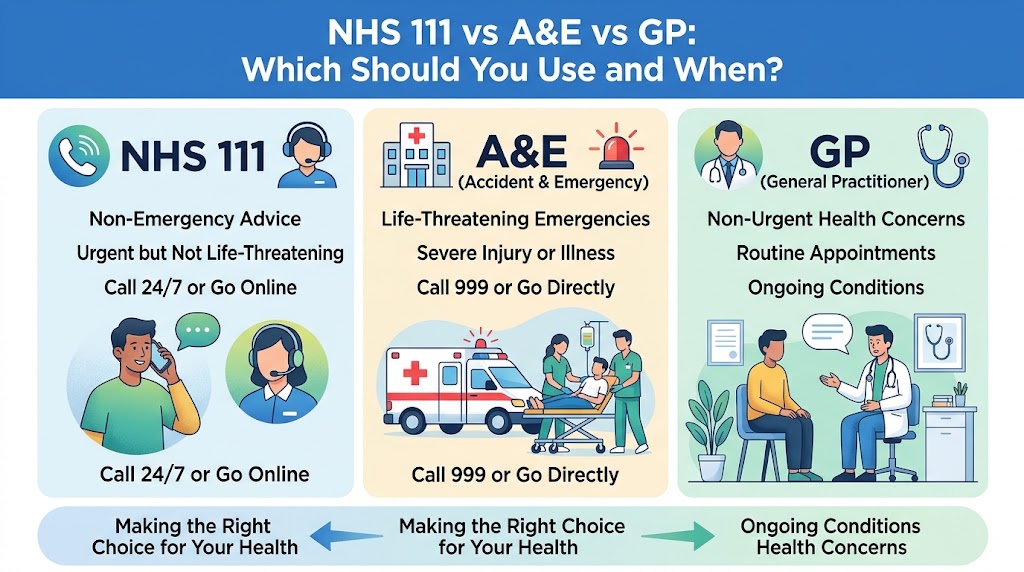
Call 999 or go to A&E for serious or life-threatening emergencies. Use NHS 111 for urgent medical advice when you are unsure what to do or need help outside normal GP hours. Contact your GP for routine health concerns, ongoing symptoms, prescriptions and long-term condition management.
Choosing the appropriate service can help you get the right care without unnecessary delays. This guide explains when to use each NHS service, what happens when you contact them and where to turn when your usual GP surgery is closed.
Important: If someone is unconscious, is not breathing normally, has severe difficulty breathing or has signs of a stroke, call 999 immediately. Do not delay emergency treatment to use NHS 111.
NHS 111 vs A&E vs GP: What’s the difference?
The main difference is the urgency and severity of your medical problem.
NHS 111 — urgent medical advice
Use NHS 111 when you need medical help urgently but the situation does not appear immediately life-threatening. It can direct you to an appropriate service, including an urgent treatment centre or an out-of-hours GP where available.
Access: Call 111 or use NHS 111 online.
A&E — serious injuries and emergencies
Accident and Emergency departments assess and treat serious injuries and illnesses that need immediate hospital care. Examples include suspected heart attacks, strokes, severe bleeding and major injuries.
Access: Attend an emergency department or call 999 when emergency assistance is needed.
GP — routine and ongoing healthcare
Your general practitioner is usually the best starting point for non-emergency symptoms, repeat prescriptions, referrals, preventive care and ongoing health conditions.
Access: Contact your registered GP surgery or use its online consultation service if available.
When should you call NHS 111?
NHS 111 is designed for situations where you need urgent healthcare advice but do not know which service is most appropriate.
You can call 111 or use the online service at 111.nhs.uk. The service asks questions about your symptoms and helps identify the next appropriate step.
When to use NHS 111
Consider contacting NHS 111 if:
- You have a worsening infection and need urgent assessment.
- You develop a painful ear, throat or urinary symptom that needs prompt advice.
- You have a minor injury and are unsure whether you need an urgent treatment centre.
- You need urgent medical advice when your GP surgery is closed.
- You are unsure whether your symptoms require a GP appointment, urgent treatment or hospital assessment.
- You need advice about an urgent health concern that cannot reasonably wait for a routine appointment.
NHS 111 may direct you to a pharmacist, GP, out-of-hours service, urgent treatment centre or A&E, depending on your symptoms and local service availability.
Can NHS 111 book an appointment?
Depending on your assessment and local services, NHS 111 may arrange or direct you to an appropriate appointment. The options available vary by location and clinical need.
Can NHS 111 replace a GP?
No. NHS 111 helps with urgent advice and access to appropriate services. It does not replace your regular GP for continuing healthcare, routine reviews or long-term condition management.
When should you go to A&E?
A&E is for serious injuries and illnesses that need emergency hospital assessment. It is not generally intended for routine medical problems or conditions that can safely be managed by a GP or urgent treatment centre.
Symptoms that may require emergency care
Call 999 for suspected life-threatening emergencies, including:
- Heart attack: chest pressure or pain, particularly with breathlessness, sweating, nausea or pain spreading to the arm, back, neck or jaw.
- Stroke: sudden facial weakness, arm weakness or speech difficulty, even if the symptoms improve.
- Severe breathing difficulty: struggling to breathe, particularly if the person cannot speak normally.
- Unconsciousness: a person who cannot be woken or is not breathing normally.
- Severe bleeding: bleeding that is heavy or cannot be controlled.
- Major injuries: serious road traffic injuries, significant head injuries or suspected major fractures with severe complications.
- Severe allergic reaction: symptoms such as throat or tongue swelling, breathing difficulty or collapse.
Call 999 rather than driving yourself if you suspect a life-threatening emergency or need an ambulance.
For serious symptoms that require emergency assessment but are not immediately life-threatening, attend A&E when appropriate. If you are uncertain about the safest destination, seek urgent professional advice, provided doing so does not delay emergency care.
Should you go to A&E for chest pain?
New, unexplained or persistent chest pain can be a medical emergency. Call 999 if you suspect a heart attack, especially if pain is accompanied by breathlessness, sweating, nausea or pain spreading to other areas.
Do not assume chest pain is caused by stress or anxiety. Although anxiety can cause physical symptoms, serious causes must be considered.
Read our guide to panic attacks vs heart attack for further information. It is not a substitute for emergency assessment.
When should you contact your GP?
Your GP is usually the most appropriate service for non-emergency medical concerns, ongoing symptoms and preventive healthcare.
Contact your GP if your symptoms are not immediately life-threatening but need medical assessment, diagnosis, treatment or follow-up.
Common reasons to book a GP appointment
- Persistent cough, fatigue or unexplained changes in your health.
- Recurring headaches or digestive problems.
- Skin conditions such as eczema, acne or psoriasis.
- Mental health concerns, including anxiety and depression.
- Management of diabetes, asthma and other long-term conditions.
- Medication reviews and repeat prescriptions.
- Referral to a specialist when clinically appropriate.
- Screening, vaccinations and preventive health advice.
Your GP can assess your symptoms, arrange tests, prescribe treatment and refer you to specialist services when necessary.
For example, if you experience recurring eczema symptoms, your GP may help you identify triggers and discuss appropriate treatment. Read our guide to eczema flare-ups and NHS treatment options.
If you have diabetes, routine reviews are also important for monitoring your health and reducing the risk of complications. Our guide to type 2 diabetes remission in the UK explains another aspect of ongoing diabetes care.
What if you are not registered with a GP?
You can find out how to register with a local surgery and what information you may need in our guide on how to register with a GP in the UK.
If you need urgent medical advice before registration is complete, NHS 111 can help you identify an appropriate service. Do not delay emergency care while trying to register.
NHS 111 vs A&E vs GP: Quick comparison
| Healthcare service | Best for | How to access it |
|---|---|---|
| NHS 111 | Urgent advice when the right service is unclear | Call 111 or visit 111.nhs.uk |
| A&E | Serious injuries and emergency medical problems | Attend A&E when appropriate |
| 999 ambulance | Life-threatening emergencies | Call 999 |
| GP | Routine symptoms, diagnosis and ongoing care | Contact your GP surgery |
| Urgent treatment centre | Certain urgent illnesses and minor injuries | Check local availability or follow NHS 111 advice |
| Pharmacy | Advice and treatment for many minor conditions | Visit a participating pharmacy |
The NHS service you need depends on your symptoms, clinical urgency and the services available in your area. A&E departments prioritise patients according to clinical need, so waiting times may vary.
What is the difference between NHS 111 and 999?
NHS 111 and 999 serve different purposes.
NHS 111 helps you access urgent medical advice when you need help quickly but the situation is not clearly life-threatening. The service can recommend an appropriate next step based on your symptoms.
999 is for emergencies that require immediate assistance, including suspected heart attacks, strokes, severe breathing difficulties and unconsciousness.
Remember: If you believe someone is experiencing a life-threatening emergency, call 999. Do not use NHS 111 as an alternative to emergency services.
What is the difference between A&E and an urgent treatment centre?
An urgent treatment centre treats certain urgent but generally less serious conditions, including some minor injuries and illnesses.
Depending on the centre’s facilities and local arrangements, it may assess problems such as:
- Minor cuts and wounds.
- Sprains and strains.
- Suspected minor fractures.
- Minor burns.
- Certain infections or other urgent symptoms.
A&E is intended for more serious conditions that may need emergency hospital investigations, specialist teams or admission.
Not every urgent treatment centre offers the same services. Some require a referral, while others accept walk-in patients. Check local arrangements or contact NHS 111 if you are unsure where to go.
What should you do if your GP surgery is closed?
If your GP surgery is closed and you need urgent medical advice, you can contact NHS 111.
Depending on your symptoms and local arrangements, you may be directed to an out-of-hours GP, urgent treatment centre or another appropriate service.
For a health concern that can safely wait, you may be able to arrange a routine GP appointment when the surgery reopens.
For example, a persistent skin problem may need a GP review, while a sudden severe allergic reaction requires emergency assistance.
If you experience a significant deterioration in your condition, do not wait for your GP surgery to reopen. Seek urgent help or call 999 if the situation is life-threatening.
Can you use NHS 111 for children?
Yes. NHS 111 can help parents and carers decide where to seek urgent medical advice for a child.
Contact NHS 111 if your child needs urgent assessment and you are unsure which service to use. However, do not delay emergency care if your child has severe breathing difficulties, is unresponsive, has a seizure for the first time or has other signs of a life-threatening illness.
Babies and young children can become seriously unwell quickly. Seek prompt medical advice if you are concerned, particularly if your child is unusually drowsy, is struggling to breathe, has signs of dehydration or is getting worse.
For dental concerns, parents can also read our guide to children’s NHS dental care.
Can you use NHS 111 for mental health emergencies?
NHS 111 can help you access urgent mental health support in England. The mental health option is available through NHS 111, although the precise arrangements may vary across the UK.
If someone is in immediate danger, has seriously harmed themselves or requires emergency medical assistance, call 999 or attend A&E as appropriate.
For non-emergency mental health concerns, a GP can discuss symptoms, treatment and referrals. You can also explore our guides to free mental health support in the UK and how to talk to your GP about depression.
If you are concerned about your own safety or someone else’s, seek immediate help rather than waiting for a routine appointment.
How to choose the right NHS service: Practical examples
These examples can help you understand the differences between NHS 111, A&E and GP services. They are general guidance, not a diagnosis.
Example 1: A worsening sore throat
If symptoms are worsening and you need urgent advice, NHS 111 can help you decide whether you need a clinician, an urgent treatment centre or another service. If symptoms are mild and stable, a pharmacist or GP may be appropriate.
Example 2: Sudden facial drooping
Call 999 immediately if someone develops sudden facial weakness, arm weakness or speech difficulties. These can be signs of a stroke, even if they improve.
Example 3: Persistent fatigue
Arrange a GP appointment if fatigue persists, affects daily life or has no clear explanation. A clinician can assess possible causes and decide whether tests are needed.
Example 4: An urgent problem at night
Contact NHS 111 if you need urgent medical advice outside your GP’s opening hours and the problem is not life-threatening. Follow the service’s recommendations.
How to get the most from NHS services
To help healthcare professionals assess your situation, prepare the following information where possible:
- Your main symptoms and when they started.
- Whether the symptoms are getting better, staying the same or worsening.
- Any medicines you take and relevant allergies.
- Existing medical conditions.
- Your temperature or other measurements, if available and relevant.
- Any recent injuries, illnesses or changes in medication.
Give accurate information about your symptoms and explain if you feel significantly worse. If your condition deteriorates while waiting for advice or an appointment, seek help again; call 999 for a life-threatening emergency.
Frequently asked questions (FAQs)
Is NHS 111 the same as A&E?
No. NHS 111 provides urgent medical advice and helps you find the appropriate service. A&E treats serious injuries and emergencies requiring hospital assessment. Call 999 for life-threatening emergencies.

NHS+2
Should I call NHS 111 or my GP?
Contact your GP for routine medical concerns, ongoing symptoms and long-term condition reviews. Use NHS 111 when you need urgent medical advice, particularly outside normal GP opening hours or when you are unsure which service to use.
NHS+1
Is NHS 111 available 24 hours a day?
Yes. You can call NHS 111 at any time in England. NHS 111 online is also available for eligible users. Different arrangements apply in Scotland, Wales and Northern Ireland.
NHS+1
Can NHS 111 send you to A&E?
Yes. After assessing your symptoms, NHS 111 may advise you to attend A&E or direct you to another suitable service. If you are experiencing a life-threatening emergency, call 999 rather than waiting for an NHS 111 assessment.
NHS+1
Can I go straight to A&E without calling NHS 111?
Yes. You can attend A&E directly when you need emergency hospital assessment. If someone has a life-threatening condition, call 999. You do not need to call NHS 111 first.
NHS+1
What should I do if my GP is closed?
If you need urgent medical advice that cannot wait until your GP reopens, call NHS 111 or use the online service if eligible. You may be directed to an out-of-hours GP or another appropriate service.
NHS+1
Can I use NHS 111 if I am not registered with a GP?
Yes. You can contact NHS 111 for urgent medical advice without being registered with a GP. If you need continuing healthcare, you should also arrange GP registration when possible.
NHS+1
Is NHS 111 free?
Yes. Calling NHS 111 is free from landlines and mobile phones. You can also access NHS 111 online through the official NHS website.

English_BL amended+1
Can NHS 111 help with a mental health crisis?
In England, you can call 111 and select the mental health option for urgent mental health support. If someone’s life is at risk or they cannot keep themselves or another person safe, call 999 or go to A&E
Conclusion: NHS 111 vs A&E vs GP
Understanding NHS 111 vs A&E vs GP can help you access appropriate healthcare when you need it.
- Call 999 for life-threatening emergencies.
- Use NHS 111 for urgent medical advice when you are unsure where to go or need help outside routine GP hours.
- Visit A&E for serious injuries and illnesses requiring emergency hospital assessment.
- Contact your GP for routine symptoms, ongoing health concerns, prescriptions and long-term condition management.
- Consider an urgent treatment centre or pharmacy for suitable minor injuries and illnesses, depending on local services and your needs.
When in doubt, prioritise safety. Do not delay emergency treatment because you are uncertain which NHS service to use.