

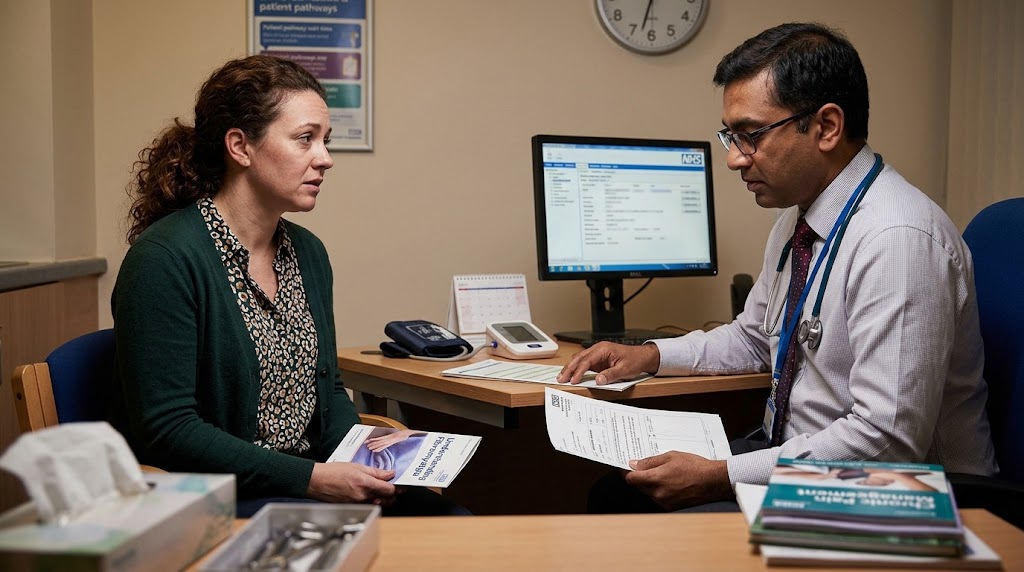
Fibromyalgia diagnosis UK can be a lengthy process for people experiencing persistent pain, overwhelming fatigue and poor sleep, particularly when medical tests fail to explain their symptoms. For many, getting diagnosed involves repeated GP appointments, blood tests and investigations to rule out other health conditions..
Fibromyalgia is a long-term condition associated with widespread pain, increased sensitivity to pain, fatigue, sleep difficulties and problems with memory or concentration. There is no single blood test or scan that confirms it, which can make diagnosis challenging. NHS+1
However, a lack of a definitive test does not mean that symptoms are imaginary or that a diagnosis is impossible. Healthcare professionals can assess the pattern, duration and impact of symptoms alongside a medical history and physical examination.
Quick answer: Why does fibromyalgia take so long to diagnose?
Fibromyalgia can take a long time to diagnose because its symptoms overlap with conditions such as rheumatoid arthritis, an underactive thyroid, vitamin deficiencies and myalgic encephalomyelitis or chronic fatigue syndrome (ME/CFS). Doctors may need to investigate these possibilities before reaching a diagnosis. There is no single test that confirms fibromyalgia, and symptoms can fluctuate or affect people differently. NHS+2
This guide explains how fibromyalgia is diagnosed on the NHS, which tests you may be offered, why delays happen and how to prepare for your next GP appointment.
What is fibromyalgia?
Fibromyalgia is a chronic condition associated with widespread pain and changes in how the nervous system processes pain signals. It can affect several areas of the body and interfere with sleep, energy levels, concentration, work and everyday activities.
The exact cause is not fully understood. Fibromyalgia can develop alongside other health conditions, and its symptoms may become more noticeable during periods of stress, disrupted sleep or changes in physical activity. NHS+2
Common symptoms include:
- Widespread muscle and body pain that persists or comes and goes.
- Fatigue that does not always improve after resting.
- Waking up feeling unrefreshed, even after sleeping for several hours.
- Stiffness, particularly after remaining in one position or waking up.
- Difficulty concentrating, remembering information or thinking clearly, sometimes called fibro-fog.
- Headaches, increased sensitivity to touch and digestive symptoms such as those associated with irritable bowel syndrome (IBS).
Not everyone experiences all these symptoms, and their severity can vary over time. NHS+1
If persistent pain is affecting your daily life, arrange a GP appointment rather than relying on self-diagnosis.
Why does fibromyalgia diagnosis UK take so long ?
There is no single reason for delays. The time needed to reach a diagnosis depends on a person’s symptoms, medical history, access to appointments and whether additional investigations are necessary.
1. There is no definitive fibromyalgia test
Unlike some conditions that can be confirmed using a specific laboratory test or scan, fibromyalgia is diagnosed primarily through clinical assessment.
Blood tests and imaging may help identify other causes of symptoms, but they cannot independently confirm fibromyalgia. As a result, doctors must consider the overall pattern of symptoms and the findings from an examination. NHS+1
2. Symptoms overlap with other health conditions
Widespread pain, fatigue and poor sleep can occur in several medical conditions. Before making a diagnosis, a GP may consider whether symptoms could be related to:
- Rheumatoid arthritis or another inflammatory condition.
- An underactive thyroid.
- Anaemia or certain nutritional deficiencies.
- ME/CFS.
- Other conditions affecting muscles, joints or the nervous system.
The investigations required depend on the symptoms and clinical findings. Not everyone needs the same tests, and having another condition does not automatically rule out fibromyalgia. Both can occur together. NHS+3
3. Symptoms can fluctuate
Some people experience persistent pain, while others have periods when symptoms improve and then worsen. Fatigue, sleep disruption and cognitive difficulties may also change over time.
When symptoms vary, it can be difficult to describe their full impact during a short appointment. Keeping a record of good days, difficult days and recurring symptoms may help your GP identify the broader pattern. NHS+1
4. Several appointments may be needed
A GP may need to review your medical history, examine you, arrange investigations and discuss the results at a follow-up appointment.
If symptoms remain unexplained or the clinical picture is complex, further assessment or specialist advice may be appropriate. This can add time, particularly when appointments or investigations are not immediately available.
There is no single UK-wide timeframe that applies to every fibromyalgia diagnosis. The process may be relatively straightforward for some people and more involved for others.
5. Fibromyalgia can coexist with other conditions
A person may have fibromyalgia alongside IBS, anxiety, depression, a sleep disorder or another chronic condition. These overlapping problems can make it harder to determine which symptoms are connected and which need separate assessment.
A thorough evaluation helps clinicians build a more complete picture and plan appropriate care. NHS+1
How is fibromyalgia diagnosed on the NHS?
If you think you may have fibromyalgia, your first step is usually to book an appointment with your GP. You do not need to be certain that you have the condition before asking for an assessment.
The diagnostic process commonly involves the following steps.
Step 1: Discuss your symptoms and medical history
Your GP will ask about the type of pain you experience, where it occurs, how long you have had it and how it affects your everyday life.
They may also ask about fatigue, sleep, concentration, previous illnesses, medications and other symptoms.
Be specific about how your health affects practical activities, such as climbing stairs, preparing meals, working or getting dressed.
Step 2: Have a physical examination
A GP may examine your joints and muscles, assess movement and look for signs that suggest another condition.
For example, visible joint swelling may indicate an inflammatory problem that needs further investigation. The examination helps guide decisions about whether additional tests are necessary. NHS+1
Step 3: Complete any recommended tests
There is no blood test specifically for fibromyalgia. However, your GP may recommend tests to investigate alternative or coexisting conditions.
| Investigation | Why it may be considered |
|---|---|
| Full blood count | To check for anaemia and other blood abnormalities |
| Thyroid function test | To investigate an underactive thyroid |
| Inflammatory markers, such as ESR or CRP | To look for evidence of inflammation when clinically indicated |
| Kidney, liver or other blood tests | To investigate symptoms or check for other medical conditions |
| Further investigations or imaging | If your symptoms or examination suggest a specific problem |
Not every patient needs every investigation. Your GP should choose tests based on your individual circumstances rather than ordering a standard battery of tests for everyone. NHS+2
Step 4: Review the findings and consider diagnostic criteria
A clinician will consider whether your symptoms fit fibromyalgia and whether another condition better explains them.
Commonly used diagnostic criteria consider widespread pain, the number of affected body areas, symptom severity and duration. Pain and associated symptoms generally need to have persisted for at least three months under commonly used criteria. NHS inform+1
The three-month period is not a guarantee of diagnosis at a particular appointment. A clinical assessment is still necessary.
Step 5: Agree on a diagnosis and care plan
If the overall assessment supports fibromyalgia, a clinician can explain the diagnosis and discuss symptom management.
A specialist referral is not automatically necessary for every person. Referral may be considered when symptoms are complex, the diagnosis remains uncertain or specialist input would help with management. RCP+2
Can you have fibromyalgia if your blood tests are normal?
Yes. Normal blood test results do not rule out fibromyalgia.
Fibromyalgia does not have a specific blood marker that doctors can use to confirm or exclude the condition. Blood tests are mainly used to investigate other possible explanations for symptoms.
For example, normal inflammatory markers do not by themselves establish a diagnosis of fibromyalgia, just as an abnormal result does not automatically exclude it. Results need to be interpreted alongside symptoms, examination findings and medical history. NHS+2
If your tests come back normal but you continue to experience widespread pain and fatigue, ask your GP what the results mean and what the next step should be.
You can also read HealthCresto’s guide to getting a second opinion on the NHS if you remain concerned that your symptoms have not been adequately assessed.
How long does a fibromyalgia diagnosis take in the UK?
There is no reliable fixed timeframe for everyone. Some people receive a diagnosis after a clinical assessment and relevant investigations, while others experience longer periods of uncertainty.
The process may take longer when:
- Symptoms are new, changing or difficult to characterise.
- Other conditions need to be investigated.
- Several appointments are needed to review test results.
- The person has multiple health conditions.
- Access to primary care or specialist services is delayed.
It is important to distinguish between time needed for medical assessment and time spent waiting for an appointment or referral. These are different parts of the process.
If you have been waiting without a clear plan, ask your GP when your results will be reviewed, whether further tests are needed and when you should return if symptoms continue.
What conditions can be mistaken for fibromyalgia?
Several conditions share symptoms with fibromyalgia. This does not mean that doctors should assume every case of widespread pain is caused by another illness. Instead, they should consider the features that make each diagnosis more or less likely.

Rheumatoid arthritis
Can cause joint pain, stiffness and swelling. A GP may look for inflammatory signs and arrange relevant blood tests or a specialist referral if indicated. NHS

Underactive thyroid
Can cause tiredness, muscle aches and other symptoms. A thyroid function blood test may help investigate this possibility.

Anaemia
Can contribute to fatigue, weakness and reduced exercise tolerance. A full blood count may be used to investigate it.

ME/CFS
Can involve severe fatigue, unrefreshing sleep, cognitive difficulties and symptoms that worsen after activity. Post-exertional symptom worsening is an important feature to discuss with a clinician. NHS+1

Irritable bowel syndrome (IBS)
Can cause abdominal pain, bloating and changes in bowel habits. IBS may coexist with fibromyalgia rather than replace it as a diagnosis. NHS+1
This list is not exhaustive. Your GP will decide which conditions need investigating based on your particular symptoms.
How to prepare for a fibromyalgia assessment
Preparing for an appointment can make it easier to explain symptoms that are difficult to describe or change from day to day.
Before your appointment, consider the following:
- Keep a symptom diary: Record where you experience pain, how severe it feels, how long it lasts and whether it affects sleep or concentration.
- Write down your main concerns: Include fatigue, stiffness, headaches, digestive symptoms and any other recurring problems.
- Bring a medication list: Include prescription medicines, over-the-counter treatments and supplements.
- Explain the effect on everyday life: Describe what you can no longer do comfortably, how often you need to rest and whether symptoms affect work or relationships.
- Take previous results if available: Include details of blood tests, scans and previous assessments.
- Ask what happens next: Find out whether further tests are needed, when results will be reviewed and how to arrange a follow-up.
You could say to your GP:
“I’ve been experiencing widespread pain and fatigue for several months, and it’s affecting my sleep and daily activities. I’d like to understand what might be causing these symptoms, whether fibromyalgia is a possibility and what investigations or follow-up would be appropriate.”
You do not need to use medical terminology or arrive with a self-diagnosis. A clear description of your symptoms is a useful starting point.
What should you do if your GP does not identify the cause?
If your symptoms continue but the initial assessment does not provide an explanation, you can ask for clarification and a plan for follow-up.
Consider these steps:
- Ask which conditions have been considered and whether any further investigations are appropriate.
- Explain if your symptoms have changed or are affecting your ability to manage everyday tasks.
- Arrange a review if symptoms persist, particularly if you were advised to return.
- Ask whether a second opinion or specialist assessment would be appropriate for your circumstances.
- Seek a fresh assessment if you develop new symptoms rather than assuming everything is caused by fibromyalgia.
HealthCresto’s guide on how to get a second opinion on the NHS explains how to discuss ongoing concerns about your care.
For help navigating NHS services, you can also read how to register with a GP in the UK.
What happens after a fibromyalgia diagnosis?
A diagnosis can help you and your healthcare team focus on managing symptoms, improving day-to-day function and identifying support that suits your needs.
Treatment is individualised. It may include education about the condition, pacing activities, suitable physical activity, sleep support and medication review.
NICE guidance for chronic primary pain recommends a person-centred approach and advises considering options such as supervised exercise programmes and, where appropriate, cognitive behavioural therapy (CBT) or acceptance and commitment therapy (ACT) for pain. These options should be discussed according to the individual’s needs and preferences. NICE+1
You may also benefit from:
- Activity management: Finding a sustainable balance between activity and rest.
- Sleep support: Discussing persistent sleep difficulties with your GP.
- Psychological support: Learning strategies for coping with chronic pain, stress and its effects on daily life.
- Workplace adjustments: Considering flexible hours, rest breaks or changes to duties if symptoms affect employment.
- Regular reviews: Revisiting your care plan if symptoms change or current strategies are not helping.
For additional reading, see HealthCresto’s guide to how stress affects the body. Stress can influence how pain is experienced, but that does not mean fibromyalgia is imaginary or that stress is necessarily its cause.
When should you seek urgent medical advice?
Do not automatically attribute new or severe symptoms to fibromyalgia, even if you already have a diagnosis.
Seek urgent medical advice if you develop a sudden or substantial change in your condition, a new unexplained symptom or symptoms that concern you. Call 999 or attend A&E for a life-threatening emergency, such as severe difficulty breathing, sudden weakness affecting one side of the body or severe chest pain.
For urgent medical advice that is not a life-threatening emergency, NHS 111 can help direct you to appropriate care. Your GP remains the usual starting point for non-emergency assessment of persistent widespread pain.
Read HealthCresto’s guide to NHS 111 vs A&E vs GP for more information about choosing the appropriate service.
Frequently asked questions (FAQ)
Why is fibromyalgia so difficult to diagnose?
Fibromyalgia is difficult to diagnose because there is no single test that confirms it, and its symptoms can resemble other conditions. Doctors assess the pattern and duration of symptoms, examine the patient and may arrange tests to investigate alternative or coexisting conditions. NHS+1
How long does it take to get diagnosed with fibromyalgia in the UK?
There is no fixed UK-wide timeframe. The process depends on the symptoms, investigations needed, clinical uncertainty and access to appointments. Some people receive a diagnosis following a relatively straightforward assessment, while others need further reviews.
Can a GP diagnose fibromyalgia on the NHS?
Yes. A GP can assess symptoms and may diagnose fibromyalgia when the clinical picture supports it. A specialist referral is not automatically required in every case, although specialist advice may be appropriate for complex or uncertain presentations. RCP+1
Can fibromyalgia be diagnosed with a blood test?
No. There is no specific blood test that confirms fibromyalgia. Blood tests may help investigate other conditions that can cause similar symptoms. NHS+1
Can you have fibromyalgia if all your tests are normal?
Yes. Normal test results do not rule out fibromyalgia. Diagnosis depends on clinical assessment, including symptoms, medical history and examination, alongside investigations where appropriate.
What symptoms should I tell my GP about?
Tell your GP about persistent or recurring widespread pain, fatigue, unrefreshing sleep, stiffness, concentration problems and any other symptoms affecting daily life. Explain how long they have been present and whether they are getting worse.
Do I need to see a rheumatologist for fibromyalgia?
Not necessarily. A GP may be able to assess and diagnose fibromyalgia. Referral to a rheumatologist or another specialist may be considered if there are signs of another condition, uncertainty about the diagnosis or a need for specialist input. RCP+1
Is fibromyalgia a real medical condition if scans and blood tests are normal?
Yes. Fibromyalgia is a recognised condition. Normal scans or blood tests do not mean that symptoms are imaginary; these investigations simply may not show the changes associated with fibromyalgia. NHS+1
What should I do if my GP dismisses my symptoms?
Explain how your symptoms affect everyday life, ask for clarification about the assessment and agree on a follow-up plan. If concerns remain unresolved, you can discuss whether another opinion or further assessment is appropriate.
Conclusion: Getting answers about fibromyalgia
Fibromyalgia diagnosis in the UK can take time because symptoms overlap with other conditions, there is no definitive diagnostic test and some people need multiple appointments or investigations. However, persistent widespread pain, fatigue and sleep difficulties deserve a careful assessment, even when initial blood tests are normal.
If you suspect fibromyalgia, keep a record of your symptoms, discuss their impact with your GP and ask for a clear plan for investigations and follow-up. You do not need to prove that you are unwell before seeking help.
A diagnosis may not happen immediately, but understanding your symptoms is an important step towards finding appropriate support and managing your health.