
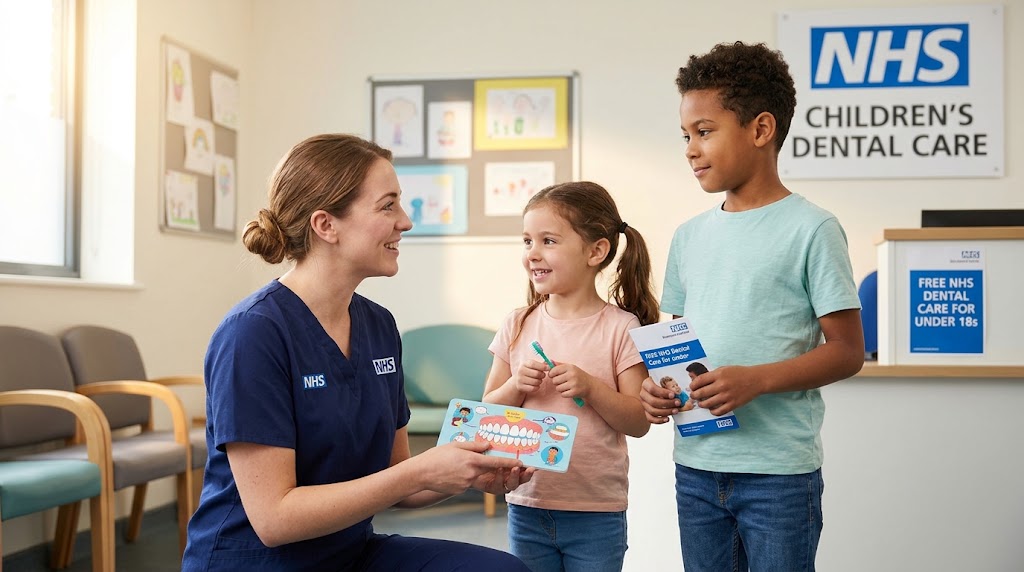
Children’s NHS dental care helps families access essential dental treatment without paying standard NHS dental charges. In England, NHS dental treatment is generally free for children under 18 and young people under 19 who are in full-time education. However, the rules differ across the UK, and not every dental service is automatically covered by the NHS.

NHS
+1
Understanding what is included can help parents arrange regular check-ups, identify dental problems early and make informed decisions about treatments such as fillings, tooth extractions and braces.
In this guide, HealthCresto explains what’s free, what may require private payment, how NHS orthodontic treatment works and how to find an NHS dentist for your child.
Is NHS dental care free for children in the UK?
Yes, children can receive free NHS dental care, but the eligibility rules depend on where they live.
In England, children under 18 generally qualify for free NHS dental treatment. Young people aged 18 may also qualify if they are in full-time education and meet the relevant conditions.
NHS
+1
Here is a quick overview of the rules across the UK.
| UK nation | Children’s NHS dental care |
|---|---|
| England | Generally free for under-18s and eligible under-19s in full-time education. |
| Scotland | NHS dental examinations are free, and NHS dental treatment is free for under-26s. |
| Wales | Children under 18 generally qualify for free NHS dental treatment. |
| Northern Ireland | Children under 18 generally qualify for free Health Service dental treatment, subject to the applicable eligibility rules. |
Rules and eligibility can change. Confirm the arrangements with your local dental service, particularly if your child is approaching the age limit. Scotland’s under-26 exemption and the different examination rules in Wales are explained in official NHS guidance.
NHSBSA FAQ
+1
What NHS dental treatments are free for children?
When treatment is clinically necessary and provided under the NHS, eligible children can receive a wide range of dental services without standard NHS patient charges.

1. Routine dental check-ups
Regular appointments help dentists monitor tooth development, assess gum health and identify early signs of tooth decay. A dentist can also advise parents on brushing, diet and preventive care.

2. Preventive dental treatment
Depending on the child’s needs, preventive care may include fluoride varnish, oral hygiene advice and other clinically appropriate measures to reduce the risk of cavities.

3. Fillings and treatment for tooth decay
If a child develops a cavity, the dentist can recommend an appropriate filling or another treatment based on the severity of the decay.

4. Dental X-rays when clinically necessary
X-rays may be used to investigate problems that cannot be fully assessed through a visual examination, such as decay between teeth or certain developmental concerns.

5. Tooth extractions and other necessary treatment
If a tooth cannot be saved or removal is clinically appropriate, an NHS dentist can assess the child and discuss the options. Other necessary treatments may include root canal treatment or care for a dental infection.
These are examples of treatments that may be included in NHS care. The dentist decides what is clinically appropriate after assessing the child. Eligibility for free treatment does not mean every requested or cosmetic procedure will be provided by the NHS.
NHSBSA FAQ
+2
For more information about tooth removal, read HealthCresto’s guide to wisdom tooth removal under the NHS.
What isn’t covered by free NHS dental care?
The key distinction is between treatment that is clinically necessary and treatment requested mainly for cosmetic reasons.
Eligible children do not usually pay standard NHS charges for covered NHS treatment. However, parents may need to pay privately if they choose a treatment that is not offered or provided under NHS arrangements.
Examples include:
- Cosmetic teeth whitening: Whitening for appearance is not a standard NHS dental treatment.
- Cosmetic veneers: Veneers requested solely to improve the appearance of teeth are generally private treatments.
- Non-NHS orthodontic options: A child who does not qualify for NHS braces may choose private orthodontic treatment.
- Optional cosmetic treatments: Procedures that are not clinically necessary may require private payment.
Always ask the dental practice to confirm whether a proposed procedure is NHS-funded or private before agreeing to treatment. A child who qualifies for free NHS dental care may still need to pay for a separate private procedure.
NHSBSA FAQ
+1
Are children’s NHS braces free?
NHS braces are free for children and young people under 18 who meet the clinical eligibility criteria. However, braces are not automatically available to every child who has crooked or crowded teeth.
NHS
+1
An orthodontist assesses whether the position of the teeth and jaws creates a sufficient clinical need for treatment. The assessment may consider difficulties with biting, chewing, cleaning the teeth and the severity of the alignment problem.
The usual process is:
- A dentist examines your child’s teeth and bite.
- If appropriate, the dentist refers your child to an orthodontist.
- The orthodontist assesses the severity of the problem and determines eligibility.
- If NHS treatment is approved, the orthodontist explains the available treatment and likely waiting time.
Waiting lists can be lengthy in some areas. If your child is not eligible for NHS braces, you can discuss monitoring, other clinically appropriate options or private treatment with a qualified dental professional.
NHS
+1
At what age should a child visit the dentist?
Parents should arrange a dental visit as soon as their baby’s first teeth appear, or by their first birthday. Starting early helps children become familiar with dental appointments and allows professionals to identify potential problems before they become more serious.
NHS
+1
Regular visits are important even when a child has no obvious dental pain. Your dentist will recommend how frequently your child should attend, based on their individual risk of tooth decay and other oral health concerns.
At home, parents can help protect their children’s teeth by:
- Brushing twice daily with an age-appropriate fluoride toothpaste.
- Supervising brushing until the child can clean their teeth effectively.
- Limiting sugary snacks and drinks, particularly between meals.
- Encouraging water as a regular drink.
- Attending recommended dental check-ups.
If you notice persistent toothache, swelling, visible cavities or sensitivity, contact a dentist rather than waiting for the next routine appointment.
How to find an NHS dentist for your child
Finding an NHS dentist can be challenging in some areas, so it is sensible to start looking before your child develops a dental problem.
Follow these steps:
- Search for local NHS dental practices. Use the official NHS Find a Dentist service.
- Ask whether the practice accepts children as NHS patients. Check whether it is currently taking new NHS patients.
- Explain your child’s needs. Mention whether you need a routine check-up, treatment for toothache or an orthodontic assessment.
- Ask about waiting times. If the practice cannot offer an appointment soon, ask whether it can advise you on other local services.
- Seek urgent care for serious symptoms. Do not delay assessment if your child has significant pain or a suspected dental infection.
For additional advice, see HealthCresto’s guides on finding an NHS dentist in 2026 and getting same-day NHS emergency dental treatment.
What should you do if your child has a dental emergency?
Dental problems can become painful quickly, especially when decay progresses or an infection develops.
Contact a dentist promptly if your child has persistent toothache, a broken tooth, gum swelling or pain that interferes with eating or sleeping.
Seek emergency medical care if your child develops severe swelling affecting breathing or swallowing, or other signs of a potentially life-threatening infection.
If a permanent tooth is knocked out, seek urgent dental advice immediately. Handle the tooth by the crown rather than the root, and do not attempt to reinsert a baby tooth.
Read our guide to emergency dentists in the UK for further information about accessing urgent dental services.
Is NHS dental treatment free for children under 18?
Yes. In England, children under 18 generally receive NHS dental treatment free of standard NHS charges. Different age-related arrangements apply in other UK nations.
Are children’s dental fillings free on the NHS?
Yes. Eligible children can receive clinically necessary NHS fillings without standard patient charges. The dentist will decide which treatment is appropriate.
Are braces free for children on the NHS?
NHS braces are free for eligible patients under 18 with a qualifying clinical need. An orthodontist assesses eligibility, so not every child with crooked teeth will qualify.
Do children have to pay for NHS dental check-ups?
In England, eligible children receive NHS dental check-ups without standard charges. Scotland and Wales also provide free NHS dental examinations under their respective rules.
Are private dental treatments free for children?
No. Treatments provided privately are not automatically free, even if the child qualifies for free NHS dental care. Ask the practice to clarify the treatment type and price.
When should I take my child to the dentist for the first time?
Arrange a dental visit when the first teeth appear, or by your child’s first birthday. Early appointments help establish healthy dental habits and identify potential problems.
How can I find an NHS dentist accepting children?
Use the official NHS Find a Dentist service and contact local practices to check whether they accept new NHS child patients.
Are children’s NHS dental rules the same throughout the UK?
No. England, Scotland, Wales and Northern Ireland have different eligibility and charging arrangements. Check the rules applicable to your child’s location.
How parents can reduce children’s dental costs
Although eligible children generally receive NHS dental care without standard patient charges, prevention remains important for protecting their oral health and reducing avoidable discomfort.
Practical steps include:
- Booking dental appointments regularly.
- Helping younger children brush effectively.
- Following advice on fluoride toothpaste and preventive treatments.
- Reducing frequent consumption of sugary foods and drinks.
- Seeking advice early when symptoms appear.
- Confirming that a proposed procedure is NHS-funded before agreeing to any private alternative.
Parents should also keep a record of dental appointments and any advice provided, particularly if a child is being monitored for orthodontic problems.
Conclusion
Children’s NHS dental care helps families access essential oral healthcare without standard NHS dental charges when the child is eligible and the treatment is provided under the NHS.
Routine examinations, clinically necessary fillings and other appropriate treatments can help protect developing teeth. NHS braces may also be available when an orthodontist identifies a qualifying clinical need.
The most important steps are to register your child with a dentist early, attend recommended check-ups and seek prompt advice when dental symptoms appear. If a treatment is described as private, ask why it is not available through the NHS and confirm the full cost before proceeding.