
Going to the dentist can feel frightening for some people. Even a routine check-up may cause sweating, a racing heartbeat, difficulty sleeping or an overwhelming urge to cancel the appointment. This experience is commonly known as dental anxiety, and it can affect people of all ages.
For some patients, the fear comes from a previous painful dental experience. Others worry about injections, dental instruments, drilling sounds, losing control or feeling embarrassed about the condition of their teeth. Whatever the reason, feeling nervous about dental treatment is nothing to be ashamed of.
The good news is that modern UK dentistry offers several ways to support nervous patients. Dentists can use gentle communication, shorter appointments, relaxation techniques, pain-control methods and, when clinically appropriate, sedation to make treatment more manageable.
If you have been avoiding dental appointments because of fear, understanding your options can be the first step towards getting comfortable with dental care again.
This guide explains why people experience dental anxiety, how NHS and private dentists support nervous patients, what sedation involves and where to find appropriate help in the UK.
What Is Dental Anxiety?
Dental anxiety describes feelings of worry, nervousness or fear associated with visiting a dentist or receiving dental treatment.
It can range from mild nervousness before an appointment to an intense fear that prevents someone from attending altogether.
Some people experience anxiety only during particular procedures, such as tooth extractions or injections. Others feel uncomfortable simply entering a dental practice or sitting in the waiting room.
Dental anxiety is different for everyone. It may involve:
- Feeling nervous several days before an appointment.
- Experiencing a racing heartbeat when entering a dental clinic.
- Sweating, shaking or feeling sick during treatment.
- Feeling uncomfortable when a dentist examines your mouth.
- Worrying about pain or unexpected dental procedures.
- Cancelling appointments repeatedly because of fear.
- Avoiding dental care for months or even years.
Severe fear may sometimes be described as dental phobia. This is when the emotional response becomes so overwhelming that accessing routine dental care feels extremely difficult.
Importantly, you do not need to have a diagnosed phobia to ask your dentist for additional support.

What Causes Dental Anxiety?
There is no single explanation for dental anxiety. It can develop through personal experiences, emotional responses, concerns about pain or other underlying factors.
Understanding what triggers your fear can help your dentist choose the most suitable approach.
1. Previous painful dental experiences
A painful or uncomfortable dental procedure can leave a lasting impression.
For example, someone who experienced inadequate pain relief during a tooth extraction may become frightened of future treatment, even when modern techniques can provide better comfort.
2. Fear of injections and needles
Some patients feel particularly anxious about local anaesthetic injections.
They may worry about the needle, the sensation of the injection or whether the anaesthetic will work properly.
Dentists can explain the process, discuss ways to reduce discomfort and allow patients to take breaks when needed.
3. Fear of losing control
Sitting in a dental chair with your mouth open can make you feel vulnerable.
You may worry that you cannot communicate properly, move comfortably or ask the dentist to stop.
Having an agreed stop signal and discussing each stage of treatment beforehand can help restore a sense of control.
4. Embarrassment about dental health
People who have not visited a dentist for several years may feel ashamed about tooth decay, missing teeth, bad breath or gum problems.
They might expect criticism or worry that treatment will be expensive.
A professional dentist should approach these situations without judgement and focus on helping you improve your oral health.
If bad breath is one of your concerns, our guide to bad breath causes and treatment explains some common underlying reasons.
5. Anxiety, stress and previous trauma
General anxiety, panic attacks and traumatic experiences can make dental appointments particularly difficult.
Some patients also have sensory sensitivities, which means bright lights, unfamiliar smells, equipment noises or physical contact can increase their discomfort.
A dentist who understands these concerns can discuss adjustments to make appointments more manageable.
How Do UK Dentists Help Nervous Patients?
Modern dental practices increasingly recognise that patients need more than technical treatment. They also need to feel safe, respected and involved in decisions about their care.
Managing dental anxiety may involve several approaches depending on the patient’s needs and the treatment required.
1. Talking through your fears before treatment
One of the simplest ways to make dental treatment easier is to discuss your concerns before the examination begins.
Your dentist may ask:
- Have you had a bad dental experience previously?
- Are you frightened of injections?
- Do particular sounds or instruments make you uncomfortable?
- Would you prefer the dentist to explain every step?
- Do you need regular breaks?
You can also explain whether you experience panic attacks, feel faint or have difficulty sitting in the dental chair.
This conversation helps the dental team understand your concerns and plan suitable support.
You do not have to explain everything perfectly. Simply saying, “I am frightened of the dentist” is enough to begin the conversation.
2. Using a stop signal during treatment
Patients sometimes worry that they will not be able to communicate once treatment starts.
Dentists can agree on a simple hand signal before beginning. For example, raising your left hand could mean that you need the dentist to stop.
This allows you to request a break whenever you feel uncomfortable.
Knowing that you can pause treatment can make dental anxiety easier to manage because you retain some control over what happens.
3. Starting with short appointments
If you have avoided dental care for a long time, immediately undergoing complicated treatment may feel overwhelming.
Your dentist may recommend starting with a short consultation rather than performing treatment straight away.
An initial appointment might involve:
- Discussing your concerns and medical history.
- Looking around the dental practice.
- Meeting the dentist and dental nurse.
- Having a simple examination if you feel comfortable.
- Discussing possible treatment options.
Some practices may arrange gradual appointments to help patients become familiar with the environment.
This approach can be particularly useful when fear has prevented someone from attending for several years.
4. Explaining procedures before they happen
Not knowing what will happen can increase fear.
A supportive dentist should explain the proposed treatment, why it is needed, what sensations you might experience and what pain-control options are available.
For example, if you need a filling, the dentist can explain how local anaesthetic works, how the tooth will be treated and approximately how long the appointment may take.
You can ask questions before agreeing to treatment.
5. Providing effective pain relief
Fear of pain is one of the most common reasons people avoid dental treatment.
Modern dentistry uses different pain-control techniques depending on the procedure.
Local anaesthetic is commonly used for treatments such as fillings, root canal procedures and extractions. It temporarily numbs the relevant area so you should not feel sharp pain during treatment.
If you experience discomfort, tell your dentist rather than trying to tolerate it silently.
Patients who are worried about painful procedures may also find our guide to root canal treatment and NHS costs helpful.
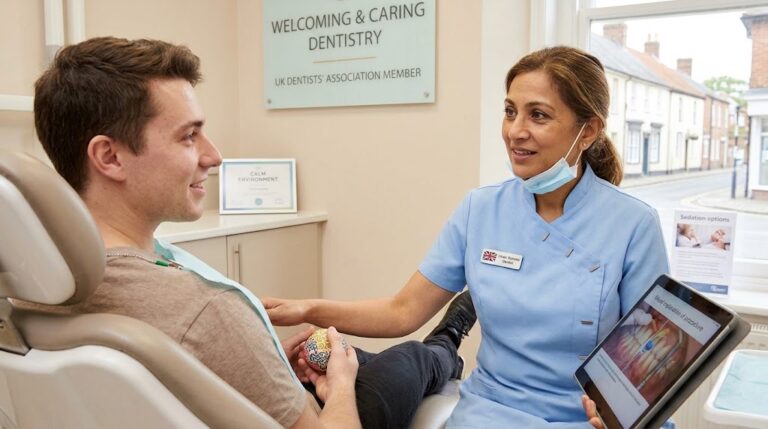
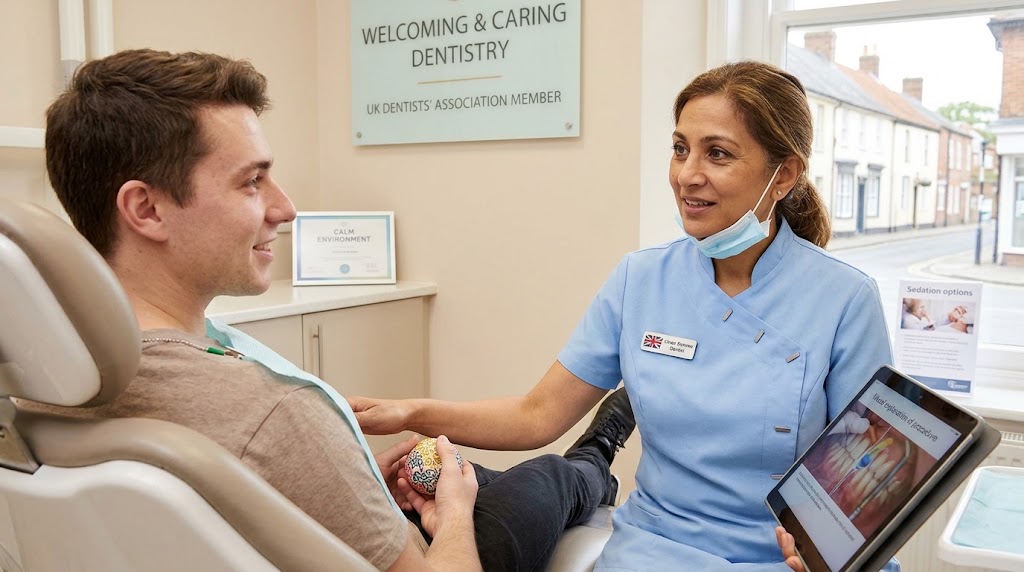
6. Creating a calmer dental environment
Small environmental changes can make a meaningful difference.
Depending on the practice, your dentist may be able to offer:
- A quieter appointment time.
- Headphones to listen to music.
- A comfortable position in the dental chair.
- Reduced exposure to unnecessary equipment.
- Additional time with the dental team.
- A dental nurse who can provide reassurance.
These adjustments are not guaranteed at every practice, but it is worth asking what can be arranged.
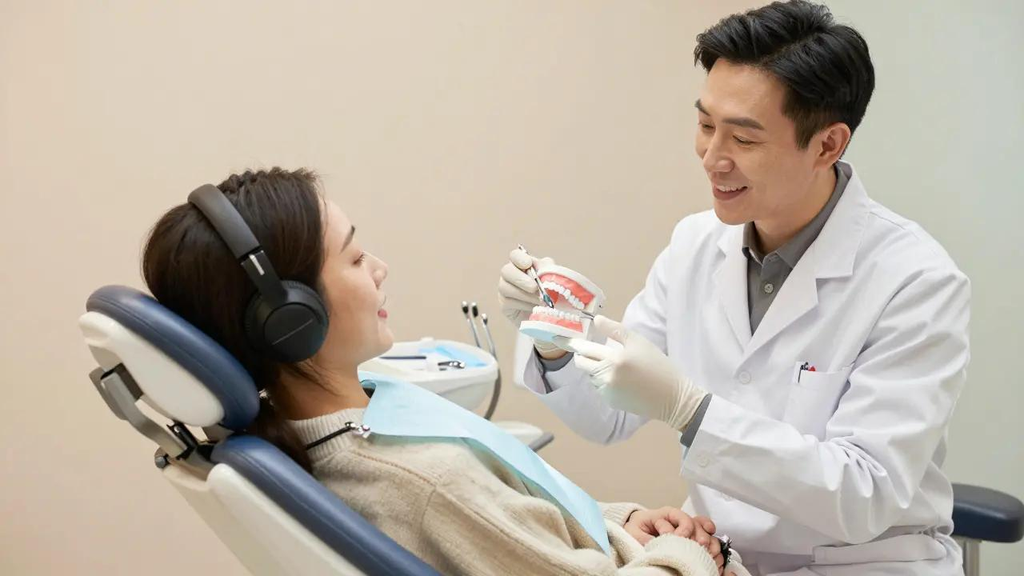
Suggested placement: Add this second image after the section about creating a calmer dental environment.
What Is Dental Sedation and Can It Help Nervous Patients?
For people with more severe dental anxiety, sedation may be an option.
Dental sedation uses medication to help patients feel calmer and more relaxed during treatment. It may be considered when other anxiety-management techniques are not sufficient or when the planned procedure requires additional support.
The most important thing to understand is that conscious sedation is not the same as general anaesthesia.
With conscious sedation, you remain conscious and can usually respond to instructions, although you may feel sleepy, relaxed or less aware of the procedure.
Your suitability depends on your medical history, anxiety level, treatment needs and the facilities available.
Types of dental sedation available in the UK
1. Inhalation sedation
Inhalation sedation involves breathing a mixture of oxygen and nitrous oxide through a small nosepiece.
It can help you feel relaxed during treatment while remaining conscious.
Some patients find this option helpful because it generally works relatively quickly and the effects wear off relatively quickly after the gas is stopped.
It is sometimes called relative analgesia or gas-and-air sedation.
2. Intravenous sedation
Intravenous (IV) sedation involves administering sedative medication through a small injection into a vein, usually in the hand or arm.
It can produce a deeper feeling of relaxation than some other methods.
You remain conscious during conscious sedation and should be able to respond to verbal instructions. Some patients remember very little about the procedure afterwards.
A responsible adult may need to accompany you home, and you will receive instructions about activities to avoid following treatment.
3. Oral sedation
In selected cases, a dentist may consider medication taken by mouth to help reduce anxiety.
Availability and suitability vary, and oral medication should only be used under appropriate clinical assessment and instructions.
4. General anaesthesia
General anaesthesia makes you unconscious during treatment.
It is not normally the first option for adults who are simply nervous about dental treatment. It may be considered in selected cases involving complex needs, significant treatment requirements or circumstances where other approaches are unsuitable.
NHS England guidance recommends considering behavioural support and conscious sedation before referral for general anaesthesia where appropriate. NHS England+1
For further information, see the Guy’s and St Thomas’ NHS guide to dental sedation.
Is Sedation Dentistry Available on the NHS?
Yes, NHS dental sedation is available in some circumstances, but it is not automatically offered to everyone who feels nervous.
Availability depends on clinical need, the patient’s medical history, the complexity of treatment and local NHS commissioning arrangements.
In England, NHS England’s clinical guide for dental anxiety management describes different approaches, including behavioural techniques, conscious sedation and referral for general anaesthesia when clinically appropriate.
A patient may need to be assessed by their general dentist before referral to a suitable sedation service.
In Scotland, NHS patients can also discuss their concerns with their dentist and ask about appropriate sedation services.
Wales and Northern Ireland have their own NHS dental service arrangements, so availability and referral pathways may differ.
Important: NHS sedation is not guaranteed, and some specialist services accept referrals only when specific clinical criteria are met.
If you cannot find an NHS dentist, our guide to how to find an NHS dentist in 2026 explains how to look for available services.
You can also read our guide to UK dental waiting lists to understand potential access difficulties.
NHS Dentist vs Private Dentist for Nervous Patients
Both NHS and private dentists can support patients who feel frightened about dental treatment.
However, the services, appointment arrangements and available anxiety-management options may differ.
| Feature | NHS dentist | Private dentist |
|---|---|---|
| Initial consultation | Available according to NHS arrangements | Depends on the practice |
| Gentle communication | Should be part of professional care | Should be part of professional care |
| Longer appointments | Depends on availability and clinical need | May offer more flexible scheduling |
| Conscious sedation | Available through selected services | Available at selected practices |
| Treatment costs | NHS charges or exemptions may apply | Practice-specific fees |
| Referral for specialist care | Through appropriate NHS pathways | Through private referral pathways |
Private dentistry does not automatically mean better anxiety support. Similarly, NHS treatment should not mean that your concerns are ignored.
Before choosing a practice, ask about experience supporting nervous patients, available appointment times, sedation options and the total cost of any proposed treatment.
For more information, read our guide to NHS dental charges in 2026.
10 Practical Ways to Overcome Dental Anxiety
Professional support is important, but there are also practical steps you can take before and during an appointment.
Here are ten ways to make your next dental visit easier.
1. Book an initial consultation
Start with a conversation rather than committing to treatment immediately. Explain your concerns and ask whether the dentist offers appointments for nervous patients.
2. Choose an appointment time carefully
Try to book a time when you are less likely to feel rushed. An early appointment may help if waiting increases your nervousness.
3. Be honest about your fear
Do not feel embarrassed about telling the dental team that you are frightened. They need this information to provide appropriate support.
4. Take someone you trust
Ask whether a friend or family member can accompany you. Having someone familiar nearby may help you feel more comfortable.
5. Practise slow breathing
Breathe gently through your nose and make your exhalation slightly longer than your inhalation. Avoid forcing deep breaths if that makes you feel uncomfortable.
6. Use headphones
Listening to familiar music or a relaxing podcast may help distract you from unfamiliar sounds.
7. Agree on a stop signal
Discuss a hand signal with your dentist so you can ask for a break without needing to speak.
8. Ask questions beforehand
Understanding the treatment process can reduce uncertainty. Ask about pain relief, appointment length and what will happen at each stage.
9. Take one step at a time
You do not need to complete every treatment during one appointment. Discuss whether treatment can be divided into smaller stages.
10. Celebrate progress
Attending a consultation after avoiding the dentist for years is a meaningful achievement. Recognise your progress, even if you still feel nervous.
These strategies can help reduce dental anxiety, although people with severe phobia may need additional professional support.
What Happens If You Avoid the Dentist Because of Fear?
Avoiding dental appointments may provide temporary relief, but it can create longer-term problems.
Small dental issues can become more complicated when they are not identified and treated early.
Potential consequences include:
- Tooth decay becoming more advanced.
- Gum disease developing or worsening.
- Toothache and sensitivity becoming more difficult to manage.
- Dental infections requiring urgent treatment.
- Difficulty eating comfortably.
- Reduced confidence when smiling or speaking.
For example, untreated tooth decay may eventually require more extensive treatment than an early filling.
If you experience tooth sensitivity, our article on tooth sensitivity and its causes explains when symptoms should be assessed.
Similarly, persistent dental pain should not be ignored. Our guide to dental emergencies and same-day NHS treatment explains where to seek urgent help.
Dental anxiety is understandable, but avoiding necessary care indefinitely can make the situation harder to manage.
When Should You Seek Professional Help for Dental Anxiety?
You should consider asking for additional support if fear is affecting your ability to maintain oral health.
Signs that you may benefit from professional help include:
- Repeatedly cancelling dental appointments.
- Experiencing panic symptoms before treatment.
- Avoiding dental care despite persistent pain.
- Feeling distressed when thinking about dental procedures.
- Being unable to tolerate routine examinations.
- Having a previous traumatic dental experience that continues to affect you.
Your dentist can assess your concerns and discuss suitable management options.
For severe or persistent dental phobia, psychological support may also be helpful. Cognitive behavioural therapy (CBT), delivered by an appropriately qualified professional, can help people understand and change unhelpful patterns of fear and avoidance.
If your anxiety affects other areas of life, you may also find our guide to early signs of anxiety useful.
How to Find a Dentist Who Treats Nervous Patients in the UK

Finding a suitable dentist can make a significant difference to your experience.
You can begin by:
- Searching for local NHS dental practices through the NHS website.
- Contacting practices directly and explaining your concerns.
- Asking whether they regularly treat nervous or phobic patients.
- Checking whether longer consultations or quieter appointments are available.
- Asking whether conscious sedation is offered or whether referrals are possible.
- Confirming treatment charges before agreeing to private care.
You can also check whether a dentist is registered with the General Dental Council (GDC).
For patients in England, the NHS website provides information about finding dental services. In Scotland, Wales and Northern Ireland, use the relevant national NHS dental service.
If you need urgent dental treatment, do not delay seeking help simply because you feel frightened. Explain your concerns when contacting the service so that staff can discuss appropriate support.
Frequently Asked Questions About Dental Anxiety
1. Can I tell my NHS dentist that I am frightened?
Yes. You should tell your dentist about your concerns before treatment begins. NHS dental professionals should listen to your worries and discuss ways to make the appointment more comfortable.
2. Can dentists treat patients with severe dental anxiety?
Yes, many dentists have experience supporting patients with significant fear. Depending on your needs, they may offer gradual appointments, behavioural techniques, additional pain relief or referral for sedation assessment.
3. Can I have dental treatment without feeling pain?
Dentists can use local anaesthetic to numb the treatment area for many procedures. You may experience pressure or movement, but you should not experience sharp pain. Tell your dentist if you feel discomfort.
4. Does dental sedation put you to sleep?
Conscious sedation does not usually make you unconscious. You remain conscious and able to respond to instructions, although you may feel relaxed or sleepy. General anaesthesia is different because it makes you unconscious.
5. Is dental sedation free on the NHS?
NHS sedation may be available when clinically appropriate, depending on the service and your eligibility. However, access is not guaranteed, and NHS dental charges or exemptions may apply according to the treatment and relevant national arrangements.
6. Can I take someone with me to a dental appointment?
Many practices allow patients to bring a friend or family member for reassurance, but arrangements vary. Ask the practice before your appointment.
7. What should I do if I have not visited a dentist for years?
Start by booking a consultation and explaining why you have avoided dental care. You do not need to apologise or feel embarrassed. A supportive dentist can assess your oral health and discuss treatment at a manageable pace.
8. Can dental anxiety be treated permanently?
Many people become more comfortable with dental visits through gradual exposure, supportive dental care and psychological techniques such as CBT. However, results differ between individuals, and some people may continue to need additional support.
9. Are private dentists better for nervous patients?
Not necessarily. Some private practices offer longer appointments or additional services, but NHS dentists can also provide compassionate care and appropriate anxiety management. Compare the services available rather than assuming one option is always better.
10. What if I have a dental emergency but am too frightened to attend?
Contact an urgent dental service or NHS 111 in England for advice about accessing urgent care. Explain your fear and ask what support can be arranged. If you have severe facial or neck swelling affecting breathing or swallowing, seek emergency medical help immediately.
Conclusion
Dental anxiety should never make you feel ashamed or prevent you from seeking the dental care you need. Whether your fear comes from a previous painful experience, injections, unfamiliar equipment or a general feeling of losing control, there are ways to make dental appointments more manageable.
UK dentists can support nervous patients through gentle communication, shorter appointments, effective pain relief, relaxation techniques and conscious sedation when clinically appropriate.
The most important step is to communicate your concerns openly. You can begin with a simple consultation, ask questions and agree on a treatment plan that respects your comfort and individual needs.