
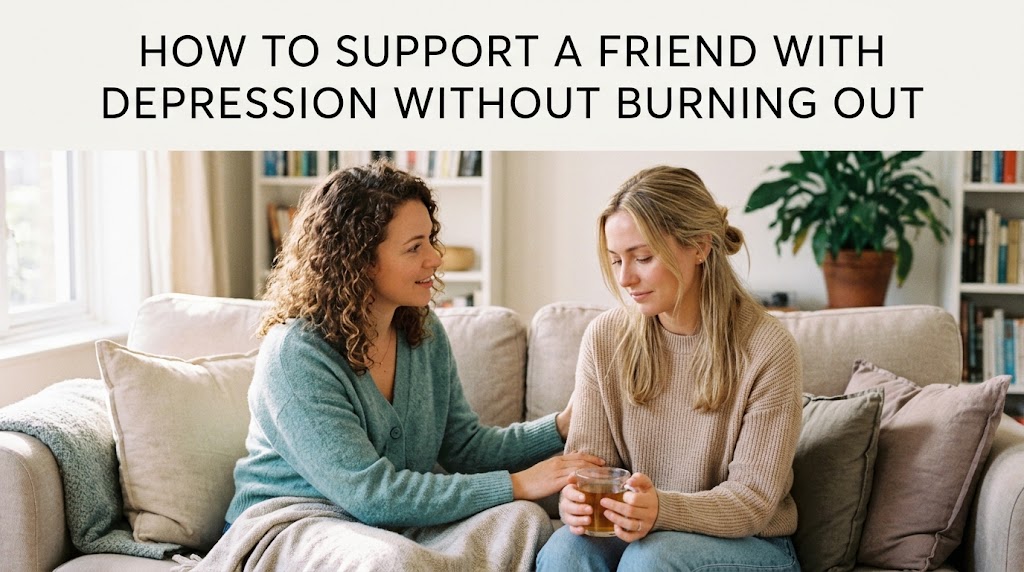
Supporting a friend with depression can be emotionally challenging, especially when you care deeply about them and want to make everything better. You may spend hours listening, checking in, offering advice and worrying about their wellbeing. However, providing constant emotional support can gradually affect your own mental health. Learning how to offer compassionate support while maintaining healthy boundaries can help you protect your wellbeing without abandoning someone you care about
Learning how to support a friend with depression without burning out means finding a healthy balance between compassion, practical help and personal boundaries. You can be a dependable friend without becoming their therapist, taking responsibility for their recovery or neglecting your own needs.
In the UK, there are several ways to help someone experiencing depression, including encouraging professional support through their GP, NHS Talking Therapies and mental health charities. Equally importantly, you can protect your wellbeing while remaining a supportive presence.
This guide explains how to recognise when a friend needs help, what to say, how to establish boundaries, where to find UK mental health support and how to recognise when a situation requires urgent intervention.

Quick Answer: How Can You Support a Friend With Depression Without Burning Out?
The healthiest way to support a friend with depression is to listen without judgement, stay connected, offer manageable practical help and encourage professional treatment when needed.
You should also:
- Set realistic limits on your time and emotional availability.
- Avoid taking responsibility for their recovery.
- Share the support role with trusted people where appropriate.
- Make time for sleep, exercise, relationships and activities you enjoy.
- Seek support for your own emotional wellbeing.
- Know where to access urgent mental health assistance if your friend is at risk.
Remember: You can support someone through depression without sacrificing your own mental health.
1. Understand What Your Friend Is Experiencing
Before deciding how to support a friend with depression, it helps to understand that depression is more than occasional sadness or having a difficult day.
Depression is a mental health condition that can affect how someone thinks, feels, behaves and manages everyday activities. It can influence relationships, employment, education, sleep, appetite and physical wellbeing.
Some people experience persistent sadness, while others may appear unusually quiet, irritable, withdrawn or emotionally exhausted.
According to the NHS, depression can involve symptoms lasting two weeks or longer and affecting everyday life.
Common signs your friend may be experiencing depression
You might notice that your friend:
- Stops enjoying activities they previously loved.
- Avoids social gatherings and conversations.
- Frequently expresses hopelessness or worthlessness.
- Experiences changes in sleeping patterns.
- Has difficulty concentrating or making decisions.
- Appears constantly tired or lacking motivation.
- Experiences changes in appetite or weight.
- Becomes unusually irritable or withdrawn.
- Struggles with work, education or everyday responsibilities.
- Talks about feeling like a burden or having no future.
Not everyone experiences depression in the same way. Some people continue working, socialising and fulfilling responsibilities while privately struggling.
If you notice these changes, approach your friend with kindness rather than making assumptions about their mental health.
For more information, read our guide to depression versus anxiety, which explains how these conditions differ and why they can sometimes occur together.
You may also find our article on depression symptoms in men versus women helpful for understanding differences in how depression can present.
2. Start a Conversation Without Making Your Friend Feel Judged
One of the most important steps when learning how to support a friend with depression is starting a conversation that makes them feel safe.
People experiencing depression may struggle to explain their emotions. They might worry about being judged, misunderstood or treated differently.
Instead of asking lots of questions or immediately offering solutions, create an opportunity for an honest conversation.
What should you say?
Try gentle, open-ended questions such as:
- “I’ve noticed you haven’t seemed yourself lately. How are you feeling?”
- “Would you like to talk about what’s been happening?”
- “Is there anything I can do to make things a little easier?”
- “You don’t have to pretend everything is fine around me.”
- “Would you prefer company or some time to yourself?”
These questions communicate concern without demanding an explanation.
What should you avoid saying?
Some seemingly positive comments can make someone with depression feel misunderstood.
Avoid statements such as:
- “Just think positively.”
- “Other people have worse problems.”
- “You have nothing to be depressed about.”
- “You need to get out more.”
- “Why can’t you simply move on?”
Although these comments may be intended to encourage someone, they can unintentionally minimise their feelings.
Instead, acknowledge their experience.
For example, say:
“I might not fully understand what you’re experiencing, but I care about you and I’m willing to listen.”
Remember: You do not need perfect words. Being patient, present and non-judgemental is often more valuable than giving advice.
3. Listen Without Trying to Fix Everything
When a friend discusses depression, your natural reaction may be to find solutions immediately.
You might suggest changing their routine, exercising more, getting a new job or speaking to a therapist.
Although practical suggestions can sometimes help, listening should come first.
A person experiencing depression may not have the energy to make decisions or follow complicated advice.
How to become a better listener
Try these approaches:
Give them your attention: Put away distractions and allow them to explain how they feel.
Avoid interrupting: Give your friend time to organise their thoughts, even when conversations become emotional.
Validate their feelings: You can acknowledge their pain without necessarily agreeing with every negative thought.
Ask what they need: Sometimes someone wants advice, while at other times they simply need company.
Respect silence: You do not need to fill every quiet moment with questions.
For example, you could say:
“Would you like me to help you think through this, or would you prefer me just to listen?”
This simple question helps prevent misunderstandings and makes your support more useful.
Learning how to support a friend with depression is not about having every answer. It is about helping them feel heard without taking responsibility for solving every problem.
4. Offer Small, Practical Ways to Help
Depression can make ordinary activities feel overwhelming.
Tasks such as preparing meals, answering messages, attending appointments or completing household chores may become difficult.
Rather than offering vague promises such as “Let me know if you need anything”, suggest specific, manageable forms of assistance.
Practical ways to support your friend
- Offer to prepare or share a simple meal.
- Invite them for a short walk.
- Help them organise an appointment with their GP.
- Offer to accompany them to an appointment if they would find it reassuring.
- Send a supportive message without expecting an immediate reply.
- Help with shopping or essential household tasks.
- Suggest watching a film or enjoying a quiet activity together.

Small gestures can make everyday life feel more manageable.
However, always ask before helping. Some people appreciate practical assistance, while others may feel uncomfortable if someone takes over their responsibilities.
The aim is to make life easier, not remove their independence.
You can also explore our guide to free mental health support in the UK to discover additional services that may help your friend.
5. Set Healthy Emotional Boundaries
This is one of the most important parts of supporting someone with depression.
You may feel that being a good friend means always answering calls, responding to messages immediately and being available whenever they need you.
However, constant availability can become emotionally exhausting.
Supporting a friend with depression should not mean sacrificing your sleep, work, relationships or personal wellbeing.
What do healthy boundaries look like?
Healthy boundaries might include:
- Deciding when you are available for conversations.
- Avoiding late-night conversations when you need to sleep.
- Explaining when you are unable to provide emotional support.
- Maintaining your existing commitments.
- Refusing requests that make you uncomfortable.
- Encouraging your friend to develop additional sources of support.
For example, you could say:
“I care about you, and I want to support you. However, I cannot always answer immediately because I also have work and personal responsibilities. I’ll get back to you when I can.”
Another useful response is:
“I can listen, but I think this is something a mental health professional could help you work through.”
These statements do not mean you are abandoning your friend.
They communicate that your friendship matters while recognising that you have limitations.
Why boundaries are important
Without healthy boundaries, you may begin experiencing:
- Emotional exhaustion.
- Constant worry about your friend’s wellbeing.
- Difficulty concentrating on your responsibilities.
- Resentment or frustration.
- Sleep disturbances.
- Anxiety about missing messages or calls.
- Reduced interest in your own social activities.
If you recognise these experiences, it may be time to reassess how much emotional responsibility you are carrying.
Our guide on recovering from burnout while still working provides further advice on recognising exhaustion and rebuilding healthier routines.
6. Recognise the Signs of Emotional Burnout in Yourself
Sometimes, the person supporting someone with depression can begin experiencing emotional difficulties of their own.
You might initially feel motivated to help. However, as weeks or months pass, the responsibility can become overwhelming.
Recognising emotional burnout early is essential if you want to continue supporting your friend in a sustainable way.
Common signs of caregiver or emotional burnout
Pay attention if you:
- Feel emotionally drained after every conversation.
- Constantly worry about your friend’s mental health.
- Feel guilty whenever you spend time on yourself.
- Experience irritability or frustration more frequently.
- Struggle to sleep because you are worrying.
- Avoid your own friends and family.
- Feel responsible for preventing every difficult situation.
- Lose interest in hobbies and activities you previously enjoyed.
- Feel that your friend’s problems are becoming your entire life.
- Experience persistent stress or anxiety.
These experiences do not mean you are a bad friend.
They may indicate that your current level of emotional involvement is becoming difficult to maintain.
If you recognise several of these signs, take a step back and consider what needs to change.
Learning how to support a friend with depression also means understanding when you need support yourself.
Emotional exhaustion versus ordinary tiredness
| Ordinary tiredness | Emotional exhaustion |
|---|---|
| Usually improves after rest | May continue despite resting |
| Often follows a busy day | Can build up over weeks or months |
| Does not necessarily affect relationships | May cause irritability and withdrawal |
| Usually temporary | Can affect everyday functioning |
If your own symptoms persist or interfere with daily life, consider speaking to your GP or accessing appropriate mental health support.
7. Do Not Become Your Friend’s Only Support System
One of the biggest mistakes people make when supporting someone with depression is becoming their only source of emotional support.
You may feel special because your friend trusts you. However, being their sole source of reassurance can create an unhealthy dependency.
Your friend deserves a wider support network, and you deserve time away from the emotional demands of supporting someone else.
Encourage a wider support network
Depending on your friend’s circumstances, you could encourage them to connect with:
- Family members they trust.
- Other close friends.
- Their GP.
- NHS mental health services.
- A qualified counsellor or therapist.
- Local depression support groups.
- Mental health charities and peer-support communities.

You can also help them identify people they feel comfortable contacting when you are unavailable.
For example, you might say:
“I am glad you feel comfortable talking to me. I also think it would help to have a few other people you can turn to, so you never feel that you have to depend on just one person.”
This approach is particularly important when learning how to support a friend with depression over an extended period.
Important: Do not share your friend’s private information without permission, except where you need to disclose information to protect someone from serious or immediate harm.
8. Encourage Professional Help Without Pressuring Them
Friendship and professional mental health treatment serve different purposes.
You can provide emotional reassurance, practical help and companionship. However, you cannot diagnose depression, prescribe medication or provide specialist psychological treatment.
If your friend’s symptoms are persistent or affecting everyday life, encourage them to speak to a healthcare professional.
How can someone access depression support in the UK?
There are several routes.
1. Contact their GP
A GP can discuss symptoms, assess their mental health, consider possible physical health factors and recommend suitable treatment.
You could offer to help them arrange an appointment or accompany them if they would find that helpful.
Read our guide on how to talk to your GP about depression for practical advice.
2. NHS Talking Therapies
In England, adults can generally self-refer to NHS Talking Therapies for conditions including depression and anxiety.
Depending on their needs, treatment may include cognitive behavioural therapy (CBT), counselling or other evidence-based approaches.
3. Medication when appropriate
A healthcare professional may recommend antidepressants, particularly when depression is moderate or severe.
Medication decisions should always be made with a qualified prescriber. Never encourage your friend to start, stop or change medication without medical advice.
4. Other mental health services
Some people may benefit from specialist community mental health services, local charities or structured peer support.
For more information, read:
- Can therapy help depression?
- How to get CBT on the NHS without a long waiting list
- How long does it take to get NHS therapy?
- NHS mental health waiting lists in 2026
If your friend is reluctant to seek help, try to understand their concerns. They may be worried about stigma, waiting times, confidentiality or being judged.
Offer reassurance without forcing them to accept treatment.
9. Make Time for Your Own Mental Health
Supporting someone else should not mean putting your own wellbeing last.
You need time to rest, enjoy your life and maintain relationships outside the friendship.
A healthy routine can make it easier to remain emotionally available without becoming overwhelmed.

Five practical self-care habits
1. Protect your sleep
Try to maintain regular sleeping hours. Avoid making yourself available throughout the night unless there is a genuine emergency requiring immediate action.
2. Maintain your social relationships
Continue spending time with family members and other friends. Do not allow your entire social life to revolve around one person’s mental health.
3. Stay physically active
Walking, cycling, swimming or another enjoyable activity can help support your own physical and mental wellbeing.
4. Make time for activities you enjoy
Read a book, watch a film, cook, pursue a hobby or spend time outdoors.
You do not need to feel guilty about enjoying your life while someone you care about is experiencing depression.
5. Talk about your own feelings
Find someone trustworthy to discuss your emotional experiences with. This could be a family member, counsellor or mental health professional.
You can talk about how supporting someone affects you while respecting your friend’s privacy.
If stress is becoming difficult to manage, our article about how stress affects the body may help you understand the connection between prolonged stress and physical wellbeing.
10. What to Do When Your Friend Rejects Help
It can be frustrating and upsetting when someone you care about refuses professional support.
You might have suggested speaking to a GP several times, offered to arrange an appointment or shared information about mental health services.
However, your friend may not feel ready.
There are several reasons someone with depression might avoid seeking help:
- They feel embarrassed about discussing their mental health.
- They believe nobody will understand them.
- They are worried about being judged.
- They have had negative experiences with healthcare services.
- They lack the motivation or energy to arrange an appointment.
- They are afraid of medication or psychological treatment.
- They believe their symptoms are not serious enough to require help.
How should you respond?
Try not to argue, threaten or repeatedly pressure them.
Instead:
- Ask what makes professional support difficult.
- Listen to their concerns without dismissing them.
- Offer to research available services together.
- Suggest taking one small step at a time.
- Respect their decisions when there is no immediate safety concern.
- Remind them that help remains available whenever they feel ready.
You can say:
“I understand that speaking to someone might feel difficult. I won’t pressure you, but I would be happy to help you explore your options whenever you’re ready.”
Remember that supporting a friend with depression does not mean you must convince them to follow every suggestion.
You can encourage positive choices while recognising that their recovery is not entirely within your control.
11. Know When Depression Becomes a Mental Health Emergency
Although boundaries are important, there are situations where immediate action is necessary.
If your friend talks about suicide, expresses an intention to harm themselves or appears unable to stay safe, take their words seriously.
Do not assume they are simply looking for attention.
Warning signs that need urgent attention
Look out for:
- Talking about wanting to die or end their life.
- Expressing that everyone would be better off without them.
- Describing a specific suicide plan.
- Giving away important possessions unexpectedly.
- Saying goodbye in an unusual way.
- Self-harming or threatening to do so.
- Showing signs of severe confusion or unusual behaviour.
If you are concerned, ask directly and calmly whether they are thinking about suicide or harming themselves.
Asking about suicidal thoughts does not mean you are encouraging them.
What should you do in an emergency?
Urgent safety information
If your friend has seriously harmed themselves, may act on suicidal intentions or is in immediate danger:
- Call 999 or take them to the nearest A&E department.
- Stay with them if it is safe to do so, or arrange for another trusted person to remain with them.
- Do not promise to keep immediate safety concerns secret.
- Follow emergency professionals’ advice.
If they urgently need mental health help but are not in immediate danger, contact NHS 111 and select the mental health option in England, or use the NHS 111 online service where appropriate.
Mental health crisis arrangements differ across the UK, so people in Scotland, Wales and Northern Ireland should also check their local urgent mental health services.
Useful UK crisis and listening services
| Service | Contact | What it offers |
|---|---|---|
| NHS 111 | 111 | Urgent mental health advice in England |
| Emergency services | 999 | Immediate danger or medical emergency |
| Samaritans | 116 123 | Free, confidential listening support, 24/7 |
| Shout | Text SHOUT to 85258 | Free, confidential crisis text support, 24/7 |
| NHS GP | Local GP practice | Assessment and treatment advice |
These services can also be contacted by someone worried about another person.
For additional information, see our UK guide to mental health support.
12. How to Maintain a Healthy Friendship During Depression
Depression can change the way people communicate and participate in relationships.
Your friend may cancel plans, take longer to reply or struggle to show appreciation.
Try not to interpret every change in behaviour as a rejection of your friendship.
At the same time, you should not accept harmful behaviour simply because someone is experiencing depression.
Keep the friendship balanced
Consider these practical approaches:
- Arrange activities that do not require much energy.
- Maintain ordinary conversations rather than discussing depression every time you meet.
- Avoid expecting immediate replies to messages.
- Let your friend know when you are unavailable.
- Celebrate small positive steps without creating unrealistic expectations.
- Allow space for both people to express their needs.
- Recognise that friendship should include mutual respect.
You can also maintain your own emotional boundaries while being compassionate about your friend’s difficulties.
For example, if your friend repeatedly cancels plans, suggest a flexible alternative, such as a short phone call or a quiet visit.
However, if the friendship becomes consistently harmful to your wellbeing, it is reasonable to reconsider the level of involvement you can manage.
What if you start feeling resentful?
Resentment can develop when you repeatedly ignore your own needs.
Rather than feeling guilty, consider whether you have taken on too much responsibility.
Ask yourself:
- Am I supporting my friend because I want to, or because I feel obligated?
- Do I have enough time for my own responsibilities?
- Am I receiving support from other people?
- Have I communicated my boundaries clearly?
- Am I expecting myself to solve something beyond my control?
These questions can help you develop a more sustainable approach.
The aim is not to withdraw affection. It is to protect the friendship from becoming an unhealthy source of pressure.
13. Create a Sustainable Support Plan
A simple support plan can help you stay connected without becoming overwhelmed.
It does not need to be complicated or formal. The purpose is to establish what you can realistically offer and identify other sources of help.
| Area | A healthy approach |
|---|---|
| Communication | Agree on realistic check-in arrangements |
| Emotional support | Listen without becoming their therapist |
| Practical assistance | Offer specific, manageable help |
| Professional care | Encourage GP or mental health support |
| Personal boundaries | Protect your time and availability |
| Your wellbeing | Maintain rest, relationships and hobbies |
| Emergencies | Know the appropriate crisis contacts |
Example of a balanced weekly routine
- Monday: Send a short message to check how they are doing.
- Tuesday: Focus on your work, family and personal responsibilities.
- Wednesday: Offer a short walk or phone conversation.
- Thursday: Make time for your own hobbies and relaxation.
- Friday: Check whether they need help arranging professional support.
- Weekend: Spend time together if both of you feel comfortable.
This is only an example, not a treatment schedule. Adjust the frequency of contact according to your friendship and circumstances.
Learning how to support a friend with depression becomes easier when expectations are realistic and responsibilities are shared.
14. Common Mistakes to Avoid When Supporting Someone With Depression
Even with good intentions, certain behaviours can make supporting a friend more difficult.
Here are some common mistakes to avoid:
Trying to become their therapist: Your role is to provide friendship and encouragement, not diagnose or treat depression.
Ignoring your own needs: Constantly prioritising someone else’s wellbeing can eventually damage your own mental health.
Giving unwanted advice: Ask whether your friend wants advice before suggesting solutions.
Taking every negative comment personally: Depression can affect communication and relationships. Try to understand the situation without accepting hurtful behaviour.
Making unrealistic promises: Avoid promising that you will always be available or that everything will definitely improve quickly.
Keeping everything secret: Respect privacy, but never agree to conceal an immediate risk of serious harm.
Expecting quick recovery: Depression can take time to improve. Progress may involve setbacks, and professional treatment may be necessary.
A healthier approach combines patience, realistic expectations and appropriate professional support.
15. When Should You Step Back From Supporting a Friend?
Sometimes, reducing your involvement is necessary for your wellbeing.
This does not mean ending the friendship or abandoning someone who is struggling.
It means recognising that you cannot continue providing support at the expense of your own health.
Consider stepping back or changing your level of involvement when:
- You regularly feel emotionally exhausted.
- Your own mental health is deteriorating.
- Your friend expects you to be available constantly.
- Your personal responsibilities are suffering.
- You feel pressured to solve every problem.
- The relationship has become consistently unhealthy.
- You are struggling to maintain reasonable boundaries.
You can communicate this kindly:
“I care about you, and I want our friendship to continue. However, I have been feeling overwhelmed recently. I think we need to find a way for you to receive support from other people and services as well.”
You can remain a caring friend while reducing the amount of emotional responsibility you take on.
If there is an immediate safety concern, stepping back should not mean leaving someone in danger. Involve appropriate emergency or professional support.
Frequently Asked Questions (FAQs)
1. How do you support a friend with depression without burning out?
Listen without judgement, offer practical assistance and encourage professional treatment. Establish clear boundaries around your availability and make time for your own health, relationships and responsibilities. You can be supportive without becoming responsible for their recovery.
2. What should you say to a friend who is depressed?
Use reassuring statements such as “I’m here if you want to talk”, “You don’t have to pretend everything is fine” and “How can I make things easier for you?” Avoid dismissing their feelings or telling them to simply think positively.
3. Can supporting someone with depression affect your mental health?
Yes. Providing ongoing emotional support can contribute to stress, anxiety and emotional exhaustion, particularly when you feel responsible for another person’s wellbeing. Maintaining boundaries and seeking your own support can help reduce this risk.
4. How often should I check on a friend with depression?
There is no fixed rule. It depends on your friendship, their preferences and your availability. Regular, manageable check-ins can help them feel connected without making either person feel pressured.
5. What if my friend refuses to get professional help?
Listen to their concerns and gently explain the benefits of professional support. Offer to help them contact their GP or explore NHS Talking Therapies. Avoid forcing treatment unless an immediate safety concern requires urgent intervention.
6. Should I give my friend space when they have depression?
Yes, when they want it. However, giving someone space does not mean disappearing completely. Let them know you care, respect their preferences and continue occasional supportive contact without demanding replies.
7. How can I tell if I am experiencing emotional burnout?
Common signs include persistent tiredness, irritability, anxiety, sleep difficulties, emotional exhaustion and feeling guilty about spending time on yourself. If these symptoms persist, consider seeking professional advice.
8. Can I help my friend recover from depression?
You can provide valuable emotional and practical support, but you cannot control their recovery. Depression may require professional treatment, including talking therapies or medication. Your role is to encourage and support them while maintaining healthy boundaries.
9. What should I do if my depressed friend talks about suicide?
Take their comments seriously. Ask calmly whether they are thinking about suicide and whether they are in immediate danger. If they may act on suicidal thoughts or have seriously harmed themselves, call 999 or take them to A&E. For urgent mental health help in England that is not an immediate emergency, contact NHS 111 and select the mental health option.
10. Is it selfish to take a break from a friend with depression?
No. Taking breaks is a healthy part of maintaining boundaries. You can care about someone while recognising your own emotional and physical limitations. Sustainable support requires looking after both people.
Conclusion
Learning how to support a friend with depression without burning out is about balancing compassion with self-respect.
Your friendship can make a meaningful difference through listening, regular communication, practical assistance and encouragement to seek professional help. However, you should never feel that another person’s recovery depends entirely on you.
Remember that you are allowed to have boundaries, enjoy your own life and ask for support when things become overwhelming.
You do not need to be available every minute, solve every problem or have all the answers.
Sometimes, being a good friend simply means listening, showing kindness and helping someone recognise that professional support is available.