
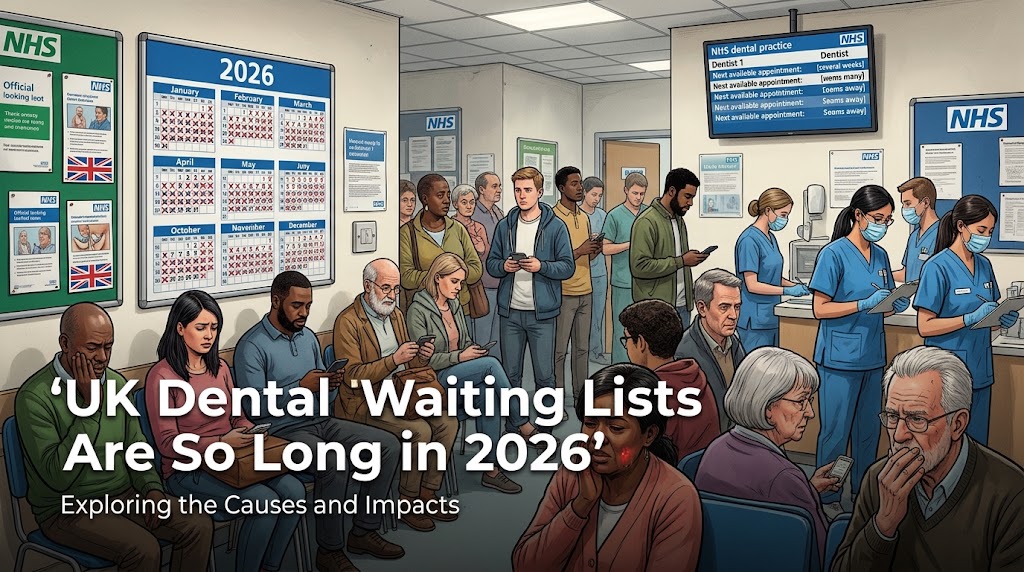
UK dental waiting lists remain a major concern in 2026, with millions of people struggling to find an NHS dentist accepting new patients. From staff shortages and funding pressures to outdated NHS dental contracts and increasing demand, several factors have contributed to the difficulty of accessing affordable dental treatment across the UK.
Although the NHS has introduced measures to improve dental access, many patients still experience long waits for routine check-ups, fillings, root canal treatment and other essential procedures. Some people are forced to contact multiple dental practices, travel outside their local area or consider private treatment because they cannot find an available NHS appointment.
The problem is not simply that there are too few dentists. The way NHS dental services are funded, organised and delivered also affects how many patients practices can treat.
In this guide, we explain why NHS dental waiting lists are so long in 2026, what the latest statistics reveal, how the situation differs across England, Scotland, Wales and Northern Ireland, and what patients can do if they cannot find an NHS dentist.
How Bad Are UK Dental Waiting Lists in 2026?
Access to NHS dentistry remains a significant challenge, particularly for adults who are not already receiving treatment from an NHS dental practice.
According to the latest NHS Business Services Authority statistics for England, published in August 2026:
- 18.8 million adults accessed NHS dental care during the 24 months ending 31 March 2026.
- This represented approximately 40% of England’s adult population.
- Around 28.2 million adults did not access NHS dental care during that period.
- Approximately 7.17 million children received NHS dental care in the 12 months ending March 2026.
- There were 25,419 dentists carrying out NHS activity in England during 2025/26.
- NHS dental practices delivered 37.6 million courses of treatment, an increase of 6.2% compared with the previous year.
Although dental activity has increased, these figures demonstrate that access remains far from universal. NHS BSA Open Data+2
An important distinction is that these figures measure patients accessing treatment, not the number of people on a single national waiting list.
Is there an official NHS dental waiting list in England?
No. England does not operate one central national waiting list for routine NHS dental appointments. Individual dental practices may maintain their own waiting lists, but patients generally need to contact practices directly to ask whether they are accepting NHS patients. UK Parliament+2
1. Shortage of NHS Dentists and Dental Staff
One of the biggest reasons behind long NHS dental waiting times is the limited availability of dental professionals willing and able to provide NHS treatment.
Although the number of dentists carrying out NHS work increased to 25,419 in England during 2025/26, this does not mean that every dentist provides the same amount of NHS care.
Some dentists divide their working hours between NHS and private patients, while others may provide only a limited number of NHS appointments.
This reduces the number of appointments available to patients who depend on affordable NHS treatment.
Why are dentists moving towards private dentistry?
Several factors influence dentists’ decisions, including:
- Financial pressures associated with providing NHS treatment.
- Limited appointment capacity within NHS contracts.
- Administrative responsibilities and workload.
- Difficulties recruiting and retaining dental professionals.
- Greater financial flexibility in private dental practices.
Consequently, patients in some areas may find several private dental practices but very few NHS appointments.
The shortage is also not evenly distributed. Some rural, coastal and deprived communities experience particularly difficult access to NHS dentistry.
2. NHS Dental Funding Problems
Funding is another important factor affecting NHS dental services.
Dental practices need sufficient financial support to cover staff salaries, equipment, laboratory expenses, materials, rent and other operating costs.
However, concerns about NHS dental funding have continued for years.
According to the House of Commons Library, after accounting for inflation, NHS England’s contribution to dental services fell by approximately 16% between 2014/15 and 2024/25. House of Commons Library
This creates financial challenges for practices providing NHS treatment.
When the amount paid for treatment does not adequately reflect the time and resources required, some practices may find it financially difficult to expand their NHS services.
As a result, patients may experience:
- Fewer available NHS appointments.
- Limited opportunities for new patients to join practices.
- Reduced availability of certain treatments.
- Longer delays for routine dental care.
3. The NHS Dental Contract Creates Challenges
The NHS dental contract in England has been criticised for failing to provide sufficient incentives for practices to treat patients with more complex dental needs.
The current system has historically relied heavily on Units of Dental Activity (UDAs), which determine how NHS dental practices are paid for delivering treatment.
However, not every dental procedure requires the same amount of clinical time or resources.
For example, a straightforward examination may take considerably less time than complicated root canal treatment or extensive restorative dental work.
This can make it financially challenging for practices to provide certain treatments within their NHS contracts.
The NHS Dental Recovery Plan introduced measures intended to improve access, including additional payments for treating new patients.
However, NHS England’s evaluation found that the new patient premium did not produce the expected improvement in adult access during 2024/25. NHS England+1
Further dental contract reforms are therefore important for improving the long-term availability of NHS treatment.
4. Growing Demand for NHS Dental Treatment
Another reason for long NHS dental waiting lists is increasing demand for affordable dental services.
Many people prefer NHS treatment because private dental procedures can be expensive.
Patients who cannot afford private check-ups, fillings, crowns or other procedures may continue searching for NHS appointments.
Demand is also influenced by people who have missed routine dental appointments for several years.
When patients eventually seek treatment, they may require more complicated procedures than they would have needed with regular preventive care.
For example, untreated tooth decay can progress and eventually require fillings, root canal treatment or tooth extraction.
Read our guide to root canal treatment NHS costs in the UK to understand treatment options and potential charges.
As more people seek affordable treatment, practices with limited NHS capacity can struggle to accommodate everyone.
5. COVID-19 Created a Long-Term Dental Backlog
The COVID-19 pandemic significantly disrupted dental services across the UK.
During the pandemic, many routine dental appointments were postponed or cancelled because of infection prevention requirements and restrictions on clinical services.
Although practices eventually reopened, returning to normal service levels took time.
The disruption created a backlog of patients who needed routine check-ups, preventive treatment and more complex dental procedures.
NHS England’s analysis of the Dental Recovery Plan identifies the pandemic as an important factor behind reduced dental activity and continuing access problems. NHS England
The effects have not disappeared completely.
Some patients who missed routine appointments during the pandemic still face difficulties finding an NHS dentist.
6. Regional Differences in NHS Dental Access
NHS dental access is not equal across the UK.
Where someone lives can significantly affect how easily they find an NHS dentist.
For example, NHS dental statistics for England in 2025/26 showed substantial differences between Integrated Care Boards (ICBs).
The Royal College of Surgeons of England reported:
- South Yorkshire had the highest adult access rate, with approximately 56% of adults seen by an NHS dentist.
- Somerset had the lowest adult access rate, at approximately 23%.
These figures demonstrate how significantly access can vary between different areas. Royal College of Surgeons
NHS dental access across the four UK nations
| UK nation | Dental access situation |
|---|---|
| England | Patients generally contact NHS dental practices directly. Some practices operate local waiting lists. |
| Scotland | Patients need to find a practice accepting new NHS patients. Some practices maintain registration waiting lists. |
| Wales | The Dental Access Portal allows eligible people to register their interest in routine NHS dental care. |
| Northern Ireland | Patients generally need to contact Health Service dental practices directly to find one accepting new patients. |
Sources: NHS+3
Wales has introduced a Dental Access Portal to help people seeking routine NHS dental treatment. Eligible applicants can register their interest and wait to be allocated a suitable practice.
You can find more information through the official NHS Wales Dental Access Portal.
In Northern Ireland, the Health and Social Care service advises patients that finding a practice accepting new Health Service patients can be difficult. Digital Health and Care Wales+1
7. Why Are Children and Vulnerable Patients Also Affected?
NHS dentistry is particularly important for children, older adults and people who may struggle to afford private dental treatment.
Children require regular dental examinations to identify tooth decay, monitor development and prevent future dental problems.
However, the latest England figures show that only 60% of children received NHS dental care during the 12 months ending March 2026.
This means approximately four in ten children did not access NHS dental care during that period. NHS BSA Open Data+1
Older adults and people with disabilities or complex medical conditions may also experience difficulties accessing appropriate dental services.
Limited availability of specialist and community dental services can create additional challenges for patients who need more support.
Parents can read our guide to children’s NHS dental care to understand available services and treatment options.
What Is the NHS Doing to Reduce Dental Waiting Times in 2026?
The government and NHS organisations have introduced several measures intended to improve dental access.
These include:
1. Additional urgent dental appointments
Integrated Care Boards have been commissioning additional urgent dental appointments to help patients who cannot access treatment through routine services.
2. Increased NHS dental activity
The latest 2025/26 statistics show that NHS dental courses of treatment increased by 6.2% compared with the previous year.
3. Dental contract reforms
The government has committed to more fundamental reforms of the NHS dental contract to improve incentives and encourage practices to provide more NHS treatment.
4. Recruitment and workforce support
Measures such as Golden Hello payments are intended to encourage dentists to work in areas experiencing difficulties with dental access.
5. Greater focus on prevention
Preventive programmes, including supervised toothbrushing initiatives, aim to reduce avoidable dental problems and future treatment demand.
Although these measures are intended to improve access, patients should not assume that every area will immediately have shorter waiting times. UK Parliament+2
How to Find an NHS Dentist in 2026
If you are struggling to find an NHS dentist, there are several practical steps you can take.
1. Search the NHS Dentist Finder
Start by using the official NHS dentist search tool.
Enter your town, city or postcode to find nearby practices and check which ones may offer NHS appointments.
Visit: Find an NHS Dentist.
2. Contact Multiple Dental Practices
Do not rely on contacting just one dental surgery.
Call or email several practices and ask:
- Are you currently accepting new NHS patients?
- Do you have a waiting list?
- Can children join the practice?
- Do you offer urgent NHS dental appointments?
- Can you provide treatment if I am not registered?
Some practices may have availability even when others are full.
3. Contact Your Local Integrated Care Board
If you live in England and cannot find an NHS dental appointment, contact your local Integrated Care Board (ICB).
Your ICB manages local NHS dental services and may be able to provide information about available appointments and urgent dental services.
4. Consider a Wider Search Area
If local practices are not accepting NHS patients, consider contacting dental surgeries in nearby towns or neighbouring areas.
In England, you are not restricted to registering with an NHS dentist in your immediate local area.
5. Understand NHS Dental Charges
Most adults pay for NHS dental treatment unless they qualify for an exemption or help with healthcare costs.
Understanding the charges can help you plan for treatment.
Read our detailed guide to NHS dental charges in 2026.
For further information about the difference between treatment options, see our guide to private vs NHS dental implants in the UK.
What If You Need Urgent Dental Treatment?
Routine NHS dental waiting lists should not prevent you from seeking help when you have an urgent dental problem.
You should contact a dentist or NHS 111 if you experience:
- Severe or persistent toothache.
- Dental swelling or suspected infection.
- A knocked-out tooth.
- Significant dental injury.
- Bleeding following a tooth extraction.
- A broken tooth causing considerable pain.
- A growing lump or persistent unusual patch inside your mouth.
In England, NHS 111 can help direct you towards appropriate urgent dental services.
Depending on the problem, urgent dental treatment should generally be offered within 24 hours or seven days. A knocked-out adult tooth requires emergency assessment as soon as possible, ideally within one hour. NHS+1
Important: Go to A&E or call 999 if you have severe swelling affecting your breathing, serious facial injuries or heavy bleeding that will not stop.
For more information, read our guides:
- Dental Emergency: How to Get Same-Day NHS Treatment
- Emergency Dentist UK: What to Do When You Need Urgent Treatment
- NHS 111 vs A&E vs GP: Where Should You Go?
NHS vs Private Dentistry: Is Private Treatment Faster?
Some patients consider private dentistry because they cannot find an available NHS appointment.
Private dental practices often offer appointments without the same NHS availability restrictions. However, appointment availability varies between providers.
| Factor | NHS Dentistry | Private Dentistry |
|---|---|---|
| Appointment availability | Can be limited in some areas | Often more flexible |
| Treatment costs | Usually lower, with exemptions available | Generally higher |
| Treatment options | Clinically necessary NHS treatment | Wider choice of cosmetic and elective treatments |
| Waiting times | Depend on local NHS capacity | Depend on practice availability |
| New patients | Some practices have waiting lists | Often easier to arrange an initial appointment |
Private treatment is not automatically better, and patients should compare costs, treatment plans and professional qualifications before making a decision.
If you are considering private treatment, our guides to adult braces in the UK and how to whiten teeth safely explain common treatment options.
Will NHS Dental Waiting Lists Improve in 2027?
The outlook for NHS dentistry will depend on whether planned reforms successfully address the underlying problems.
Increasing the number of dentists working in the NHS is important, but recruitment alone will not resolve the issue.
Long-term improvements will also require:
- Sustainable NHS dental funding.
- Better payment arrangements for complex treatments.
- More dentists working within NHS contracts.
- Improved access in rural and underserved communities.
- More preventive dental care.
- Better availability of appointments for new patients.
The increase in NHS dental activity during 2025/26 is encouraging. However, the latest access figures demonstrate that significant challenges remain.
Patients should therefore expect improvements to vary between locations rather than assuming that waiting times will fall everywhere at the same rate.
Frequently Asked Questions (FAQs)
1. Why are NHS dental waiting lists so long in 2026?
NHS dental waiting times are affected by limited appointment availability, workforce pressures, funding problems, NHS contract arrangements, regional inequalities and increased demand for affordable treatment.
2. How long is the NHS dental waiting list in the UK?
There is no single national waiting list or standard waiting time for routine NHS dental appointments in England. Individual practices may operate their own waiting lists, and waiting times vary considerably by location.
3. Is there a shortage of NHS dentists in the UK?
There are ongoing difficulties accessing NHS dental services, particularly in some rural, coastal and deprived communities. Although the number of dentists undertaking NHS work has increased, the availability of NHS appointments remains limited in many areas.
4. Can I join an NHS dental waiting list?
Yes. Some NHS dental practices accept patients onto local waiting lists when they cannot offer an immediate appointment. In Wales, eligible patients can register through the Dental Access Portal.
5. Can I see an NHS dentist outside my local area?
Yes. In England, patients are not restricted to NHS dental practices within their local area. You can contact other practices to ask whether they accept new NHS patients.
6. What should I do if I cannot find an NHS dentist?
Search the official NHS dentist finder, contact multiple dental practices and speak to your local ICB if you live in England. If you need urgent dental treatment, contact NHS 111.
7. Are NHS dental waiting times getting shorter?
NHS dental activity in England increased by 6.2% in 2025/26. However, access remains a significant challenge, with only 40% of adults accessing NHS dental care during the 24 months ending March 2026.
8. Can I get emergency dental treatment while waiting for an NHS dentist?
Yes. You do not need to wait for a routine dental appointment if you have an urgent dental problem. Contact a dentist or NHS 111 for advice and access to urgent treatment.
9. Why are NHS dentists not accepting new patients?
Some practices have limited NHS contract capacity, insufficient staff or financial pressures that prevent them from accepting additional NHS patients.
10. Is private dental treatment the only alternative to NHS waiting lists?
No. You can contact other NHS practices, ask your ICB about local availability or seek urgent NHS treatment if your symptoms require it. Private dentistry is another option, but it is not the only route to accessing care.
Conclusion
Long NHS dental waiting lists in 2026 reflect wider problems within the UK’s dental healthcare system. Workforce shortages, funding pressures, contract limitations and growing demand have made it difficult for many people to access routine NHS treatment.
Although NHS dental activity is increasing, millions of adults still struggle to find an available dentist.
If you cannot access routine dental care, contact multiple practices, explore NHS dental services in neighbouring areas and speak to your local NHS organisation for guidance. Most importantly, do not delay seeking urgent dental treatment when you experience severe pain, swelling or signs of infection.
Improving NHS dental access will require sustained investment, meaningful contract reform and a stronger dental workforce so that affordable treatment is available to everyone who needs it.