
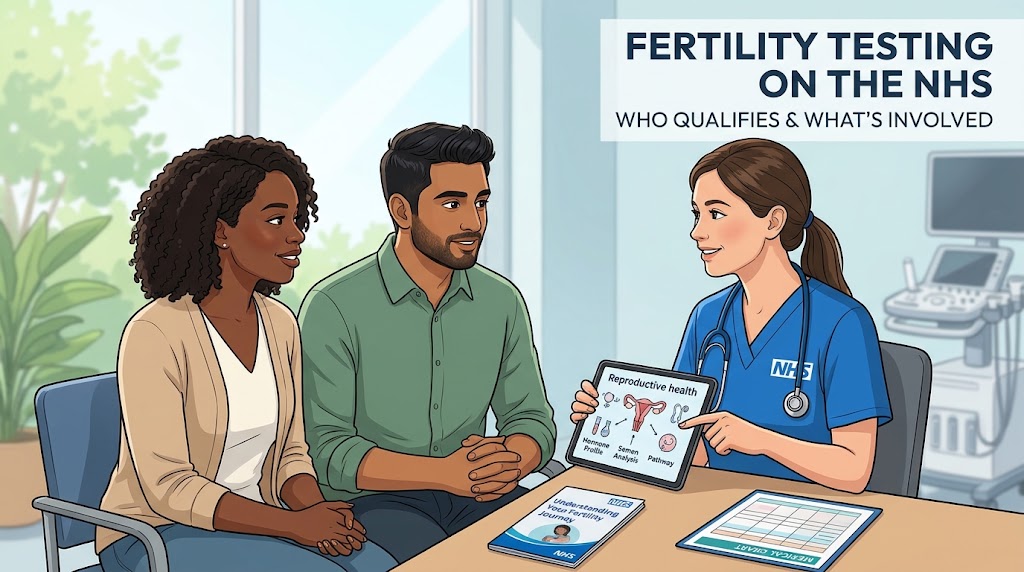
Trying to conceive can be an emotional experience, particularly when pregnancy takes longer than expected. If you have been trying for a baby without success, you may be wondering whether you qualify for fertility testing on the NHS, which investigations are available, and how to start the process.
In the UK, NHS fertility testing usually begins with an appointment with your GP. Depending on your circumstances, your GP may arrange initial investigations, assess possible causes of infertility and refer you to a specialist fertility service if further assessment is needed.
The key thing to know is that fertility testing and NHS-funded fertility treatment are not the same. You may be eligible for initial investigations even if you do not meet your local NHS criteria for treatments such as in vitro fertilisation (IVF).
This guide explains who may qualify for NHS fertility tests, what the investigations involve, how referrals work across the UK, and when you should seek medical advice.

What is NHS fertility testing?
NHS fertility testing refers to medical investigations used to identify possible reasons why a person or couple may be having difficulty conceiving.
These investigations can assess ovulation, hormone levels, sperm health, reproductive organs and certain medical conditions that may affect fertility.
Testing may involve:
- Blood tests to assess reproductive hormones or check whether ovulation has occurred.
- Semen analysis to assess sperm concentration, movement and shape.
- Ultrasound scans to examine the uterus and ovaries.
- Further investigations, such as tests to assess whether the fallopian tubes are open, when clinically appropriate.
Not everyone needs every test. Your GP or fertility specialist will recommend investigations based on your medical history, symptoms, age and how long you have been trying to conceive.
If you have symptoms such as persistent pelvic pain or particularly painful periods, read HealthCresto’s guide to endometriosis diagnosis in the UK, as endometriosis can sometimes affect fertility.
Who qualifies for fertility testing on the NHS?
Eligibility depends on your individual circumstances and the NHS service available in your area. England, Scotland, Wales and Northern Ireland can have different referral pathways and fertility treatment policies.
In general, you can contact your GP for advice about fertility testing if you have been trying to conceive without success, have irregular or absent periods, have a known reproductive health condition, or have concerns about your fertility.
1. People who have been trying to conceive for 12 months
If you are under 35 and have regular unprotected sex without becoming pregnant, a fertility assessment is commonly considered after 12 months.
However, this is not a requirement to wait in every situation. You should speak to your GP sooner if you have irregular periods, a known fertility condition, previous pelvic infections, a history of cancer treatment or another reason to suspect a fertility problem.
2. Women aged 35 and over
Age can affect fertility, including egg quantity and quality. If you are aged 35 or over, it is sensible to seek medical advice after around six months of trying to conceive rather than automatically waiting a full year.
If you are approaching 40 or have other known risk factors, your GP may recommend earlier assessment.
3. People with irregular or absent periods
Irregular periods, very long menstrual cycles or periods that stop altogether can indicate that ovulation is not happening regularly.
Possible causes include polycystic ovary syndrome (PCOS), thyroid problems, changes in body weight and other hormonal conditions.
Your GP may recommend blood tests and further investigations to identify the cause. You can also read our guide to PCOS symptoms and treatments.
4. People with known reproductive health conditions
You may need fertility investigations earlier if you have a condition that could affect conception, such as:
- Endometriosis.
- Previous pelvic inflammatory disease.
- Known problems affecting the fallopian tubes.
- Previous ectopic pregnancy or certain pelvic surgeries.
- A history of chemotherapy or radiotherapy that could affect fertility.
- Suspected ovulation disorders.
A previous diagnosis does not automatically mean you will have difficulty conceiving, but it can influence when testing is appropriate.
5. Men and people providing sperm
Fertility assessment is not just for women. Male-factor infertility can contribute to difficulties conceiving, so both partners should generally be assessed when applicable.
A GP may arrange a semen analysis and other investigations based on medical history, symptoms and the initial results.
Testing both partners early can help avoid unnecessary delays and identify the most appropriate next steps.

What fertility tests are available on the NHS?
The tests you receive will depend on your symptoms and clinical assessment. There is no single fertility test that can explain every case of difficulty conceiving.
1. Blood tests to check ovulation
Your GP may arrange a blood test to assess whether ovulation has occurred. A progesterone blood test is commonly used for this purpose.
The timing matters. It is often taken around seven days before your expected next period, rather than automatically on day 21 for everyone. If your menstrual cycle is irregular, the timing may need to be adjusted.
Other hormone tests may be recommended when there are irregular periods or symptoms suggesting an underlying hormonal condition.
2. Hormone blood tests
Depending on your circumstances, investigations may include tests for thyroid function, prolactin or other reproductive hormones.
These tests can help identify conditions that may interfere with ovulation or menstrual cycles.
Anti-Müllerian hormone (AMH) testing may also be used in some fertility settings to help estimate ovarian reserve and predict how the ovaries might respond to fertility medication.
Important: AMH does not reliably predict whether you will conceive naturally, and a result should not be interpreted in isolation as a measure of your ability to become pregnant.
3. Semen analysis
A semen analysis assesses several characteristics of a sperm sample, including:
- Sperm concentration and total number.
- Sperm movement, known as motility.
- Sperm shape, known as morphology.
- Other sample characteristics relevant to the laboratory assessment.
You will receive instructions on how to provide the sample. If the first result is abnormal, repeat testing may be recommended because semen quality can vary.
Additional tests or referral to a specialist may be appropriate depending on the findings.
4. Pelvic ultrasound scan
A pelvic ultrasound can help examine the uterus and ovaries. It may identify fibroids, ovarian cysts, features associated with PCOS or other structural concerns.
An ultrasound does not establish every aspect of fertility, and a normal scan does not guarantee that conception will occur.
5. Tests to assess the fallopian tubes
If your clinical assessment suggests a need, a specialist may recommend a test to determine whether the fallopian tubes are open.
Depending on local services and your circumstances, this may involve hysterosalpingography (HSG), which uses contrast and X-ray imaging, or a contrast ultrasound technique.
These tests can help identify possible tubal blockage. They are not necessary for everyone and may be arranged after initial investigations.
6. Further investigations when necessary
Some people need additional tests based on their symptoms, medical history or initial results.
These might include more detailed imaging, hysteroscopy or a specialist assessment for suspected endometriosis or other reproductive conditions.
Invasive procedures are not routinely required for every fertility assessment. Your clinician should explain why a proposed investigation is appropriate, its potential risks and any alternatives.
How to get fertility testing on the NHS: step by step
Step 1: Book a GP appointment
Explain how long you have been trying to conceive, your menstrual cycle pattern if relevant, any symptoms, and any known medical conditions. If both partners are involved, mention relevant medical history for each.
Step 2: Discuss your medical history
Your GP may ask about age, previous pregnancies, menstrual cycles, sexual health, medications, lifestyle factors and how long you have been trying.
Step 3: Complete initial investigations
Where appropriate, your GP can arrange blood tests or a semen analysis and review the findings. Some investigations may need to be arranged through a local fertility service.
Step 4: Get a referral if needed
Depending on the results, your GP may refer you to a fertility specialist for further investigations, diagnosis or treatment advice
Step 5: Discuss your options
The specialist can explain the results, recommend next steps and discuss whether any treatment is appropriate. NHS-funded treatment eligibility is assessed separately.
For help arranging the first appointment, see our guide on how to register with a GP in the UK.
NHS fertility testing eligibility versus NHS-funded IVF
One of the most common misunderstandings is that qualifying for fertility tests automatically means qualifying for NHS-funded IVF.
These are different decisions.
| Fertility investigations | NHS-funded IVF |
|---|---|
| Assess possible causes of difficulty conceiving. | Provide a specific fertility treatment when clinically appropriate. |
| May start with your GP or a local fertility service. | Usually requires specialist assessment and referral. |
| Depend on symptoms, history and local pathways. | Depends on clinical factors and the relevant nation’s and local area’s funding policy. |
| Do not automatically guarantee access to treatment. | May have additional eligibility criteria and restrictions. |
In England, integrated care boards (ICBs) determine local fertility funding policies within the wider NHS framework. Criteria can include age, previous children, smoking status, BMI, previous fertility treatment and other factors, depending on the policy.
Scotland, Wales and Northern Ireland have their own arrangements and eligibility criteria.
For more information about treatment rather than testing, read HealthCresto’s complete UK guide to NHS-funded IVF in 2026.
Always check the latest policy for your area, as eligibility and service arrangements can change.
How long does NHS fertility testing take?
There is no single waiting time for fertility testing across the UK. The timeframe depends on local appointment availability, which tests are needed, whether repeat tests are required and whether you need a specialist referral.
Your initial GP appointment may be followed by blood tests, semen analysis and further investigations over several weeks or longer. Specialist fertility appointments can involve additional waiting.
To help avoid unnecessary delays:
- Book an appointment when you meet the relevant assessment criteria or have concerns that warrant earlier advice.
- Attend requested tests at the recommended times.
- Ask when and how you will receive your results.
- Check whether both partners need investigations.
- Ask your GP which local service manages fertility referrals and whether there are any referral requirements.
If you are concerned about a delay, ask the practice or fertility service for an update and discuss whether any additional initial investigations are appropriate while you wait.
What can affect fertility test results?
Fertility results must be interpreted in context. A single result does not always provide a complete explanation.
Factors that can influence fertility or particular test results include:
- Age: fertility generally declines with age, particularly because of changes in egg quantity and quality.
- Ovulation problems: irregular or absent ovulation can reduce the chance of conception.
- Sperm health: sperm concentration, movement and other characteristics may affect the likelihood of pregnancy.
- Reproductive conditions: endometriosis, tubal problems and some uterine conditions can affect fertility.
- Hormonal conditions: thyroid disorders and other hormonal changes may interfere with reproductive function.
- Lifestyle and general health: smoking, alcohol use, certain medications and some health conditions may affect reproductive health.
Weight can also be relevant to fertility for some people, particularly where it affects ovulation or overall health. However, weight alone cannot explain every fertility problem, and fertility concerns should not be dismissed on that basis.
If you are concerned about symptoms associated with hormonal changes, our guide to menopause symptoms in the UK explains how reproductive hormone changes can affect menstrual patterns at a different stage of life.
Can you get fertility tests privately if you do not qualify on the NHS?
Private fertility clinics may offer consultations, blood tests, semen analysis, scans and more specialised investigations.
However, private testing is not always necessary, and an individual test may not provide a clear answer without a proper clinical assessment. Before paying for investigations, ask what the test can establish, whether a GP or specialist referral would be more appropriate, and who will interpret the results.
If you obtain private test results, share them with your NHS clinician where relevant. This may help your care team understand your situation, although the NHS service may still need to repeat tests or carry out additional investigations.
Private test results also do not guarantee NHS-funded fertility treatment.
When should you speak to your GP about fertility?
Consider booking a GP appointment if:
- You have been trying to conceive for 12 months without success.
- You are aged 35 or over and have been trying for around six months.
- Your periods are absent, very irregular or unusually infrequent.
- You have severe period pain or persistent pelvic pain.
- You or your partner have a known condition that may affect fertility.
- You have previously had pelvic surgery, certain infections or cancer treatment that could affect fertility.
- You are worried about fertility because of your medical history or age.
You do not need to wait for a particular time threshold if you have a known risk factor or symptoms that need assessment. Seek urgent medical advice if you may be pregnant and experience severe abdominal pain, fainting or significant bleeding, as these can be signs of a serious condition, including an ectopic pregnancy.
Frequently asked questions about NHS fertility testing
1. Can my GP refuse NHS fertility tests?
Your GP will assess your symptoms, medical history and clinical needs before deciding which investigations or referrals are appropriate. Local service pathways can differ, but you can ask why a test is or is not recommended and what the next step should be. If you remain concerned, ask for a review or clarification of the referral criteria.
2. Do I need to be trying for a baby for one year before getting fertility tests?
Not always. Twelve months is a common threshold for people under 35 without known risk factors, but earlier assessment may be appropriate if you are 35 or over, have irregular or absent periods, or have a known condition that could affect fertility.
3. Are fertility blood tests free on the NHS?
Medically indicated tests arranged through NHS services are generally provided without a separate charge to the patient. The specific investigations offered depend on clinical need and the local care pathway.
4. Does the NHS test male fertility?
Yes. Semen analysis is a common initial investigation when assessing male fertility. Additional tests may be recommended if the initial results or medical history indicate a need.
5. Can I have an AMH test on the NHS?
AMH testing may be offered in certain fertility assessments, particularly when clinicians need information about ovarian reserve or likely response to fertility medication. It is not routinely necessary for everyone, and it cannot reliably tell you whether you will conceive naturally.
6. Does a normal fertility test mean I can get pregnant?
Not necessarily. Normal results are reassuring in some respects, but no fertility test can guarantee pregnancy. Some people experience unexplained infertility even after standard investigations.
7. Can I get fertility tests if I am single?
You can discuss fertility concerns with your GP regardless of relationship status. The investigations offered and the route to specialist services depend on your medical circumstances and local service arrangements. Access to NHS-funded treatment is assessed separately and may have additional criteria.
8. Does NHS fertility testing mean I qualify for IVF?
No. Testing and treatment have different eligibility requirements. Even if investigations are available through the NHS, access to NHS-funded IVF depends on the relevant national and local policy.
9. How long do NHS fertility test results take?
It varies by test and service. Blood tests and semen analysis may be reported within different timeframes, while specialist investigations and appointments can take longer. Ask the clinician or laboratory service when you should expect results and how they will be discussed with you.
10. What should I do if my fertility tests are normal but I still cannot conceive?
Ask your GP or fertility specialist to review the findings alongside your age, how long you have been trying and your medical history. Further assessment or specialist advice may be appropriate even if the initial results are normal.
Conclusion
Fertility testing on the NHS can help identify possible reasons why conception is taking longer than expected and guide decisions about further investigations or treatment.
If you are concerned about fertility, start by speaking to your GP. You may not need to wait a full year if you are aged 35 or over, have irregular periods, or have a known condition that could affect reproductive health.
Remember that access to fertility investigations does not automatically guarantee NHS-funded IVF. Your clinical needs, local referral pathway and applicable funding criteria will determine what happens next.
Seeking advice early when appropriate can help you understand your options and make informed decisions about your reproductive health