

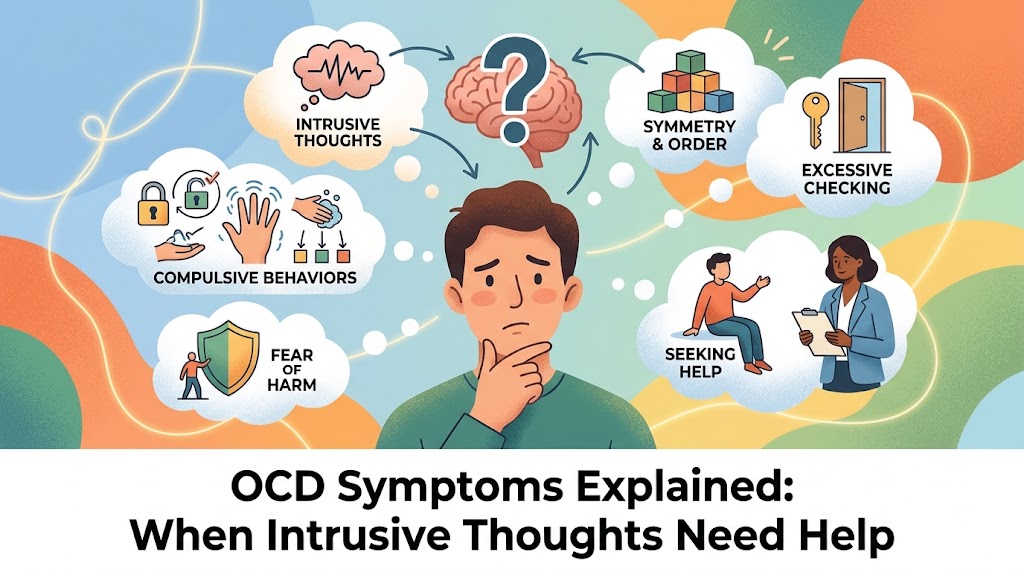
Have you ever experienced an unwanted thought that felt disturbing, frightening or completely out of character? Perhaps you repeatedly check whether you have locked the door, worry that you might accidentally harm someone, or feel compelled to repeat an action until it feels right.
Occasional intrusive thoughts and habits are common. However, when unwanted thoughts become persistent and lead to repetitive behaviours, intense anxiety or significant disruption to daily life, they may be signs of obsessive-compulsive disorder (OCD).
OCD is a recognised mental health condition, not a personal weakness or simply a preference for cleanliness and organisation. It can affect people of any age and background, and symptoms can vary considerably from person to person.
Understanding the difference between ordinary worries and possible OCD symptoms can help you recognise when professional support may be beneficial.
Quick answer: What are the main symptoms of OCD?
OCD typically involves obsessions, compulsions, or both. Obsessions are recurring, unwanted thoughts, images or urges that cause distress. Compulsions are repetitive behaviours or mental acts performed in response to these thoughts or according to rigid rules, often to reduce anxiety or prevent a feared outcome. Symptoms may become clinically significant when they are time-consuming, distressing or interfere with everyday life.
What is obsessive-compulsive disorder (OCD)?
Obsessive-compulsive disorder is a mental health condition characterised by a cycle of unwanted intrusive experiences and repetitive responses.
An obsession might involve a fear of contamination, doubts about whether something is safe, distressing thoughts about causing harm, or a persistent need for certainty. A compulsion might involve repeated checking, washing, counting, seeking reassurance or mentally reviewing an event.
These behaviours may provide temporary relief, but the relief often does not last. The doubt or anxiety returns, creating pressure to repeat the behaviour.
OCD is not limited to visible rituals. Some people experience predominantly mental compulsions that other people may not notice.
It is also important to distinguish OCD from general anxiety, ordinary habits and occasional intrusive thoughts. A qualified clinician can assess the pattern, severity and impact of symptoms.
If you are also trying to understand broader mental health concerns, our guide to mental health in the UK: symptoms, support and treatment provides further context.
What are the main symptoms of OCD?
The main symptoms of OCD are obsessions and compulsions. Some people experience both clearly, while others spend much of their time dealing with internal rituals, repeated doubts or attempts to neutralise unwanted thoughts.
1. Persistent intrusive thoughts
Intrusive thoughts are unwanted thoughts, images or urges that enter your mind without invitation. They may feel disturbing, embarrassing or inconsistent with your values.
Examples can include:
- Fear of accidentally harming yourself or another person.
- Worries about contamination, germs or illness.
- Repeated doubts about whether you have made a serious mistake.
- Unwanted sexual, religious or taboo thoughts.
- Fear that something bad will happen unless you perform a particular action.
- Persistent uncertainty about relationships, responsibility or personal decisions.
Having an intrusive thought does not automatically mean you have OCD. Intrusive thoughts can occur in people without a mental health condition.
OCD becomes more concerning when these experiences repeatedly cause distress, prompt compulsive responses or interfere with normal activities.
2. Repeated checking
Checking compulsions may involve repeatedly confirming that a door is locked, an appliance is switched off, a message was sent correctly or a task was completed safely.
For example, someone might check the front door once before leaving but continue returning to check it many times because they cannot feel certain that it is locked.
The key issue is not simply checking. It is the repeated urge to check despite having already obtained reasonable evidence that the task is complete.
3. Excessive washing or cleaning
Some people with OCD experience intense fears about germs, contamination, illness or substances they believe may be harmful.
This may lead to repeated handwashing, prolonged cleaning, avoiding particular objects or following rigid hygiene routines.
Ordinary hygiene is not OCD. The concern arises when washing or cleaning feels difficult to resist, causes substantial distress, damages the skin or interferes with daily life.
4. Counting, ordering and repeating
OCD can also involve a strong need for symmetry, exactness or a particular feeling that something is complete.
Possible behaviours include:
- Arranging objects according to rigid rules.
- Repeating words, movements or actions.
- Counting silently until a sequence feels correct.
- Restarting an activity because it does not feel right.
- Repeating everyday tasks to prevent a feared event.
Not everyone with OCD has visible rituals. Some experience an internal sense of incompleteness or a need for certainty that is difficult to explain to others.
5. Mental compulsions and reassurance seeking
Mental compulsions can be harder to recognise because they happen internally.
Examples include repeatedly reviewing a memory, mentally checking whether a thought reflects your character, silently repeating phrases, or trying to cancel an unwanted thought with a different thought.
Some people also repeatedly ask family members, friends or partners for reassurance. Although reassurance can provide short-term comfort, repeatedly seeking certainty may maintain the OCD cycle.
It is important to understand that an unwanted thought is not the same as an intention, action or prediction. The meaning and context of a thought matter, and intrusive thoughts alone do not establish a diagnosis.
When do intrusive thoughts become a problem?
Intrusive thoughts deserve attention when they become persistent, distressing or difficult to disengage from.
Consider speaking to a healthcare professional if you notice that:
- You spend substantial time thinking about the same fear or doubt.
- You feel compelled to repeat behaviours or mental rituals.
- You avoid places, people or situations because of unwanted thoughts.
- You repeatedly seek reassurance but rarely feel reassured for long.
- Your symptoms affect sleep, work, education, relationships or social activities.
- You feel unable to resist rituals even when you recognise that they are excessive.
- You experience significant distress, shame or exhaustion because of the cycle.
There is no need to wait until symptoms become severe before asking for help.
OCD is not diagnosed simply because someone has intrusive thoughts. A clinician considers the overall pattern, distress, time spent on symptoms, functional impact and other possible explanations.
If persistent worry is your main concern, you may also find our article on the difference between anxiety and stress useful. These conditions can overlap with OCD, but they are not interchangeable.
OCD symptoms versus ordinary habits and worries
| Feature | Ordinary habits or worries | Possible OCD symptoms |
|---|---|---|
| Frequency | Usually occasional or manageable | Recurrent and difficult to disengage from |
| Distress | Often mild or proportionate | Can cause significant anxiety or distress |
| Behaviour | Flexible and easy to stop | May feel driven, rigid or difficult to resist |
| Relief | Often lasts once the issue is resolved | May be brief, with doubt or anxiety returning |
| Daily impact | Usually limited | Can interfere with work, relationships or routines |
| Support | Often manageable independently | May benefit from professional assessment and treatment |
This comparison is for general information, not self-diagnosis. OCD can present differently across individuals, and only an appropriate clinical assessment can establish whether symptoms meet diagnostic criteria.
What causes OCD?
There is no single known cause of OCD. Research suggests that a combination of biological, genetic, psychological and environmental factors may contribute.
Possible influences include:
- Genetic factors: OCD can occur more frequently in some families, although family history does not determine whether someone will develop it.
- Brain and biological factors: Research indicates that brain circuits and processes involved in habit formation, threat detection and decision-making may play a role.
- Psychological factors: How a person interprets intrusive thoughts, uncertainty and perceived responsibility may influence the OCD cycle.
- Stressful experiences: Stress may contribute to the onset or worsening of symptoms in some people, but it does not explain every case.
OCD is not caused by weak character, a lack of willpower or simply being too tidy. People do not choose to experience distressing obsessions or compulsions.
OCD may also occur alongside other mental health conditions. For example, someone might experience OCD and anxiety or depression at the same time. A professional assessment can help distinguish overlapping symptoms and identify suitable treatment.
For more information about overlapping conditions, read our guides to depression versus anxiety and early signs of anxiety.
How is OCD diagnosed in the UK?
If you think you may have OCD, consider arranging an appointment with your GP or another qualified healthcare professional.
There is no single blood test or scan that confirms OCD. Diagnosis usually involves a clinical assessment of your symptoms, how long they have been occurring, their impact on daily life and whether another condition could better explain them.
A clinician may ask about:
- The nature and frequency of intrusive thoughts.
- Repetitive behaviours or mental rituals.
- The amount of time symptoms take up.
- How much distress they cause.
- Their effects on work, relationships and daily routines.
- Other mental health concerns and relevant medical history.
In England, you can ask your GP about assessment and treatment, or in many areas refer yourself to NHS Talking Therapies for anxiety and depression services. However, access to specialist OCD treatment varies, and some people may need referral to a specialist mental health service.
Our guide explains how to get a mental health diagnosis on the NHS in 2026.
If you have already been advised to seek psychological treatment, you can also read how to access CBT through the NHS.
What treatments can help OCD?
OCD is treatable, and many people improve with appropriate psychological therapy, medication or a combination of both.
Treatment should be tailored to the person’s symptoms, preferences, clinical needs and response to care.
Cognitive behavioural therapy (CBT) with exposure and response prevention (ERP)
CBT is a psychological treatment commonly recommended for OCD. A specific approach called exposure and response prevention (ERP) helps people gradually face feared thoughts, situations or triggers while learning to resist compulsive responses.
ERP is planned collaboratively with a trained therapist. It is not about forcing someone into frightening situations or dismissing their concerns.
Over time, therapy can help people learn that uncertainty and distress can be managed without repeatedly performing rituals.
Medication for OCD
Selective serotonin reuptake inhibitors (SSRIs) may be prescribed for OCD, depending on symptom severity, individual circumstances and clinical assessment.
Medication decisions should be made with a qualified prescriber, who can explain potential benefits, side effects, monitoring and how long treatment may take to help.
Do not start, stop or change prescribed medication without discussing it with your healthcare professional.
Read our related guide to SSRIs versus talking therapy for anxiety for a broader introduction to medication and psychological treatment. OCD treatment decisions may differ from those for anxiety disorders.
Specialist mental health support
If symptoms are severe, persistent or difficult to manage, specialist mental health services may be appropriate. Treatment can be reviewed if an initial approach does not provide enough improvement.
You do not have to manage OCD alone, and seeking support does not mean you have failed to control your thoughts.
How to cope with OCD symptoms while seeking help
Self-help strategies cannot replace appropriate OCD treatment, but some practical steps may help you manage day-to-day distress while arranging support.
1. Notice the thought without treating it as a fact. An intrusive thought is a mental event, not proof that something has happened or will happen.
2. Recognise the urge to perform a ritual. When you notice the urge to check, repeat or seek reassurance, try to identify the pattern without judging yourself.
3. Avoid relying on repeated reassurance. Repeatedly asking for certainty may provide short-lived relief but can reinforce the cycle. A therapist can help you change this pattern safely.
4. Maintain everyday routines where possible. Regular sleep, balanced meals, movement and social contact may support general wellbeing, although they are not a cure for OCD.
5. Seek professional guidance. If symptoms interfere with your life, contact your GP or an appropriate mental health service. You do not need to reach a crisis point before asking for help.
6. Treat yourself with compassion. OCD can be exhausting and isolating. Having unwanted thoughts does not make you a bad person, and you deserve support without shame.
If anxiety symptoms are also affecting your daily life, our article on what high-functioning anxiety can look like may offer additional context, although it does not replace an OCD assessment.
When should you seek urgent help?
Arrange a routine GP appointment if intrusive thoughts, compulsions or anxiety are persistent, distressing or disrupting daily life.
Seek urgent help if you cannot keep yourself safe, feel at immediate risk of acting on harmful intentions, or are experiencing a mental health crisis. In the UK, call 999 or go to A&E in an emergency. If you need urgent mental health support but are not in immediate danger, NHS 111 can advise on the available options in England; select the mental health option where offered.
Intrusive thoughts alone do not necessarily indicate that someone is dangerous. However, thoughts accompanied by immediate intent, a plan or an inability to remain safe need prompt assessment.
Frequently asked questions about OCD symptoms
What are the first signs of OCD?
Early signs can include recurring unwanted thoughts, persistent doubts, repeated checking, excessive washing, counting, reassurance seeking or mental rituals. The key concern is whether these patterns cause distress, take up substantial time or interfere with daily life.
Can you have OCD without compulsions?
Yes. Compulsions are not always visible. Some people experience mental rituals, such as repeatedly reviewing memories, silently counting, analysing thoughts or trying to neutralise unwanted ideas. A clinician can assess whether these experiences fit OCD.
Are intrusive thoughts a sign of OCD?
Not necessarily. Intrusive thoughts are common and can occur without a mental health disorder. They may be associated with OCD when they are recurrent, distressing and linked to compulsions, avoidance or other significant impairment.
Does OCD mean you are obsessed with cleanliness?
No. Contamination fears and cleaning rituals are only one possible presentation. OCD can also involve checking, symmetry, responsibility, taboo thoughts, uncertainty and mental compulsions.
Can OCD be treated successfully?
Yes. Evidence-based treatments, particularly CBT incorporating exposure and response prevention, can help many people. SSRIs may also be considered. Outcomes vary, and treatment should be tailored to individual needs.
How do I get help for OCD on the NHS?
You can start by contacting your GP to discuss symptoms and possible referral. In England, some people can self-refer to NHS Talking Therapies, although specialist OCD services may be needed depending on the presentation and local pathway.
Can stress make OCD symptoms worse?
Stress may worsen symptoms for some people, but it is not the sole cause of OCD. If you notice a change in symptom severity, discuss it with your healthcare professional.
When should intrusive thoughts worry me?
Consider seeking professional help if thoughts are persistent, cause significant distress, lead to repetitive rituals or affect daily functioning. Seek urgent support if you cannot keep yourself or someone else safe.
Conclusion: Recognising OCD symptoms is the first step towards support
OCD is more than occasional worrying, unwanted thoughts or a preference for order. It can involve a distressing cycle of obsessions and compulsions that affects everyday life, relationships and wellbeing.
The important distinction is not whether a thought seems strange or upsetting, but how frequently it occurs, how it affects you and whether you feel driven to respond through repetitive behaviours or mental rituals.
With appropriate assessment and evidence-based treatment, people with OCD can learn to manage symptoms and improve their quality of life. If you recognise these patterns in yourself, speaking to a healthcare professional is a constructive first step.