
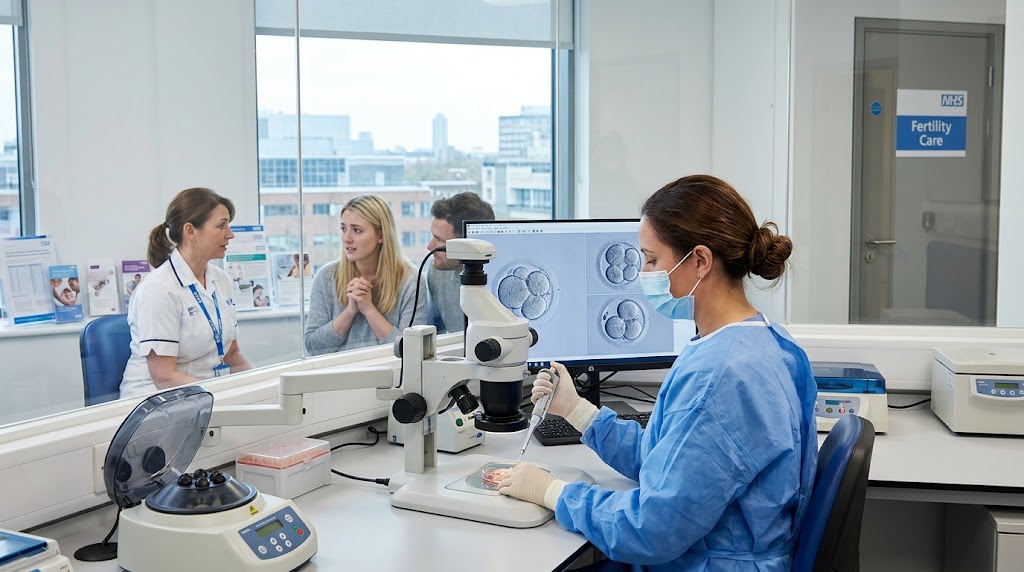
If you are trying to conceive and have been considering IVF and NHS treatment, you may be wondering whether you qualify for NHS-funded fertility treatment, how many IVF cycles you could receive, how much treatment costs privately and what the process involves.
IVF (in vitro fertilisation) is a fertility treatment in which eggs are collected and fertilised with sperm in a laboratory before an embryo is transferred into the womb. IVF may be recommended when pregnancy has not occurred naturally or when another fertility treatment has not been successful.
NHS IVF eligibility can be complicated because fertility funding is not identical across the UK. In England, Integrated Care Boards (ICBs) make local funding decisions, while Scotland, Wales and Northern Ireland have their own arrangements. This means two people with similar fertility circumstances can potentially have different access to NHS-funded IVF depending on where they live.
This guide explains IVF and the NHS in the UK, including eligibility, age limits, BMI, previous children, fertility investigations, waiting times, NHS versus private IVF, the IVF process and what to do if NHS funding is unavailable.
What Is IVF?
IVF stands for in vitro fertilisation. During IVF, eggs are collected from the ovaries and fertilised with sperm in a laboratory. If fertilisation results in embryos, an embryo can then be transferred into the womb.
IVF may be considered for a range of fertility problems, including some cases involving:
- Blocked or damaged fallopian tubes
- Ovulation problems
- Endometriosis
- Male-factor infertility
- Unexplained infertility
- Certain fertility problems where other treatments have not worked
- Some situations involving previous fertility treatment
The most appropriate treatment depends on the cause of infertility, age, ovarian reserve, sperm factors and other individual circumstances.
The updated NICE fertility guideline (NG257) recommends considering IVF for eligible people who have not yet reached their 42nd birthday in specific circumstances, including diagnosed infertility where other treatments are unsuitable or unsuccessful, or unexplained fertility problems after an appropriate period of trying to conceive.
Can You Get IVF on the NHS?
Yes, IVF is available through the NHS for some people, but eligibility depends on where you live and whether you meet the relevant funding criteria.
In England, your local Integrated Care Board (ICB) determines who receives NHS-funded IVF and how much treatment is funded. NICE provides national clinical recommendations, but local commissioners determine how these recommendations are implemented for NHS funding.
The NHS states that people aged 42 or under may be eligible for NHS IVF, but local eligibility rules can include additional requirements relating to factors such as age, BMI, smoking, previous children and previous fertility treatment.
IVF funding is different across the UK
NHS fertility funding varies between:
- England
- Scotland
- Wales
- Northern Ireland
Even within England, access can vary between different ICB areas.
For example, HFEA explains that some areas may provide three NHS-funded IVF attempts, while another area may provide one or none, depending on local commissioning policies.
Therefore, NHS IVF eligibility should always be checked against the current policy for your local area.
Who Is Eligible for NHS IVF in England?
The eligibility criteria can be complicated, but several factors are commonly considered.
1. Your age
Age is one of the most important factors affecting fertility and IVF eligibility.
Under the current NICE recommendations, IVF should be offered to eligible women, trans men and non-binary people with female reproductive organs who have not yet reached their 42nd birthday when the relevant clinical criteria are met.
The NHS currently explains that:
- People aged 39 or under may be eligible for up to three full IVF cycles if they meet the relevant criteria.
- People aged 40 to 42 may be eligible for one full IVF cycle if additional conditions are met.
- Local NHS funding policies can impose additional restrictions.
Age requirements can therefore differ between clinical recommendations and local NHS funding policies.
2. How long you have been trying to conceive
The length of time you have been trying for a baby can affect whether IVF is considered.
For unexplained fertility problems, NICE recommends IVF where eligible people have not conceived after two years of regular unprotected vaginal intercourse, or after the relevant course of artificial insemination.
However, if investigations show that natural conception is unlikely without IVF, NICE recommends referral for IVF rather than necessarily waiting for the full two-year period.
3. Previous fertility treatment
Your previous treatment can affect NHS eligibility.
Depending on your circumstances and local ICB policy, you may need to have tried other fertility treatments before IVF funding is considered.
The NHS explains that some people may qualify for IVF after trying regular unprotected sex for the required period, while others may have undergone artificial insemination or IUI first.
4. Previous children
Some NHS areas consider whether you or your partner already have children.
This is particularly important because having children previously does not automatically mean you cannot receive IVF, but your local funding policy may take existing children into account.
Always check your local ICB policy rather than relying on a general UK eligibility checklist.
5. BMI and weight
BMI may be considered when assessing eligibility for NHS-funded IVF.
Some local NHS policies have BMI requirements because body weight can affect fertility treatment, anaesthesia and pregnancy-related risks.
The NHS also states that BMI can influence the chance of success with IVF.
If you are unsure whether your weight could affect fertility treatment, speak with your GP or fertility specialist.
For additional information about NHS guidance on weight, you can also read our guide:
Am I Overweight? BMI Calculator, Chart & What the NHS Says in 2026
6. Smoking
Smoking can affect fertility and may also affect eligibility for NHS-funded IVF depending on your local policy.
Some NHS commissioners require both partners to meet specific smoking-related conditions before funded treatment begins.
For example, NHS South West London currently specifies non-smoking requirements as part of its local assisted-conception criteria.
Because these rules are local, check your own ICB’s current policy.
What Fertility Tests Are Done Before NHS IVF?
Before IVF is recommended, you will normally have a fertility assessment.
Your GP or fertility team may investigate both partners where appropriate.
Tests can include:
- Medical and fertility history
- Previous pregnancies and miscarriages
- Menstrual and ovulation history
- Blood tests
- Semen analysis
- Ultrasound scans
- Assessment of ovarian reserve
- Assessment of the fallopian tubes where appropriate
- Tests for possible causes of infertility
The NHS explains that a GP may ask about previous pregnancies, children, miscarriages and how long you have been trying to conceive.
NICE’s updated fertility guidance also recommends taking ovarian reserve into account when discussing IVF.
Why are fertility tests important?
IVF is not necessarily the first treatment for everyone.
The results of fertility testing can help doctors determine whether treatment such as:
- Ovulation induction
- IUI
- Surgery
- IVF
- ICSI
- Donor sperm
- Donor eggs
- Other fertility treatments
may be appropriate.
How Does NHS IVF Work?
Although individual treatment plans vary, IVF generally involves several stages.
Step 1: Fertility assessment
Your GP or fertility specialist assesses your fertility history and investigates potential causes of infertility.
If IVF is appropriate, you may be referred to a fertility clinic.
Step 2: Ovarian stimulation
Fertility medicines are used to stimulate the ovaries so that several eggs can develop.
The fertility team monitors your response to treatment.
Step 3: Egg collection
Once the eggs have developed sufficiently, they are collected using a procedure carried out at the fertility clinic.
Step 4: Fertilisation
The collected eggs are fertilised with sperm in the laboratory.
Depending on the circumstances, conventional IVF or a technique such as ICSI (intracytoplasmic sperm injection) may be considered.
Step 5: Embryo development
The fertilised eggs are monitored as embryos develop.
Step 6: Embryo transfer
An embryo can be transferred into the womb.
Additional suitable embryos may sometimes be frozen for future use, depending on the treatment plan and funding arrangements.
NICE defines a full IVF cycle as normally involving one episode of ovarian stimulation followed by transfer of resulting fresh and frozen embryos.
How Many IVF Cycles Does the NHS Fund?
There is no single number that applies to everyone across the UK.
This is one of the most important things to understand about NHS IVF.
In England, local ICBs determine the amount of NHS-funded treatment available. Some areas may fund up to three cycles, while others may provide fewer.
The NHS currently states that eligible people aged 39 or under may be eligible for three full cycles, while eligible people aged 40 to 42 may qualify for one full cycle under the national NHS information criteria. However, local funding rules can affect actual access.
Does one IVF cycle mean one embryo transfer?
Not necessarily.
The exact definition of a funded cycle can vary.
HFEA explains that in some areas, one funded cycle can include a fresh embryo transfer and subsequent frozen embryo transfers, while other local arrangements may define a cycle differently.
This is why it is important to ask your local NHS fertility service exactly what is included in its definition of a funded cycle.
How Long Is the NHS IVF Waiting List?
NHS IVF waiting times vary by location, clinic and individual circumstances.
There is no single UK-wide waiting time that applies to every patient.
You may experience separate waiting periods for:
- GP assessment
- Initial fertility investigations
- Fertility clinic referral
- Eligibility assessment
- Treatment planning
- Starting an IVF cycle
Waiting times can also change as NHS services manage demand and available funding.
If you are considering NHS IVF, ask your GP or fertility clinic:
- How long is the current referral wait?
- How long is the wait for the first fertility appointment?
- How long is the wait after being approved for NHS IVF?
- Is there a separate waiting list for treatment?
- What happens if my eligibility changes while I am waiting?
These questions can help you understand the actual pathway in your area.
Does the NHS Pay for Fertility Tests?
In many circumstances, fertility testing can be available through the NHS even when someone does not qualify for NHS-funded IVF.
HFEA states that fertility testing is generally available through the NHS in many circumstances, although eligibility can differ for some groups, including some same-sex couples and single women without known fertility problems.
Prescription charges can still apply to fertility medicines unless you qualify for an exemption.
NHS IVF vs Private IVF
If you do not qualify for NHS-funded IVF, or if you choose to access treatment privately, you may be able to arrange treatment directly with a private fertility clinic.
However, private IVF can be expensive.
Private fertility clinics set their own prices, and the total cost can vary substantially between providers. HFEA states that private clinics are not subject to a standardised IVF price and recommends comparing treatment costs carefully.
What can affect private IVF costs?
The overall cost may depend on:
- Initial consultation
- Fertility investigations
- IVF treatment
- Medication
- Egg collection
- Laboratory fees
- ICSI
- Embryo freezing
- Storage
- Frozen embryo transfer
- Donor eggs or sperm
- Genetic testing
- Additional treatments
Do not compare clinics based only on the advertised headline price.
Ask what is actually included in the package.
IVF Success Rates: What Affects Your Chances?
There is no single IVF success rate that applies to every person.
Your chances can depend on factors such as:
- Age
- Cause of infertility
- Ovarian reserve
- Egg quality
- Sperm quality
- Previous fertility treatment
- Number and quality of embryos
- General health
- Smoking
- BMI and other lifestyle factors
The NHS specifically notes that IVF success can be affected by the cause of fertility problems, age, BMI and lifestyle factors such as smoking and alcohol consumption.
If a fertility clinic provides a success rate, ask whether it refers to:
- Pregnancy rate
- Live birth rate
- Rate per embryo transfer
- Rate per treatment cycle
- Fresh embryo transfers
- Frozen embryo transfers
- A particular age group
This makes it easier to understand what the figure actually means.
IVF Add-Ons: Are They Necessary?
Some fertility clinics offer additional treatments or IVF add-ons alongside standard IVF.
Examples can include additional laboratory techniques, tests or procedures.
However, evidence for many add-ons remains limited.
In June 2026, the HFEA published a statement about a new study and reiterated concerns about evidence for many fertility treatment add-ons. It stated that its rating system has found no indication that the add-ons it reviewed increase the chance of having a baby for most fertility patients, although there may be individual medical circumstances where an add-on has a justified role.
If a clinic offers an add-on, ask:
- What is the purpose?
- What evidence supports it?
- Is it recommended for my specific situation?
- Could it improve my chance of having a baby?
- What are the risks?
- What does it cost?
- Is it included in NHS funding?
Do not assume that an expensive add-on will automatically improve IVF success.
What If NHS IVF Funding Is Refused?
If you are told that you are not eligible for NHS-funded IVF, ask for the reason.
Possible reasons may relate to:
- Age
- BMI
- Smoking
- Previous IVF treatment
- Previous children
- Local funding rules
- Length of time trying to conceive
- Previous fertility treatment
- Other local eligibility criteria
Ask your GP or fertility clinic to explain which specific criterion you do not meet.
You can also check your local ICB’s fertility policy.
HFEA advises patients to check their local funding arrangements because NHS fertility funding varies significantly across the UK and between areas of England.
Can You Choose Your NHS IVF Clinic?
Your choice of clinic may be limited when treatment is NHS-funded.
HFEA provides a fertility clinic search tool that allows patients to research licensed clinics and see information about treatments and NHS/private funding.
For people looking at IVF clinics in London, HFEA’s current search shows multiple clinics offering NHS treatment, although availability and eligibility depend on the relevant funding arrangements.
When comparing clinics, consider:
- HFEA licensing
- Treatments offered
- NHS funding availability
- Private treatment prices
- Patient information
- Success-rate data
- Location
- Accessibility
- Support services
What Should You Ask Your GP About IVF?
If you are concerned about fertility, consider asking your GP:
Questions about diagnosis
- What fertility tests do I need?
- Does my partner need testing?
- Could there be an identifiable cause of infertility?
- Should we be referred to a fertility clinic?
Questions about NHS IVF
- Am I eligible for NHS-funded IVF?
- Which ICB covers my treatment?
- What are the local eligibility criteria?
- How many cycles are funded?
- Do previous children affect eligibility?
- Does BMI affect my eligibility?
- Does smoking affect eligibility?
- How long is the current waiting time?
Questions about private treatment
- What would private IVF cost?
- What is included in the quoted price?
- Are medication costs included?
- Are frozen embryo transfers included?
- Are there additional laboratory charges?
IVF and NHS: What Couples Should Know
One of the biggest misconceptions about NHS IVF is that there is a single nationwide eligibility checklist.
There isn’t.
NICE provides clinical recommendations, while funding decisions can be made locally.
This means your age, medical history and fertility diagnosis matter, but your location can also affect the amount of NHS-funded treatment available to you.
For people in England, checking the policy of the relevant Integrated Care Board (ICB) is therefore an important part of understanding eligibility.
If you are in Scotland, Wales or Northern Ireland, check the fertility funding arrangements applicable to your nation rather than relying on an England-specific policy.
IVF and NHS: Key Takeaways
If you remember only a few points, remember these:
- IVF is available through the NHS for eligible patients.
- NHS IVF eligibility varies depending on where you live.
- In England, ICBs make local funding decisions.
- Age is an important consideration in IVF eligibility.
- NICE’s 2026 fertility guidance recommends IVF for eligible people under 42 in specified circumstances.
- BMI, smoking, previous children and previous fertility treatment can affect eligibility under local policies.
- NHS-funded treatment may include different numbers of cycles depending on the area.
- Fertility testing may be available through the NHS even where IVF funding is unavailable.
- Private IVF is an alternative, but costs vary between clinics.
- IVF success depends on individual circumstances, including age and the cause of infertility.
- IVF add-ons should be discussed carefully because evidence varies between treatments.
- Your GP or fertility clinic can explain the pathway and local eligibility criteria.
Frequently Asked Questions About IVF and the NHS
Can I get IVF free on the NHS?
You may be able to receive NHS-funded IVF if you meet the relevant eligibility criteria. In England, funding decisions are made locally by ICBs, so eligibility and the number of funded cycles can vary by area.
How old can you be to get IVF on the NHS?
NICE’s current guidance recommends offering IVF to eligible people who have not yet reached their 42nd birthday in specified circumstances. However, local NHS funding criteria can impose additional conditions.
How many IVF cycles does the NHS pay for?
The number of NHS-funded cycles depends on where you live and your eligibility. Some areas may fund three cycles, while others fund fewer or none.
Does having a child affect NHS IVF eligibility?
It can. Some local NHS funding policies consider whether you or your partner already have children. The exact rules depend on your local funding policy.
Does BMI affect NHS IVF eligibility?
BMI can affect fertility and IVF treatment, and some local NHS commissioners have BMI criteria for funded treatment. Check your local ICB policy for the current requirements.
How long do you have to try for a baby before NHS IVF?
For unexplained fertility problems, NICE recommends IVF after two years of regular unprotected vaginal intercourse or after the relevant artificial-insemination pathway. If tests show that natural conception is unlikely without IVF, earlier referral may be appropriate.
Is IVF available on the NHS in London?
NHS IVF is available in London, but eligibility and funding depend on the relevant local arrangements. HFEA’s current clinic search lists clinics in London that treat NHS patients.
Can I have fertility tests on the NHS if I cannot get NHS IVF?
In many cases, fertility testing is available through the NHS even when someone does not qualify for funded IVF. Eligibility can depend on individual circumstances and local arrangements.
Is private IVF faster than NHS IVF?
Private IVF may provide a different route to treatment, but waiting times vary between clinics and individuals. Private treatment also involves paying for treatment and associated costs.
Are IVF add-ons worth paying for?
Evidence varies between add-ons. The HFEA has highlighted limited evidence for many add-ons and recommends that patients discuss the evidence, potential benefits, risks and costs with their clinic.
Related Health Guides
If you are researching fertility, reproductive health or related NHS services, these HealthCresto guides may also be useful:
- Low Libido in Women in the UK: Causes and Treatment
- What Age Does Menopause Start in the UK?
- Menopause Symptoms in the UK
- Am I Overweight? BMI Calculator, Chart & What the NHS Says in 2026
- Diabetes Diet Plan: Foods to Eat and Avoid
These internal links are deliberately limited to topics that have a reasonable relationship with fertility, women’s health, weight and general health rather than adding unrelated links simply for SEO.
Final Thoughts: IVF and the NHS
Understanding IVF and NHS eligibility can be confusing because fertility funding is not completely uniform across the UK.
The most important step is to establish which NHS funding body covers your area and what its current fertility policy says. NICE’s 2026 recommendations provide an important clinical framework, but local funding decisions can determine how that treatment is provided.
If you have been trying to conceive without success, speak to your GP about fertility assessment and referral. If IVF is recommended, ask specifically about NHS eligibility, waiting times, the number of funded cycles and what is included in your local treatment pathway.
Before making decisions about fertility treatment, discuss your individual circumstances with a qualified GP or fertility specialist.