
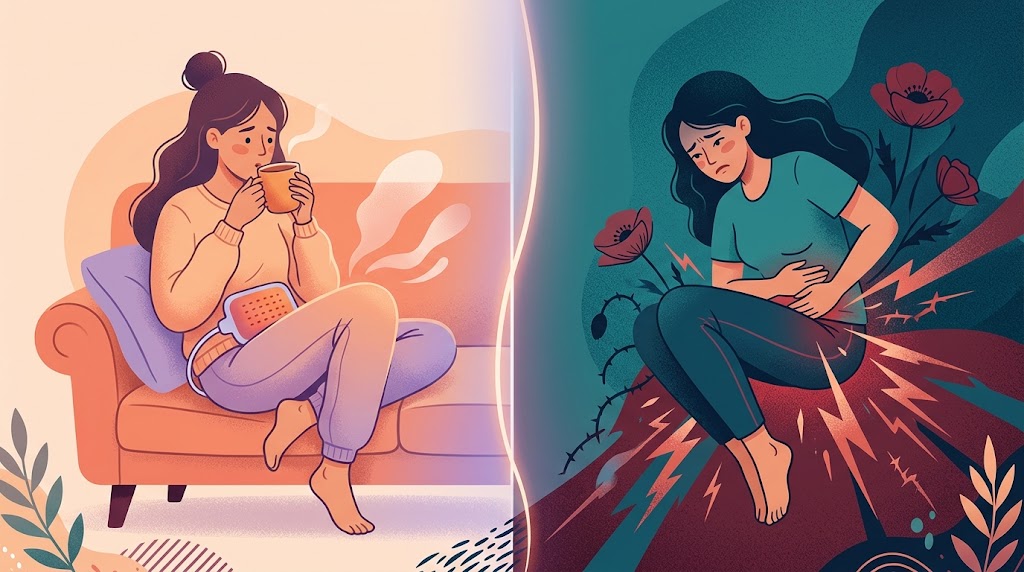
Period pain is common, but severe or persistent menstrual pain should not always be dismissed as a normal part of having periods. Endometriosis can cause painful periods that are more severe, last longer, affect everyday activities, or occur alongside symptoms such as pelvic pain, pain during sex, and pain when passing urine or opening your bowels.
The important difference is that ordinary period pain is usually caused by the womb contracting during menstruation, whereas endometriosis is a long-term condition in which tissue similar to the lining of the womb grows outside the womb.
However, symptoms can overlap, and pain alone cannot confirm whether someone has endometriosis. If period pain is severe, worsening, affecting work or daily life, or accompanied by other symptoms, speaking with a GP is recommended.
Quick Answer: Is It Normal Period Pain or Endometriosis?
A useful starting point is to consider how severe the pain is, how long it lasts, whether it happens outside your period, and whether you have other symptoms.
| Feature | Typical Period Pain | Possible Endometriosis |
|---|---|---|
| When it occurs | Usually just before or during the period | Often during periods, but may also occur at other times |
| Pain intensity | Mild to moderate for many people | Can be severe and interfere with normal activities |
| Duration | Often lasts up to around 3 days | May last longer or recur throughout the cycle |
| Location | Lower abdomen; may spread to back or thighs | Pelvis, lower abdomen, lower back and sometimes other areas |
| Pain during sex | Less typical | Can occur, particularly deep pain |
| Pain when pooing | Less typical | Can occur, particularly around periods |
| Pain when peeing | Less typical | Can occur, particularly around periods |
| Heavy periods | Can occur | Can occur |
| Fatigue | Not usually a defining symptom | Can occur |
| Fertility difficulties | Not a typical feature | May occur |
| Impact on daily life | Usually manageable | May significantly affect work, education, relationships or daily activities |
These differences are clues rather than a diagnosis. Some people with endometriosis have few symptoms, while severe period pain can also have causes other than endometriosis.
What Does Normal Period Pain Feel Like?
Period pain, medically known as dysmenorrhoea, commonly happens around the beginning of menstruation.
The pain is caused by contractions of the womb as it sheds its lining. NHS guidance describes period pain as potentially feeling like cramps, a dull ache or sharper abdominal pain. It can also spread to the back and thighs.
For many people, period pain:
- Begins shortly before or around the start of the period
- Is strongest during the early part of menstruation
- Improves as the period continues
- Lasts for up to about three days
- Can be uncomfortable without completely disrupting everyday life
Simple measures such as heat, gentle exercise and appropriate pain relief can sometimes help.
However, period pain that is severe, worsening or stopping you from doing normal activities should be assessed rather than automatically considered normal.
What Is Endometriosis Pain?
Endometriosis is a condition where tissue similar to the lining of the womb grows elsewhere in the body, commonly around the pelvis, ovaries and fallopian tubes.
It can also affect areas such as the bowel or bladder.
Because endometriosis symptoms vary considerably, there is no single type of pain that proves someone has the condition.
Common symptoms can include:
- Severe period pain
- Pelvic pain
- Lower abdominal pain
- Lower back pain
- Pain during or after sex
- Pain when opening the bowels
- Pain when passing urine
- Heavy periods
- Fatigue
- Difficulty becoming pregnant
Some people experience symptoms mainly around their period, while others can have pelvic pain at other points during the menstrual cycle.
Period Pain vs Endometriosis Pain: The Biggest Differences
1. How Severe Is the Pain?
One of the most important clues is whether menstrual pain is interfering with normal life.
Typical period cramps may be uncomfortable but manageable.
Endometriosis-related pain can be severe enough to affect:
- Work
- School or university
- Exercise
- Sleep
- Social activities
- Relationships
- Sex
- Everyday household activities
The NHS recommends seeing a GP if period pain affects daily activities.
Importantly, pain severity alone cannot diagnose endometriosis. Some people with endometriosis have relatively mild symptoms, while other conditions can cause severe pelvic pain.
2. Does the Pain Happen Outside Your Period?
Ordinary period cramps are usually closely connected to menstruation.
Endometriosis can cause pelvic pain outside the period as well.
You may notice:
- Pain before your period
- Pain during your period
- Pain shortly after your period
- Pelvic pain between periods
- Recurring pain throughout the menstrual cycle
This pattern is worth recording because it can help a healthcare professional understand whether your symptoms could be related to endometriosis or another pelvic condition.
3. Is Sex Painful?
Pain during or after sex can be associated with endometriosis.
This may be particularly noticeable with deeper penetration and may feel like deep pelvic pain rather than superficial discomfort.
Pain during sex does not automatically mean you have endometriosis. Other gynaecological, pelvic, urinary and sexual-health conditions can also cause pain.
Nevertheless, persistent pain during sex is a reason to seek medical advice.
4. Do You Have Pain When You Poop?
Pain when opening your bowels can occur with endometriosis, particularly when symptoms are linked to menstruation.
You might notice:
- Pain when passing stool
- Pelvic or rectal pain
- Bowel discomfort that becomes worse around your period
- Changes in bowel habits
- Occasionally, blood in the stool
Bowel symptoms can also have many other causes, including irritable bowel syndrome and other digestive conditions.
The pattern matters. If bowel pain repeatedly appears or becomes worse around menstruation, tell your GP.
5. Does It Hurt When You Pee?
Painful urination can occur with endometriosis, particularly when the condition affects structures around the bladder.
You may notice urinary discomfort that follows a cyclical pattern.
However, pain when urinating can also be caused by urinary tract infections and other urinary conditions.
If you have persistent urinary symptoms, blood in your urine, fever or significant pelvic pain, seek medical advice.
6. Are Your Periods Very Heavy?
Heavy periods can occur with endometriosis, although heavy bleeding is not specific to the condition.
You may have particularly heavy periods if you need to change period products very frequently, experience bleeding through clothes or find that heavy bleeding is disrupting normal activities.
Heavy periods can have many possible causes, including fibroids, adenomyosis and other gynaecological conditions.
If your periods have become significantly heavier, irregular or more painful, speak with a GP.
7. Are You Experiencing Extreme Tiredness?
Fatigue can occur alongside endometriosis.
Persistent tiredness may be related to pain, disrupted sleep, heavy periods or the wider impact of living with a chronic condition.
However, fatigue is not specific to endometriosis.
Other possible causes include:
- Iron-deficiency anaemia
- Sleep problems
- Thyroid disorders
- Stress
- Depression
- Other chronic health conditions
If tiredness is persistent or unexplained, it is worth discussing it with a healthcare professional.
What Does Endometriosis Pain Feel Like?
People describe endometriosis pain in different ways.
It may feel like:
- Severe cramps
- Deep pelvic pain
- A persistent ache
- Sharp or stabbing pain
- Burning or pressure
- Lower-back pain
- Pain that radiates into the legs
- Pain during bowel movements
- Pain during or after sex
The location and severity can change over time.
One important point is that the amount of pain does not necessarily tell you how extensive endometriosis is. Symptoms vary between individuals, so medical assessment is needed rather than trying to judge the condition based solely on pain intensity.
Can Period Pain Be a Sign of Endometriosis?
Yes.
Severe period pain is one of the recognised symptoms of endometriosis.
However, having painful periods does not automatically mean you have endometriosis.
The possibility becomes more important when painful periods occur alongside symptoms such as:
- Chronic pelvic pain
- Pain during or after sex
- Pain when opening your bowels
- Pain when passing urine
- Heavy or irregular periods
- Significant fatigue
- Difficulty becoming pregnant
- Symptoms that interfere with daily life
NICE guidance recommends considering endometriosis when symptoms and signs are suggestive of the condition.
Can You Have Endometriosis Without Severe Period Pain?
Yes.
Endometriosis does not affect everyone in exactly the same way.
Some people may have:
- Mild symptoms
- Symptoms unrelated to menstruation
- Fertility difficulties without obvious severe pain
- Bowel or bladder symptoms
- Few or no noticeable symptoms
This is why the absence of severe period cramps does not completely rule out endometriosis.
Endometriosis vs PCOS: Are They the Same?
No. Endometriosis and polycystic ovary syndrome (PCOS) are different conditions.
Endometriosis involves tissue similar to the womb lining growing outside the womb.
PCOS is associated with hormonal and metabolic changes and can affect ovulation, periods, androgen levels and fertility.
The symptoms can overlap in some people, particularly around menstrual irregularity and fertility.
If you are experiencing symptoms that could relate to PCOS, you can also read our guide to [PCOS symptoms and treatments].
What Other Conditions Can Cause Severe Period Pain?
Endometriosis is not the only possible explanation for painful periods.
Other causes can include:
- Adenomyosis
- Fibroids
- Pelvic inflammatory disease
- Ovarian cysts
- Certain complications associated with an intrauterine device
- Other pelvic conditions
This is why self-diagnosis based on symptoms alone is unreliable.
A GP may assess your symptoms, menstrual history and medical history before deciding whether you need further investigations or referral.
How Is Endometriosis Diagnosed in the UK?
There is no single symptom that confirms endometriosis.
Diagnosis starts with a detailed discussion of symptoms and their pattern.
Your GP may ask about:
- When your pain starts
- Where the pain occurs
- How severe it is
- How long it lasts
- Whether it occurs outside your period
- Whether sex is painful
- Whether bowel movements are painful
- Whether urination is painful
- How heavy your periods are
- Whether symptoms affect your daily activities
- Whether you are experiencing fertility difficulties
Depending on your symptoms, further assessment may include an examination, ultrasound or referral to gynaecology.
Importantly, current NICE guidance recommends that investigations should not necessarily be delayed while treatment is being considered.
Can an Ultrasound Detect Endometriosis?
An ultrasound scan can help identify certain forms of endometriosis and may also help identify other possible causes of pelvic pain.
However, a normal ultrasound does not necessarily mean that endometriosis has been completely ruled out.
Some forms of endometriosis can be difficult to identify with imaging.
Your healthcare professional may therefore consider your symptoms, examination and investigation results together.
Do You Need a Laparoscopy to Diagnose Endometriosis?
Not necessarily in every situation.
Laparoscopy is a surgical procedure that allows doctors to look inside the abdomen and pelvis.
Historically, laparoscopy was commonly used to confirm endometriosis, but diagnostic approaches have evolved.
NICE guidance has updated recommendations around diagnosis and investigation, including the use of ultrasound and clinical assessment.
Whether laparoscopy is appropriate depends on the individual’s symptoms, investigations, treatment response and clinical circumstances.
What Treatments Are Available for Endometriosis?
There is no single treatment that works for everyone.
Treatment can depend on:
- Your symptoms
- Pain severity
- Whether you want to become pregnant
- Your age
- Other medical conditions
- Previous treatments
- The location and extent of suspected or confirmed disease
Possible approaches include pain relief, hormonal treatment and, for some people, surgery.
A healthcare professional can help you understand the potential benefits and risks of each option.
Can Period Pain Be Treated at Home?
For ordinary period pain, several self-care measures may help.
The NHS recommends measures such as:
- Using a heat pad or hot-water bottle
- Taking a warm bath or shower
- Gentle exercise
- Massage
- Appropriate over-the-counter pain relief
Anti-inflammatory medicines such as ibuprofen may help some people, but they are not suitable for everyone.
If you have asthma or certain stomach, heart, kidney or liver conditions, for example, you may need to avoid certain anti-inflammatory medicines.
Always check the medicine information or speak with a pharmacist or healthcare professional if you are unsure.
When Should You See a GP About Period Pain?
Consider speaking with your GP if:
- Your period pain is severe
- Pain is getting worse
- Pain stops you from doing normal activities
- Painkillers are not helping
- You have pain during sex
- You have pain when pooing or peeing
- Your periods have become heavier or irregular
- You have bleeding between periods
- You have persistent pelvic pain
- You are experiencing unexplained fatigue
- You are having difficulty becoming pregnant
Keeping a menstrual symptom diary can be useful.
Record the date of your period, pain level, location of pain, bleeding, bowel or urinary symptoms, medication and how symptoms affect your activities.
This gives your GP a clearer picture of the pattern.
When Is Period or Pelvic Pain an Emergency?
Severe pelvic pain should not automatically be assumed to be period pain or endometriosis.
Seek urgent medical help if pelvic pain is severe or rapidly worsening, particularly if it occurs with symptoms such as:
- Fainting or severe dizziness
- Heavy vaginal bleeding
- Difficulty breathing
- High temperature or feeling very unwell
- Vomiting
- Difficulty passing urine or stool
- Blood in urine or stool
- Possible pregnancy
If you have severe pelvic pain and may be pregnant, urgent assessment is particularly important because some pregnancy-related conditions, including ectopic pregnancy, can cause abdominal or pelvic pain.
How to Track Endometriosis Symptoms
A symptom diary can be one of the most useful things you can prepare before seeing a GP.
Track:
Menstrual cycle
Record when your period starts and finishes.
Pain
Rate your pain from 0 to 10 and record where it occurs.
Bowel symptoms
Note constipation, diarrhoea, painful bowel movements or other changes.
Urinary symptoms
Record pain when urinating, increased frequency or blood in the urine.
Sexual symptoms
Note whether sex causes pain and whether the pain occurs during or afterwards.
Bleeding
Record whether periods are unusually heavy or whether you experience bleeding between periods.
Daily impact
Write down whether pain causes you to miss work, school, exercise or social activities.
A detailed record can help your healthcare professional identify patterns that may otherwise be difficult to remember.
Frequently Asked Questions About Period Pain and Endometriosis
How can I tell if my period pain is endometriosis?
You cannot confirm endometriosis from symptoms alone. However, severe period pain that interferes with daily life, especially when accompanied by pelvic pain, painful sex, painful bowel movements, painful urination or fertility difficulties, can warrant assessment for endometriosis.
Is endometriosis pain worse than normal period pain?
It can be, but pain severity varies significantly between individuals. Some people with endometriosis have severe pain, while others have mild or no noticeable symptoms.
How many days of period pain is normal?
Period pain commonly lasts up to around three days. Pain that is prolonged, worsening, recurrent outside menstruation or significantly affecting daily life should be discussed with a GP.
Can endometriosis cause pain every day?
Yes. Some people with endometriosis experience pelvic pain outside their periods. Others mainly experience symptoms during certain parts of the menstrual cycle.
Does endometriosis cause heavy periods?
It can. Heavy periods are one of the symptoms associated with endometriosis, although heavy menstrual bleeding can have many other causes.
Can endometriosis cause back pain?
Yes. Endometriosis can be associated with lower-back and pelvic pain.
Can endometriosis cause bowel problems?
Yes. Endometriosis can cause pain when opening the bowels and other bowel-related symptoms, particularly when symptoms follow a menstrual pattern.
Can endometriosis cause painful sex?
Yes. Pain during or after sex is a recognised symptom of endometriosis.
Can endometriosis affect fertility?
Endometriosis can be associated with difficulty becoming pregnant. If you are experiencing fertility problems alongside pelvic pain or other endometriosis symptoms, discuss this with a GP or fertility specialist.
Can you have endometriosis with a normal ultrasound?
Yes. A normal scan does not necessarily exclude endometriosis. Your symptoms and clinical assessment remain important.
Should I see a GP for severe period pain?
Yes. If period pain is severe, worsening, stopping you from doing normal activities or not improving with usual measures, NHS guidance recommends seeking medical advice.
Period Pain vs Endometriosis: Key Takeaway
The biggest difference is not simply how painful your period is. The pattern and impact of your symptoms matter.
Ordinary period pain is usually linked closely to menstruation and often improves within a few days.
Endometriosis can cause severe period pain but may also cause pelvic pain outside periods, painful sex, pain when opening the bowels or passing urine, heavy periods, fatigue and fertility difficulties.
Because several conditions can produce similar symptoms, you should not try to diagnose endometriosis from symptoms alone.
If your period pain is affecting your everyday life, becoming worse or occurring alongside other symptoms, speak with a GP. Keeping a detailed symptom diary can make that conversation more useful.
Related HealthCresto Guides
For more information about women’s health, you may also want to read our guides on:
- PCOS symptoms and treatments
- IVF and NHS-funded IVF in the UK
- Low libido in women
- Menopause symptoms in the UK
- What age menopause starts in the UK
Medical Disclaimer
This article is intended for general health information and does not replace personalised medical advice, diagnosis or treatment. Symptoms of period pain and endometriosis can overlap with other conditions. If you are concerned about severe, persistent or unusual pelvic pain, speak with a GP or another qualified healthcare professional. For severe or rapidly worsening symptoms, seek urgent medical assistance.