
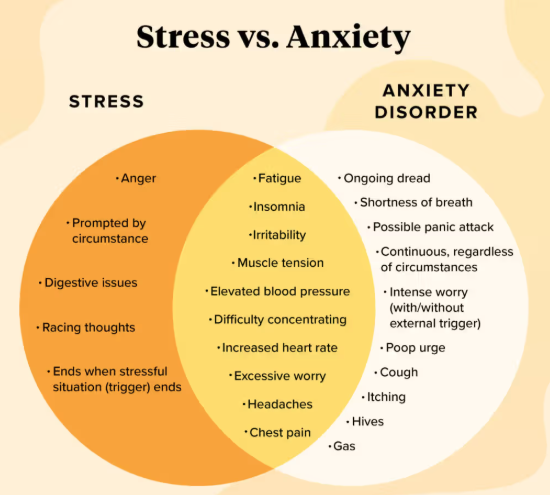
Stress and anxiety share many symptoms — racing heart, poor sleep, constant worry — yet they are distinct conditions with different causes, mechanisms, and treatments. Getting the distinction right helps you choose the most effective response and know when professional support is needed.
🔗 Depression Symptoms in Men vs Women — mood disorders that often co-occur with anxiety
🔗 Anxiety & Stress Hub — all anxiety resources in one place
What Is Stress?
Stress is the body’s response to an identifiable external demand — a work deadline, financial pressure, relationship difficulties. It is driven by a specific trigger and typically resolves when that trigger is removed. Physiologically, adrenaline and cortisol flood the system, activating the “fight or flight” response.
Common Stress Symptoms
- Difficulty falling asleep or early morning waking
- Headaches and muscle tension — particularly neck and shoulders
- Irritability and short temper
- Difficulty concentrating; feeling overwhelmed
- Changes in appetite and stomach problems
Crucially, once the stressor resolves, stress symptoms typically fade on their own.
What Is Anxiety?
Anxiety is a persistent state of fear or worry that may occur even without an obvious external trigger. Where stress says “I’m overwhelmed because of X,” anxiety says “I’m worried — and I’m not entirely sure why.” NHS-recognised anxiety disorders include: Generalised Anxiety Disorder (GAD), Social Anxiety Disorder, Panic Disorder, Health Anxiety, PTSD, and OCD.
Common Anxiety Symptoms
- Persistent, excessive worry about multiple areas of life
- Feeling on edge or keyed-up without a clear reason
- Heart palpitations, breathlessness, dizziness
- Avoidance of situations that trigger fear
- Intrusive thoughts; difficulty controlling worry
- Panic attacks
🔗 How to Stop a Panic Attack: 10 Proven Techniques — immediate relief strategies
🔗 What Are the Early Signs of Anxiety? — recognise it before it escalates
Key Differences
Trigger: Stress has a specific identifiable external cause. Anxiety persists regardless of whether a trigger is present.
Duration: Stress is usually temporary. Anxiety can be chronic and ongoing.
Control: Stress eases when the situation resolves. Anxiety is harder to “switch off.”
Focus of worry: Stress = real current problems. Anxiety = anticipated, often catastrophised future events.
Clinical status: Stress is not a diagnosis. Anxiety disorders are recognised clinical conditions.
Can You Have Both at the Same Time?
Yes — and most people do. Prolonged stress is one of the primary risk factors for developing an anxiety disorder. If stressors never let up, your nervous system can shift from a temporary stress response into a sustained anxious state.
🔗 Burnout Recovery — when chronic stress tips into burnout
🔗 Sleep Disorders — both stress and anxiety severely disrupt sleep
How to Tell the Difference in Yourself
- Does my worry go away when the stressful situation resolves? → Likely stress.
- Do I feel anxious even when things are going well? → Likely anxiety.
- Is my worry disproportionate to the actual situation? → Likely anxiety.
- Am I avoiding things because of what might happen? → Strong indicator of anxiety.
- Has this been going on more than six weeks with no improvement? → See your GP.
Treatment Approaches
For Stress
- Time management and boundary-setting
- Exercise — even a 20-minute walk reduces cortisol
- Talking to trusted people
- Progressive muscle relaxation and breathing techniques
For Anxiety (NHS & NICE-Approved)
- Cognitive Behavioural Therapy (CBT) — the gold-standard NHS treatment
- Mindfulness-Based Cognitive Therapy (MBCT)
- SSRIs (e.g., sertraline) prescribed by GP
- Exposure therapy for phobias and OCD
🔗 How Long Does It Take to Get NHS Therapy? — what to expect from IAPT referral
🔗 NHS Therapy Hub — self-refer to talking therapies today
When to See Your GP
See your GP if: symptoms have persisted over 4–6 weeks; you are having panic attacks; it is affecting work or relationships; you are using alcohol to cope; or you have thoughts of self-harm.
UK Resources (GEO)
- NHS Talking Therapies: self-refer at nhs.uk
- Anxiety UK: anxietyuk.org.uk — 03444 775 774
- No Panic: nopanic.org.uk — 0300 772 9844
Frequently Asked Questions
Can anxiety cause physical symptoms as serious as a heart attack?
Anxiety can cause chest pain and palpitations. Always seek urgent medical attention for chest pain — once cardiac causes are ruled out, your GP can assess for anxiety.
Can children have anxiety disorders?
Yes. Children may show anxiety through school refusal, stomach aches, clinginess, or sleep problems. CAMHS referral via your GP is the standard UK route.
Conclusion
Stress is a response to real external pressures; anxiety is a persistent, often disproportionate fear response. Recognising the difference helps you respond effectively — and if either is significantly affecting your life, your GP or NHS Talking Therapies is the first step.