
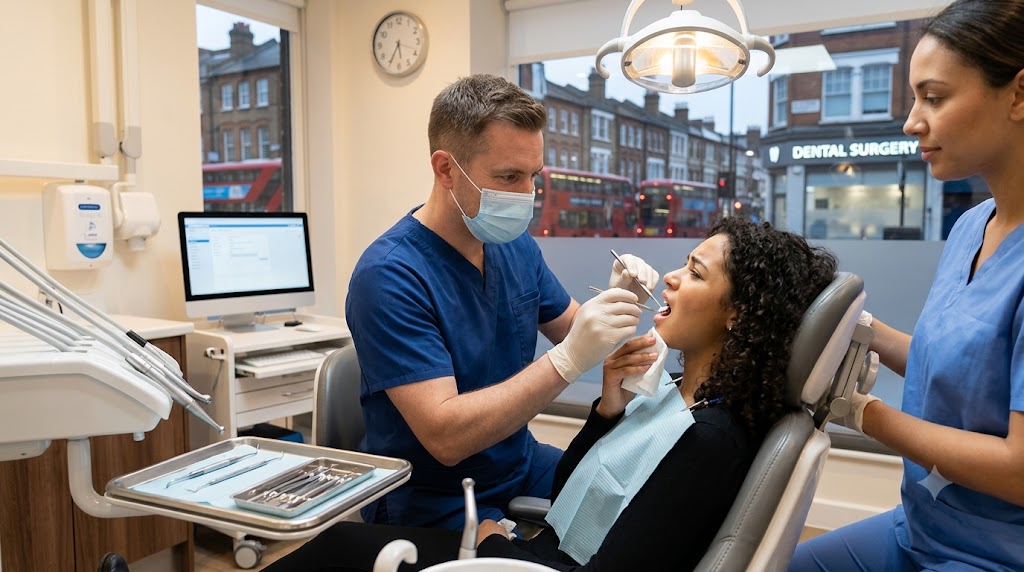
A dental emergency can strike without warning — severe toothache, a knocked-out tooth, a swollen face. Knowing what to do, where to go, and what counts as a genuine emergency can save you pain, money, and in some cases, your tooth.
🔗 NHS Dental Hub — understanding NHS dental charges and bands
🔗 How to Find an NHS Dentist in 2026 — register before an emergency strikes
What Counts as a Dental Emergency?
- Severe toothache uncontrolled by paracetamol or ibuprofen
- Dental abscess — bacterial infection causing facial swelling, fever, or difficulty swallowing or breathing
- Knocked-out (avulsed) tooth — time-critical: see a dentist within 30–60 minutes
- Broken tooth with sharp edges cutting your mouth or tongue
- Significant soft tissue injury: cuts to lips, cheeks, or tongue
- Lost crown or bridge causing sharp pain
- Lost filling causing significant sensitivity or pain
Facial swelling, fever, or difficulty breathing with a dental infection — go to A&E or call 999.
Step-by-Step: What to Do
Step 1 — Assess Severity
Facial swelling? Fever? Difficulty swallowing? → A&E or 999 immediately. Ludwig’s angina (dental infection spreading to the throat) is life-threatening.
Step 2 — Call Your Registered Dentist
Even outside hours, most NHS dental practices have an emergency out-of-hours voicemail with contact information.
Step 3 — Call NHS 111
The dental triage team can assess symptoms, give advice, and refer you to the nearest Urgent Dental Care Centre (UDCC). In many areas, NHS 111 can book a same-day emergency appointment.
Step 4 — Find a UDCC
Urgent Dental Care Centres are NHS services set up specifically for patients without a registered dentist or seen out of hours. NHS 111 will direct you to the nearest one.
Step 5 — A&E as Last Resort
A&E cannot perform dental treatment but can administer antibiotics, pain relief, and assess life-threatening complications. Use only when no dental service is reachable and symptoms include facial swelling, fever, or breathing difficulty.
🔗 Dental Emergencies Hub — full range of dental emergency scenarios
🔗 Gum Disease & Oral Hygiene — gum infections that can escalate to emergencies
First Aid for Common Dental Emergencies
Knocked-Out Tooth
- Pick up by the crown (white part) — NOT the root
- Rinse gently with cold water — do not scrub
- Try to replace in the socket and hold in place
- If not possible: keep moist in milk or between cheek and gum
- Get to an emergency dentist within 30 minutes — ideally 15 for best results
Severe Toothache
- Rinse with warm salt water
- Take paracetamol and ibuprofen alternately per packet instructions
- Apply a cold compress to the outside of the cheek
- Do NOT apply heat — this can worsen infection
- Do NOT put aspirin directly on the gum — it can burn tissue
Dental Abscess
- Do NOT try to drain it yourself
- Rinse gently with warm salt water to encourage natural drainage
- Take over-the-counter pain relief
- Antibiotics alone do not cure an abscess — dental treatment is essential
- Facial swelling or difficulty swallowing → A&E immediately
Broken or Chipped Tooth
- Rinse mouth with warm water
- Apply dental wax (available at most UK pharmacies) to cover sharp edges
- Avoid eating on the affected side
Lost Filling or Crown
- Temporary filling material (e.g., Dentemp) available from most UK pharmacies
- This is temporary only — see your dentist as soon as possible
🔗 Cosmetic Dentistry — permanent crown replacement options
NHS Emergency Dental Charges (England, 2026)
Band 1 (£26.80): Examination, diagnosis, and preventive advice including X-rays if needed.
Band 2 (£73.50): Includes Band 1 plus fillings, extractions, or root canal treatment.
Band 3 (£319.10): Complex treatment including crowns, dentures, or bridges.
Patients exempt from charges include those on Universal Credit, Income Support, NHS Low Income Scheme, pregnant women, and those who gave birth in the last 12 months.
No NHS Dentist? Here Is What to Do
- Call NHS 111 immediately — the first step for emergency care without a registered dentist
- Find a UDCC via NHS 111 or nhs.uk
- Visit a walk-in dental centre — available in many UK cities
- Private emergency dentist as last resort: expect £100–£300 for emergency treatment
🔗 Looking for a Reliable Private Dentist in Croydon? — private dental care in South London
Emergency Dental Access Across the UK
England: NHS 111 for out-of-hours referral; UDCCs widely available.
Scotland: NHS 24 (dial 111) for out-of-hours dental triage.
Wales: NHS Direct Wales (0845 46 47) out of hours.
Northern Ireland: GP Out-of-Hours service provides dental emergency triage.
Prevention
- Attend regular NHS check-ups every 6–24 months as recommended
- Wear a mouthguard for contact sports
- Address toothache early — do not wait until it becomes an abscess
- Brush twice daily, floss once daily, use fluoride toothpaste
🔗 Children’s Dental Health — preventing dental emergencies in children
🔗 Gum Disease & Oral Hygiene — daily habits that prevent dental crises
Frequently Asked Questions
Can I go to A&E for toothache?
A&E cannot perform dental treatment but can provide pain relief and antibiotics. Call NHS 111 first.
How much does an emergency dentist cost in the UK?
NHS: £26.80–£319.10 depending on treatment band. Private: £100–£300+. Some patients are exempt from NHS charges.
Is a dental abscess dangerous?
Yes. Dental abscesses can spread to the head and neck. Facial swelling, fever, or difficulty breathing = A&E immediately. Otherwise seek dental care the same day.
Conclusion
For any dental emergency in the UK: call your regular dentist first, then NHS 111. For life-threatening symptoms — facial swelling, fever, difficulty breathing — go to A&E or call 999. Regular check-ups remain the most effective way to prevent dental emergencies.