
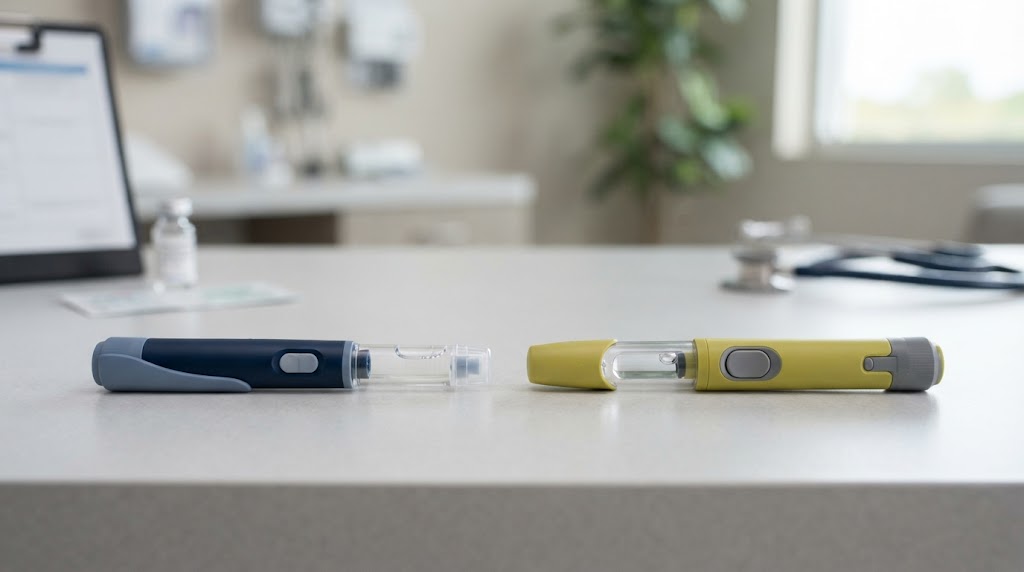
If you are researching Wegovy vs Mounjaro, you may be wondering which weight loss injection works better, which has fewer side effects, whether you can get it on the NHS, and which treatment may be suitable for your circumstances.
Wegovy contains semaglutide, while Mounjaro contains tirzepatide. Both are once-weekly prescription injections used alongside a reduced-calorie diet and increased physical activity for weight management.
The two medicines work differently. Wegovy is a GLP-1 receptor agonist, whereas Mounjaro activates both GIP and GLP-1 receptors. Clinical evidence directly comparing the two medicines has found greater average weight loss with tirzepatide in adults with obesity who did not have type 2 diabetes, although that does not mean Mounjaro is automatically the right medicine for every person.
Your eligibility, medical history, other medicines, side-effect tolerance, treatment goals and access to NHS or private services all matter.
Quick answer: Wegovy contains semaglutide and Mounjaro contains tirzepatide. In a 72-week head-to-head clinical trial, average weight loss was 20.2% with tirzepatide compared with 13.7% with semaglutide. However, individual results vary, and the most appropriate medicine should be decided with a qualified healthcare professional.
Wegovy vs Mounjaro at a glance
| Feature | Wegovy | Mounjaro |
|---|---|---|
| Active ingredient | Semaglutide | Tirzepatide |
| Drug class | GLP-1 receptor agonist | GIP and GLP-1 receptor agonist |
| Main effect | Reduces appetite and increases fullness | Reduces appetite, increases fullness and affects appetite regulation through GIP and GLP-1 |
| Frequency | Once weekly | Once weekly |
| Used for weight management | Yes | Yes |
| Used for type 2 diabetes | Wegovy is a weight-management formulation of semaglutide | Mounjaro is also licensed for type 2 diabetes |
| Lifestyle support | Reduced-calorie diet + physical activity | Reduced-calorie diet + physical activity |
| Common side effects | Nausea, vomiting, diarrhoea, constipation and other gastrointestinal symptoms | Nausea, diarrhoea, vomiting, constipation and other gastrointestinal symptoms |
| UK NHS guidance | NICE-recommended for specific eligible adults | NICE-recommended for specific eligible adults |
| Direct comparison | Lower average weight loss in SURMOUNT-5 | Higher average weight loss in SURMOUNT-5 |
NICE states that medicines for weight management should be used alongside a reduced-calorie diet and increased physical activity.
What is Wegovy?
Wegovy is a prescription medicine containing semaglutide. It is used alongside diet and physical activity for weight loss and weight maintenance in eligible adults.
Semaglutide acts similarly to the naturally occurring hormone GLP-1. It affects areas of the brain involved in appetite regulation, helping people feel fuller, experience less hunger and reduce food cravings.
For adults, the UK product information describes a gradual dose escalation beginning at 0.25 mg once weekly, with increases generally every four weeks. The standard maintenance dose reaches 2.4 mg once weekly, while the current UK product information also allows a higher 7.2 mg weekly dose for certain adults with obesity when clinically appropriate.
This gradual increase is designed to help the body adjust to treatment and may reduce problems with gastrointestinal side effects.
Who may be eligible for Wegovy?
The licensed indication includes adults with:
- A BMI of 30 kg/m² or above, or
- A BMI of 27 kg/m² to below 30 kg/m² with at least one weight-related health problem.
However, licensed use is not the same as NHS funding eligibility.
NICE’s recommendation for NHS use is more restricted. Under NICE TA875, semaglutide is recommended for eligible adults within a specialist weight-management service, generally where there is at least one weight-related comorbidity and either a BMI of at least 35 kg/m² or a BMI of 30–34.9 kg/m² with criteria for referral to specialist services. Lower BMI thresholds are generally used for certain ethnic groups at higher risk from obesity-related complications.
For a broader explanation of NHS access, see our guide:
Can You Get Semaglutide on the NHS in 2026?
What is Mounjaro?
Mounjaro contains tirzepatide, a medicine that activates both GIP and GLP-1 receptors.
It is used alongside a reduced-calorie diet and increased physical activity for weight management. Mounjaro is also used for the treatment of type 2 diabetes. The current UK patient information states that tirzepatide can reduce appetite, increase feelings of fullness and reduce food cravings.
Mounjaro is also given once weekly, with the dose increased gradually according to the prescribing instructions and the individual’s response and tolerance.
Who may be eligible for Mounjaro?
The UK marketing authorisation covers a wider BMI range, but NHS eligibility is determined by NICE recommendations and NHS implementation arrangements.
NICE recommends tirzepatide as an option for weight management alongside diet and physical activity in adults who have an initial BMI of at least 35 kg/m² and at least one weight-related comorbidity, with lower BMI thresholds usually applying to certain ethnic groups.
In England, access is being introduced in phases. NHS England’s implementation arrangements consider BMI together with weight-related conditions such as high blood pressure, abnormal blood fats, obstructive sleep apnoea, cardiovascular disease and type 2 diabetes.
Therefore, someone who appears to meet the medicine’s licensed indication may not necessarily qualify for NHS-funded treatment immediately.
Wegovy vs Mounjaro: how do they work?
The main pharmacological difference is the hormone pathways they target.
Wegovy: GLP-1
Wegovy’s active ingredient, semaglutide, is a GLP-1 receptor agonist.
GLP-1 activity can:
- Reduce appetite
- Increase feelings of fullness
- Reduce food cravings
- Slow stomach emptying
- Help reduce overall food intake
The result can be a sustained reduction in calorie intake when the medicine is combined with appropriate lifestyle changes.
Mounjaro: GIP + GLP-1
Tirzepatide activates both:
- GIP receptors
- GLP-1 receptors
This dual mechanism is one of the major differences between Mounjaro and Wegovy.
Mounjaro’s UK patient information explains that tirzepatide helps regulate appetite and satiety, making people feel fuller, less hungry and less likely to experience food cravings.
Which causes more weight loss: Wegovy or Mounjaro?
This is one of the most searched questions about these medicines.
A direct 72-week clinical trial, SURMOUNT-5, compared tirzepatide with semaglutide in 751 adults with obesity who did not have type 2 diabetes.
At 72 weeks:
- Tirzepatide: average weight change of −20.2%
- Semaglutide: average weight change of −13.7%
The study also found greater average reductions in waist circumference with tirzepatide: 18.4 cm compared with 13.0 cm for semaglutide.
The study was specifically designed as a head-to-head comparison, which makes it particularly useful when discussing Wegovy vs Mounjaro.
However, these figures represent averages from a clinical trial. They do not mean that every person taking Mounjaro will lose more weight than every person taking Wegovy.
The trial was open-label, lasted 72 weeks and was conducted in adults with obesity without type 2 diabetes. The study was funded by Eli Lilly, the manufacturer of tirzepatide.
Does Mounjaro work faster than Wegovy?
It is tempting to compare the medicines purely by asking which produces faster weight loss.
However, weight loss usually occurs over months rather than days. Both medicines require gradual dose escalation, and the speed of weight loss can differ substantially between individuals.
Your response may be influenced by:
- Starting weight
- Starting BMI
- Dose reached
- How well you tolerate dose increases
- Diet
- Physical activity
- Existing health conditions
- Other medicines
- Treatment duration
- How consistently treatment is taken
A sudden increase in dose is not a safe shortcut to faster weight loss. Dose changes should follow the prescribing instructions provided by your clinician.
If your weight loss has slowed after an initial reduction, our guide on how to deal with a weight loss plateau explains some common reasons this can happen.
Wegovy vs Mounjaro side effects
Both medicines can cause gastrointestinal side effects, particularly during dose escalation.
Common Wegovy side effects
The UK Wegovy patient information includes gastrointestinal symptoms such as:
- Nausea
- Vomiting
- Diarrhoea
- Constipation
- Abdominal discomfort
- Other digestive symptoms
Nausea, vomiting and diarrhoea can contribute to dehydration, so maintaining adequate fluid intake is important.
Common Mounjaro side effects
The current Mounjaro UK patient leaflet lists common or very common effects including:
- Nausea
- Diarrhoea
- Vomiting
- Abdominal pain
- Constipation
- Reduced appetite
- Indigestion
- Bloating
- Burping
- Gas
- Reflux or heartburn
- Fatigue
Many gastrointestinal effects are more noticeable when treatment is started or the dose is increased and may reduce over time.
Are the side effects the same?
There is considerable overlap because both medicines affect appetite and the gastrointestinal system.
However, individual experiences vary. Someone who tolerates Wegovy well may not necessarily have the same experience with Mounjaro, and vice versa.
You should discuss persistent, severe or concerning symptoms with your healthcare professional.
Wegovy vs Mounjaro: important safety considerations
These medicines are not suitable for everyone.
Before starting treatment, a prescriber should consider your medical history, existing medicines and potential contraindications or precautions.
For example, the UK product information advises discussing treatment with a healthcare professional if you have previously had pancreatitis or significant problems with stomach emptying.
Mounjaro’s patient information also highlights particular considerations for people taking insulin or sulfonylureas because of the risk of low blood glucose.
Wegovy’s product information similarly contains important warnings and precautions, including pancreatitis and dehydration associated with gastrointestinal symptoms.
This is why buying weight-loss injections from an unregulated source can be risky. Prescription medicines should be obtained through an appropriate healthcare service and used according to professional instructions.
Wegovy vs Mounjaro and the NHS
One of the biggest differences between online discussions and real-world treatment is NHS eligibility.
Can you get Wegovy on the NHS?
Yes, Wegovy is available within NHS weight-ma