
Table of Contents
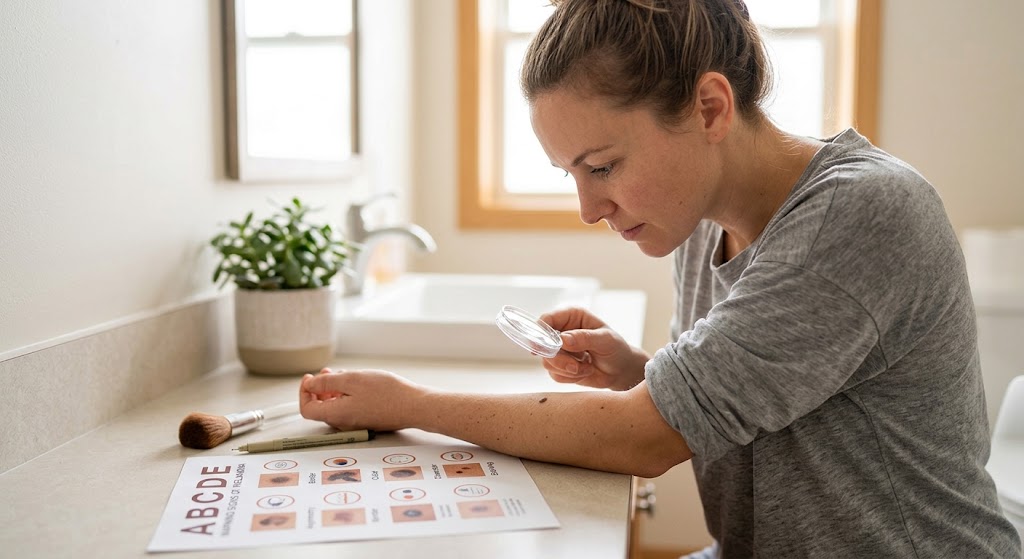
ToggleChecking your moles at home can help you notice changes that may need medical attention. One of the simplest ways to assess a mole is the ABCDE melanoma guide, which looks at Asymmetry, Border, Colour, Diameter and Evolving.
A new mole or a mole that changes in size, shape or colour does not automatically mean melanoma. Many unusual-looking moles are benign. However, recognising changes early and asking a GP to assess anything concerning can be important because melanoma is easier to treat when found at an earlier stage.
This guide explains how to check your moles at home, what the ABCDE signs mean, what melanoma can look like, when you should contact your GP in the UK and why a home skin check cannot replace professional assessment.
Important: This article is for general health information and cannot diagnose melanoma. If you have a new, changing or unusual mole or skin mark, arrange an assessment with your GP.
To check a mole at home, look for:
A — Asymmetry: one half looks different from the other.
B — Border: the edges are irregular, jagged, blurred or poorly defined.
C — Colour: the mole contains uneven or multiple colours.
D — Diameter: it is larger than around 6 mm, although melanoma can be smaller.
E — Evolving: the mole changes in size, shape, colour or appearance over time.
You should also pay attention to a mole or skin mark that becomes bleeding, crusty, inflamed, painful or itchy, or to a new unusual mark that does not disappear. NHS guidance recommends contacting your GP about these types of changes.
The ABCDE rule is a useful checklist for identifying changes that could warrant professional assessment.
It is important to remember that ABCDE is not a diagnostic test. A mole can have one of these characteristics and still be benign, while melanoma does not always follow every part of the ABCDE rule.
Cancer Research UK also recommends paying attention to a mole that looks noticeably different from your other moles, even if it does not show all the classic ABCDE features.
Imagine drawing a line through the middle of your mole.
With a typical symmetrical mole, the two halves may look reasonably similar. An asymmetric mole may have two halves that differ noticeably in shape or size.
Ask yourself:
Do the two sides look different?
Is one part wider or more irregular?
Does the shape look uneven rather than roughly round or oval?
Asymmetry can be one of the warning signs associated with melanoma, but it is not enough on its own to determine whether a mole is cancerous.
Look closely at the edge of the mole.
A concerning border may be:
Irregular
Jagged
Blurred
Uneven
Difficult to distinguish from the surrounding skin
Many ordinary moles have relatively smooth, regular edges. A mole with a noticeably irregular border should be assessed, particularly if other changes are present.
Check whether the mole has a consistent colour or contains several different shades.
Melanomas can contain combinations of colours, including different shades of:
Brown
Black
Pink
Red
Other lighter or darker areas
A mole becoming darker or developing additional colours can be a reason to seek medical advice.
However, colour alone cannot diagnose melanoma. Some benign moles naturally contain more than one shade. What matters particularly is a new or changing pattern.
Diameter refers to the width of the mole.
A commonly used ABCDE guide highlights around 6 mm as a useful reference point. Many melanomas are larger than 6 mm when identified, but melanoma can also be smaller, especially when detected early.
Therefore, don’t assume:
“It’s smaller than 6 mm, so it cannot be melanoma.”
That is not a safe conclusion.
A small mole that is changing, looks unusual or is very different from your other moles should still be checked.
“Evolving” means the mole is changing over time.
This is one of the most useful things to watch for when checking your skin.
Changes can include:
Getting larger
Changing shape
Becoming darker or developing new colours
Becoming raised
Bleeding
Becoming crusty
Becoming inflamed
Developing a new sensation such as itching or soreness
NHS guidance specifically recommends seeing a GP if a mole changes in size, shape or colour or becomes painful, itchy, inflamed, bleeding or crusty.
Another useful concept is sometimes called the “ugly duckling” sign.
Instead of assessing one mole in isolation, compare it with the other moles on your body.
Ask:
Does one mole look noticeably different from the rest?
For example, you might have several small, similarly coloured moles but notice one that is:
Much darker
Much larger
A different shape
More irregular
Changing when the others are stable
Cancer Research UK notes that melanomas can stand out from other moles, so a mole that looks very different from the others deserves attention even if it does not clearly show every ABCDE feature.
A home skin check does not require specialist equipment.
The goal is to become familiar with what is normal for your skin, so you can recognise changes.
Use good natural or artificial lighting.
A poorly lit room can make it harder to notice differences in colour, borders and small changes.
Don’t only check the areas that are easy to see.
Look at:
Face
Neck
Chest
Abdomen
Back
Arms
Legs
Hands
Feet
Remember to look at areas that may receive less attention.
A large mirror can help you examine your back and other areas you cannot easily see.
You can also ask a trusted partner, friend or family member to help check areas that are difficult to inspect yourself. Cancer Research UK and the NHS both recommend using a mirror or asking someone else to help with areas that are difficult to see.
Don’t assume melanoma only occurs on commonly sun-exposed skin.
Melanoma can occur anywhere on the body. Some rarer types can affect areas such as the palms, soles, nails, genitals and eyes.
Pay particular attention to any new or unusual dark mark.
Look at your fingernails and toenails for unusual dark areas or lines.
A dark area under a nail that is not explained by an injury should be assessed by a GP.
Rather than asking only, “Does this mole look normal?”, also ask:
“Does this mole look different from my other moles?”
This comparison can make unusual lesions easier to notice.
If you notice something that looks different, take a clear photograph for your own reference.
Try to keep the image:
Well lit
In focus
At a consistent distance
Clearly showing the affected area
Photographs can help you remember what the area looked like previously, but they should not be used to diagnose melanoma.
There is no single appearance that identifies every melanoma.
Melanoma can appear as a new mole or abnormal area of skin, or it can develop from an existing mole that changes. Some melanomas can also look different from the classic examples people associate with skin cancer.
Potential warning features include:
An uneven shape
Irregular edges
Multiple colours
Increasing size
Changes over time
Bleeding
Crusting
Inflammation
Itching or soreness
A new unusual skin mark
Cancer Research UK provides examples of abnormal moles and skin changes, but photographs should be treated only as general examples because melanoma can look different from person to person.
Yes.
The ABCDE checklist is useful, but it does not identify every melanoma.
Some melanomas may not have obvious ABCDE characteristics, and some can develop on previously normal-looking skin rather than from an existing mole.
This is why change over time and comparison with your other moles are important.
If something looks unusual for you, don’t wait for it to meet every ABCDE criterion before seeking medical advice.
Yes.
People with brown or black skin can develop melanoma, although some types and locations may differ.
Melanoma can be harder to recognise visually on darker skin. It may occur on areas such as:
Palms of the hands
Soles of the feet
Under fingernails or toenails
Cancer Research UK notes that melanoma in people with brown or black skin may not always show the typical ABCDE signs.
For this reason, checking the whole body—not only areas that are frequently exposed to sunlight—is important.
You should arrange an appointment with your GP if you notice a new or changing mole or unusual area of skin.
According to NHS guidance, reasons to seek medical assessment include a mole that:
Changes size
Changes shape
Changes colour
Becomes painful
Becomes itchy
Becomes inflamed
Bleeds
Becomes crusty
You should also contact your GP about a new or unusual mark that does not disappear after a few weeks, including one on the palms or soles, or a dark area beneath a nail that was not caused by an injury.
You do not need to have A, B, C, D and E before contacting a doctor.
One concerning change can be enough to justify an assessment.
If a mole looks significantly different from your other moles, is changing or simply worries you, it is reasonable to ask your GP about it.
Your GP will usually ask about:
When you first noticed the mole
Whether it has changed
What changes you have noticed
Your relevant medical history
Your family history of skin cancer
They will examine the mole and other affected skin.
A GP may use or arrange dermoscopy, which allows a healthcare professional to examine the skin more closely using a special magnifying instrument.
Depending on the findings, you may be referred to a specialist.
An urgent referral does not automatically mean you have cancer. It means your symptoms need further assessment to determine the cause.
A visual check at home, a photograph or even a clinical examination cannot definitively confirm melanoma.
If a suspicious mole needs to be investigated, a specialist may recommend removing the abnormal area and sending tissue to a laboratory for examination.
Cancer Research UK explains that an excision biopsy can be used to remove the abnormal area, with a pathologist examining the tissue under a microscope. This examination is what can establish whether melanoma is present.
There is currently no national screening programme for melanoma in the UK.
Instead, early detection relies heavily on knowing what your skin normally looks like and getting suspicious changes assessed by a healthcare professional. Some people at higher risk may have specialist skin checks.
This makes awareness of new and changing moles particularly important.
Anyone can develop melanoma, but certain factors can increase risk.
These include:
Having fair skin that burns easily
Having lots of freckles
Having many moles
Having large or atypical moles
A family history of melanoma
Significant exposure to ultraviolet radiation
Using sunbeds
Cancer Research UK notes that the number of moles, skin type, family history and exposure to ultraviolet radiation can all affect melanoma risk.
Having risk factors does not mean you will develop melanoma. Likewise, someone without obvious risk factors can still develop it.
Ultraviolet radiation from sunlight and sunbeds is an important environmental risk factor for melanoma.
Practical sun-safety measures include:
Avoiding sunburn
Spending time in the shade during strong sunlight
Wearing protective clothing
Wearing a suitable hat
Using sunscreen appropriately
Avoiding sunbeds
Sun protection is particularly important if you burn easily, have many moles or have other factors associated with increased melanoma risk.
There is no single ABCDE feature that can diagnose melanoma. Evolving—meaning a noticeable change over time—is particularly important, but any concerning change should be assessed.
No. Although the ABCDE guide uses around 6 mm as a useful reference, melanoma can be smaller. Don’t ignore a small mole simply because it is below 6 mm.
No. Itching can have many causes, and an itchy mole is not automatically cancerous. However, the NHS advises contacting your GP if a mole becomes itchy, particularly when accompanied by other changes.
Yes. A mole can bleed because of irritation, injury or other non-cancerous causes. However, unexplained bleeding or crusting should be medically assessed rather than assumed to be harmless.
Yes. Some melanomas develop on previously normal-looking skin rather than from an existing mole.
Yes. A dark area or line beneath a nail that is not explained by an injury should be checked by a GP.
Photographs can be useful for monitoring how an area looks over time, particularly if you notice a change. However, photographs should not replace professional assessment when you are concerned.
No. Do not attempt to cut, burn or otherwise remove a suspicious mole yourself. A healthcare professional should assess it and decide whether further investigation or removal is appropriate.
Use this quick checklist whenever you examine a mole:
A — Asymmetry: Do the two halves look different?
B — Border: Is the edge irregular, jagged or blurred?
C — Colour: Are there multiple or uneven colours?
D — Diameter: Is it around 6 mm or larger, or increasing in size?
E — Evolving: Has it changed in size, shape, colour or appearance?
New: Is this a new or unusual mark?
Different: Does it look noticeably different from your other moles?
Symptoms: Is it bleeding, crusty, inflamed, itchy or painful?
If you answer “yes” to any concerning point, don’t try to diagnose yourself. Arrange an assessment with your GP.
Checking your moles at home is mainly about knowing what is normal for you and recognising changes.
The ABCDE rule provides a simple way to remember important warning signs:
A — Asymmetry
B — Border
C — Colour
D — Diameter
E — Evolving
But melanoma does not always look textbook. A new or unusual skin mark, a mole that changes, or a lesion that looks very different from your other moles should be assessed even if it does not meet every ABCDE criterion.
If you are concerned about a mole in the UK, contact your GP rather than relying on an online image, home test or AI tool for diagnosis.
For more evidence-based UK health information, explore the Health Cresto blog.
You can also read:
Air Quality in UK Cities: Which Areas Are Worst for Asthma? — understand how environmental factors can affect respiratory health.
Is Your Inhaler Technique Wrong? — practical information about using inhalers correctly.
Asthma Action Plan — learn how an asthma action plan can help you manage symptoms.
Signs of Depression in Men: What Gets Missed in the UK — another guide covering symptoms that can sometimes be overlooked.
What Is High-Functioning Anxiety? — understand common signs and when to seek support.
This article provides general educational information and is not a substitute for medical diagnosis, examination or treatment. If you have a new, changing or unusual mole or skin lesion, speak with your GP or another qualified healthcare professional. If a skin change is rapidly worsening or you are otherwise seriously unwell, seek appropriate urgent medical care.
Information checked against NHS, Cancer Research UK and NICE guidance available in 2026.
We use cookies to improve your experience on our site. By using our site, you consent to cookies.
Manage your cookie preferences below:
Essential cookies enable basic functions and are necessary for the proper function of the website.
These cookies are needed for adding comments on this website.
Google Tag Manager simplifies the management of marketing tags on your website without code changes.
Statistics cookies collect information anonymously. This information helps us understand how visitors use our website.
Google Analytics is a powerful tool that tracks and analyzes website traffic for informed marketing decisions.
Service URL: policies.google.com (opens in a new window)